Can You Still Get ILR After 5 Years? Routes That Keep 5 Years or Less
Applying for indefinite leave to remain after 5 years: which routes allow it now, who keeps a 5-year path under the reforms, and how to apply in time.


In this article
- Who Can Apply for ILR After 5 Years Now
- Who Can Apply in Less Than 5 Years Now
- Who Is Expected to Keep 5 Years Under the Reforms
- What This Means for Tech Professionals
- The Mandatory Requirements Under the Reforms
- Applying Under the Current Rules Before the Changes
- Common Misunderstandings
- Why 5 Years Became the Norm
- Worked Examples Under the Current Rules
- Worked Examples Under the Planned Reforms
- How to Improve Your Chances of a 5-Year Path
- Partners and Children on a 5-Year Path
- The Cost of Applying After 5 Years
- If You Miss Your Window
- The Bottom Line
- Getting Help
- The Documents You Will Usually Need
- How Continuous Residence Is Counted
- How Long the Decision Takes
- After You Settle
- Questions to Ask Before You Apply
- Changing Employer Close to 5 Years
- Redundancy Before You Reach 5 Years
- How Global Talent Compares
- Keeping Track of the Rules
- A Note on Citizenship Timing
- Planning as a Household
- Your Next Step
- How We Checked This Article
For years, 5 years was the standard answer to the question of when you can settle in the UK. Skilled Workers, partners of British citizens and many others applied for indefinite leave to remain after 5 years on their route. The earned settlement reforms change that. From 2027, the default is planned to be 10 years for most people.
But 5 years has not disappeared. Under the current rules, many routes still lead to settlement after 5 years, and some after 3. Under the planned reforms, several groups will still be able to settle after 5 years or less. This guide explains who can apply for ILR after 5 years now, who is expected to keep a 5-year or shorter path under the new framework, and what you need to do to apply.
Key takeaways
- Under the current rules, Skilled Worker, partner, UK Ancestry, Scale-up and Exceptional Promise Global Talent holders endorsed by Tech Nation or Arts Council England can usually apply for ILR after 5 years.
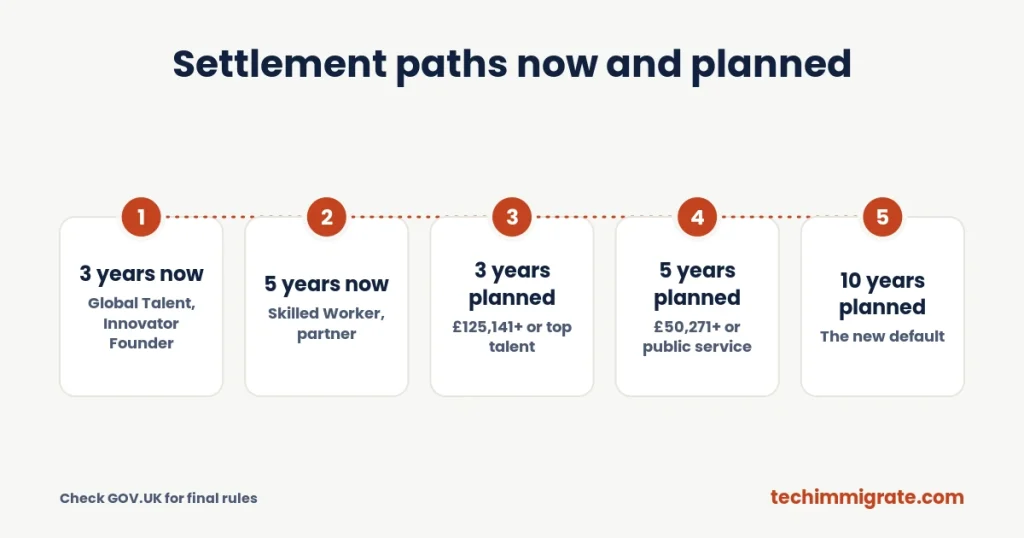
- Some routes are shorter: Global Talent (Exceptional Talent and research-endorsed) and Innovator Founder currently lead to settlement after 3 years.
- Under the earned settlement reforms, a 5-year path is planned for people earning £50,271 or more in 3 of the last 5 years, people in specified public service occupations and people with certain British connections.
- A 3-year path is planned for people earning £125,141 or more in 3 of the last 4 years and the Highest Talent Group.
- Everyone will need to meet new mandatory requirements, including B2 English from 26 March 2027.
- There is no general transitional protection, so if you can apply under the current rules before the changes take effect, that may be your safest option.
Who Can Apply for ILR After 5 Years Now
Under the current rules, these are the main routes that lead to settlement after 5 years.
| Route | Current qualifying period | Key extra conditions |
|---|---|---|
| Skilled Worker | 5 years | Still sponsored, salary meets the threshold |
| Partner of a British citizen or settled person | 5 years (two grants of 30 months) | Relationship, finances, accommodation, English |
| UK Ancestry | 5 years | Continuing to meet the route requirements |
| Scale-up | 5 years | Earnings conditions |
| Global Talent, Exceptional Promise (Tech Nation or Arts Council England) | 5 years | Earned money in your field |
| Dependants on many work routes | Usually 5 years | Meeting their own requirements |
On all of these, you also need to meet the common requirements: continuous residence, the Life in the UK test, English at B1 under the current rules, suitability and the fee of £3,226 per person.
Who Can Apply in Less Than 5 Years Now
Some routes offer a shorter path under the current rules:
- Global Talent, Exceptional Talent: 3 years.
- Global Talent, Exceptional Promise endorsed by the research bodies: 3 years.
- Global Talent, prize route: 3 years.
- Innovator Founder: 3 years, if your business meets the achievement criteria.
Our article on ILR rules by visa route maps every route.
Who Is Expected to Keep 5 Years Under the Reforms
The government's response to the earned settlement consultation, published on 2 November 2026, plans these paths from 2027:
The 5-year path
- Higher earners: people earning £50,271 or more in 3 of the last 5 years.
- Public service: people who have worked in specified public service occupations for 5 years.
- British connections: people with certain connections to the UK, as defined in the final rules.
The 3-year path
- Very high earners: people earning £125,141 or more in 3 of the last 4 years.
- The Highest Talent Group: expected to include Global Talent and Innovator Founder, with the exact definition due after advice from the Migration Advisory Committee.
Everyone else
Most others will face the 10-year default, and people with qualifying breaches or public funds claims face a 20-year path. Our article on the 10-year route to ILR explains the default.
What This Means for Tech Professionals
Many tech professionals are well placed to keep a 5-year or shorter path.
- Skilled Workers earning £50,271 or more in 3 of the last 5 years would expect the 5-year path.
- Senior engineers and leaders earning £125,141 or more in 3 of the last 4 years would expect the 3-year path.
- Global Talent holders are expected to be in the Highest Talent Group.
- Skilled Workers earning less than £50,271, including many early-career workers, may face the 10-year default unless their earnings rise.
The Mandatory Requirements Under the Reforms
Whatever your path, the response plans these requirements for everyone:
- English at B2 from 26 March 2027.
- The Life in the UK test.
- No UK criminal record.
- No public debts, including NHS, tax, National Insurance and Home Office debts.
- A sustained contribution of at least £12,571 a year, with couples able to combine income to £25,142.
Applying Under the Current Rules Before the Changes
The response does not include general transitional protection. If you will complete 5 years before the relevant changes take effect, applying under the current rules may be your safest option. Steps to take now:
- Work out your exact eligibility date. You can usually apply up to 28 days before you complete your qualifying period.
- Check your absences. Make sure you have not spent more than 180 days outside the UK in any 12-month period on work routes.
- Book the Life in the UK test. It costs £50 and must be booked at least 3 days ahead.
- Gather your English evidence. B1 is currently required, but check whether you will be applying after 26 March 2027.
- Collect your route-specific evidence. For Skilled Worker, this includes a sponsor letter and payslips.
- Consider priority services. Priority usually takes 30 working days for settlement, and super priority usually the next working day, where available.
Our article on how to apply for ILR walks through the application.
Common Misunderstandings
- "5-year ILR has been abolished." It still exists under the current rules, and is planned for some groups under the reforms.
- "I will keep 5 years because I arrived before the reforms." There is no general transitional protection.
- "Everyone earning over the general Skilled Worker threshold will get 5 years." The planned 5-year income test is £50,271, higher than the general Skilled Worker threshold of £41,700.
- "Graduate visa time counts towards my 5 years." It does not count towards the Skilled Worker period.
Yes, under the current rules on routes such as Skilled Worker and partner. Under the reforms, a 5-year path is planned for people earning £50,271 or more in 3 of the last 5 years and some others.
Under the current rules, Global Talent (Exceptional Talent, research-endorsed and prize) and Innovator Founder, after 3 years.
Under the reforms, Skilled Workers earning £50,271 or more in 3 of the last 5 years are expected to keep a 5-year path. Others may face the 10-year default.
Rules are due to be laid from December 2026, with implementation over 2027. B2 English is planned from 26 March 2027.
Usually up to 28 days before you complete your qualifying period.
Why 5 Years Became the Norm
For most of the last two decades, 5 years was the standard qualifying period on the UK's main work and family routes. It was long enough to show a lasting connection to the UK, and short enough to make the UK attractive to skilled workers and families. Many people planned their lives around it: when to buy a home, when to have children, when to apply for citizenship. The earned settlement reforms change that assumption for many people, which is why understanding who keeps a 5-year path matters so much.
Worked Examples Under the Current Rules
Ana: Skilled Worker
Ana has been a data engineer on a Skilled Worker visa for 4 years and 9 months. Her employer still sponsors her, her salary is above the threshold, and she has spent few days abroad. She can apply for ILR in 3 months, or up to 28 days earlier. If she applies before the new rules take effect, she expects to settle under the current 5-year rules.
Ben: partner of a British citizen
Ben has held two grants of permission as the partner of a British citizen, totalling 5 years. He meets the financial and accommodation requirements and has passed the Life in the UK test. He can apply for ILR under the partner route.
These examples are fictional and simplified.
Worked Examples Under the Planned Reforms
Chen: senior engineer earning £72,000
Chen has earned over £50,271 in each of the last 4 years on a Skilled Worker visa. Under the planned framework, he would expect the 5-year path, as long as he meets the mandatory requirements, including B2 English.
Fatima: early-career engineer earning £38,000
Fatima joined as a new entrant on a Skilled Worker visa. Unless her earnings rise above £50,271 for 3 of the last 5 years before she applies, she may face the 10-year default under the planned framework.
These examples are fictional and based on the planned framework, which may change.
How to Improve Your Chances of a 5-Year Path
- Track your earnings year by year. Know how many of the last 5 years you have earned above £50,271.
- Plan career moves with settlement in mind. A promotion or move to a better-paid role could make the difference.
- Keep your status valid at all times. A breach could push you onto a much longer path.
- Pay all debts promptly. Unpaid NHS, tax or Home Office debts could block settlement.
- Prepare for B2 English early. If you need a test, book it well ahead of your application.
- Consider Global Talent. If you have strong evidence of recognition, a Global Talent endorsement could put you in the Highest Talent Group.
Partners and Children on a 5-Year Path
Under the current rules, partners and children of work visa holders usually settle once they have met their own qualifying period, often 5 years. Under the reforms, partners who are with the main applicant are expected to settle at the same time as the main applicant. Partners who join later may need their own qualifying period. Children are expected to be exempt from the income, English and Life in the UK requirements. Our guide to ILR for dependants explains the current rules.
The Cost of Applying After 5 Years
The ILR fee is currently £3,226 per person. On top of this, you may pay £50 for the Life in the UK test, the cost of an English test if you need one, and £500 for priority or £1,000 for super priority if you want a faster decision. For a family of four, the ILR fees alone are nearly £13,000. Our article on ILR fees breaks down the full cost.
If You Miss Your Window
If the new rules take effect before you complete 5 years, you may need to meet the new framework's requirements. If your earnings qualify you for the 5-year path, the change may make little difference to your timeline, apart from the new mandatory requirements. If they do not, you may need to extend your visa and wait longer. Make sure your visa does not expire while you work out your options, and apply to extend in good time if needed.
The Bottom Line
ILR after 5 years is still possible, both now and under the planned reforms, but it will no longer be the default for everyone. Under the current rules, most work and family routes still lead to settlement after 5 years. Under the reforms, the 5-year path is planned for people earning £50,271 or more and some others, with a 3-year path for very high earners and top talent. If you are close to 5 years, prepare to apply as soon as you can, and keep good records of your earnings, absences and debts.
Getting Help
If your situation is complicated, for example because you have changed routes, had gaps in status, or have earnings that are hard to evidence, consider speaking to a regulated immigration adviser. A short consultation before you apply can prevent a costly refusal.
The Documents You Will Usually Need
Whichever route you are on, a settlement application after 5 years usually needs a familiar set of documents. Gathering them early saves a lot of stress.
- Your passport and access to your eVisa through your UKVI account.
- Your Life in the UK test pass, which is recorded electronically once you pass.
- English evidence, such as an approved test certificate, a degree taught in English, or proof that you are exempt.
- A record of your absences, with the dates and reasons for each trip.
- Route-specific documents, such as a sponsor letter and recent payslips for Skilled Worker, or evidence of your relationship, finances and accommodation for the partner route.
- Documents for your family, if they are applying with you.
Our article on ILR documents lists the evidence in more detail.

How Continuous Residence Is Counted
For most work routes, continuous residence means you have not spent more than 180 days outside the UK in any rolling 12-month period during your qualifying period. It is not a calendar-year test. A long trip that straddles two calendar years can still break the rule if it pushes any 12-month window over 180 days. Some absences may be allowed for specific reasons, such as serious illness or a crisis, but these are exceptions that need evidence. If you are close to the limit, check every 12-month window carefully before you apply.
How Long the Decision Takes
GOV.UK says standard settlement decisions usually take up to 6 months. The priority service, which costs £500 extra, usually takes 30 working days for settlement applications. The super priority service, which costs £1,000 extra, usually gives a decision by the end of the next working day. While your application is pending, you should usually avoid travelling outside the UK. Our article on how long an ILR application takes explains the options.
After You Settle
Once you have ILR, you no longer need a visa, you can work for any employer or for yourself, and you no longer pay the health surcharge. Most people can apply for British citizenship 12 months after getting ILR, or straight away if they are married to a British citizen, provided they meet the other requirements. Children born in the UK after you settle are usually British at birth. Our article on the benefits of ILR explains what changes.
Questions to Ask Before You Apply
- Have I completed, or will I complete within 28 days, my qualifying period?
- Have I stayed within the absence limits in every 12-month period?
- Have I passed the Life in the UK test?
- Do I have acceptable English evidence for the date I will apply?
- Do I have all the route-specific documents, such as a sponsor letter?
- Are my partner and children ready to apply too, or do they need more time?
- Do I want to pay for a faster decision?
Changing Employer Close to 5 Years
If you are on a Skilled Worker visa and thinking of changing employer near the end of your qualifying period, take care. Your new employer must sponsor you, you will usually need a new visa application, and your new employer will need to confirm that they still need you when you apply for ILR. Time with different sponsors usually counts towards the same 5-year period, as long as there are no gaps. But a move close to your settlement date adds complexity, and if the new rules take effect in the meantime, your earnings across the relevant years will matter. If you can, time a job move so that it does not disrupt your settlement application. Our guide to changing employer on a Skilled Worker visa explains the process.
Redundancy Before You Reach 5 Years
If you are made redundant on a Skilled Worker visa before you reach 5 years, your sponsor must report it, and your visa may be cut short. You will usually need to find a new sponsor and apply for a new visa within the time allowed. Time with your new sponsor can usually count towards your 5 years, as long as you do not have a gap in lawful status. If you are close to 5 years, get advice quickly. Our article on ILR requirements for Skilled Workers covers job changes and redundancy near the 5-year point.
How Global Talent Compares
If you are a tech professional on a Skilled Worker visa and worried about the 10-year default, the Global Talent visa is worth considering. Under the current rules, Exceptional Talent holders settle after 3 years and Tech Nation Exceptional Promise holders after 5. Under the reforms, Global Talent is expected to be in the Highest Talent Group with a 3-year path. The catch is that endorsement is hard to get, and how time on Skilled Worker and Global Talent combines under the new rules is still to be confirmed.
Keeping Track of the Rules
The settlement rules are changing over the coming months. Statements of Changes to the Immigration Rules, published on GOV.UK, will set out the details, usually with an explanatory memorandum in plain English. Checking GOV.UK before you make any big decision, such as changing jobs or routes, is the best way to avoid surprises.
A Note on Citizenship Timing
If your goal is British citizenship, remember that most people need to hold ILR for 12 months before applying, unless they are married to a British citizen. Settling earlier therefore brings citizenship forward too. That is another reason to apply for ILR as soon as you are eligible, rather than waiting.
Planning as a Household
If you are applying with a partner and children, plan the whole household's timeline together. Work out when each person becomes eligible, whether the main applicant's path will let the family settle together, and how much the combined fees will cost. Under the planned reforms, couples can combine income towards the sustained contribution requirement, which may help households where one partner earns less or works part-time. Starting this conversation early helps you budget and avoid one family member being left on a visa while others settle.
Your Next Step
For tech professionals, the Global Talent visa offers one of the shortest paths to settlement. Our role-specific Global Talent guides explain what Tech Nation looks for in software developers, data and AI specialists, product managers, designers, founders and more.
How We Checked This Article
We checked current settlement rules against GOV.UK's guidance for indefinite leave to remain, Skilled Worker and Global Talent, in November 2026. The planned framework is from summaries of the government's response to the earned settlement consultation of 2 November 2026. Details may change before the new rules take effect.
Tech Immigrate is independent of the Home Office. This article is general information, not legal advice. Check GOV.UK before you apply.
We write practical guides for tech professionals applying for the UK Global Talent visa. Tech Immigrate is independent of Tech Nation and the Home Office, and our articles are general information, not legal advice. Rules and fees change, so always check gov.uk before you apply.