
Immigration Health Surcharge for Skilled Worker Visas: How Much and When You Pay
IHS fees for Skilled Worker visas: annual rates, part-year rules, family examples, when you pay, exemptions and when you can get a refund.


In this article
- What the Immigration Health Surcharge Is
- How Much the Surcharge Costs
- How Part Years Are Charged
- Worked Examples
- When You Pay
- Who Is Exempt
- Extending or Switching
- Refunds
- How the Surcharge Fits Into the Total Cost
- Choosing Your Visa Length With the Surcharge in Mind
- Budgeting for the Surcharge
- What the Surcharge Gives You
- Dependants Who Join Later
- Children Turning 18
- Common Mistakes
- Is the Surcharge Likely to Change?
- How Skilled Worker Costs Compare With Global Talent
- The Surcharge and Settlement
- Questions to Ask Before You Pay
- The Bottom Line
- Getting Help
- A Worked Part-Year Example
- Employer Relocation Packages
- Paying the Surcharge When You Change Employer
- How the Surcharge Is Paid in Practice
- The Surcharge for Graduates Switching to Skilled Worker
- What Happens if You Are Refused
- Private Health Insurance
- Keeping Records of Payment
- Your Next Step
- How We Checked This Article
After the visa fee itself, the Immigration Health Surcharge is usually the largest cost of a Skilled Worker visa. It is charged for every year of your visa, for you and for every family member who comes with you, and it is paid up front, in full, before your application is decided. For a family on a 5-year visa, it can easily come to more than £18,000.
This guide explains how the Immigration Health Surcharge (IHS) works for Skilled Worker visas: how much it costs, how the amount is calculated for part years, when you pay, who is exempt, what happens if you extend or switch, when you can get a refund, and how to budget for it. It includes worked examples for single applicants and families.
Key takeaways
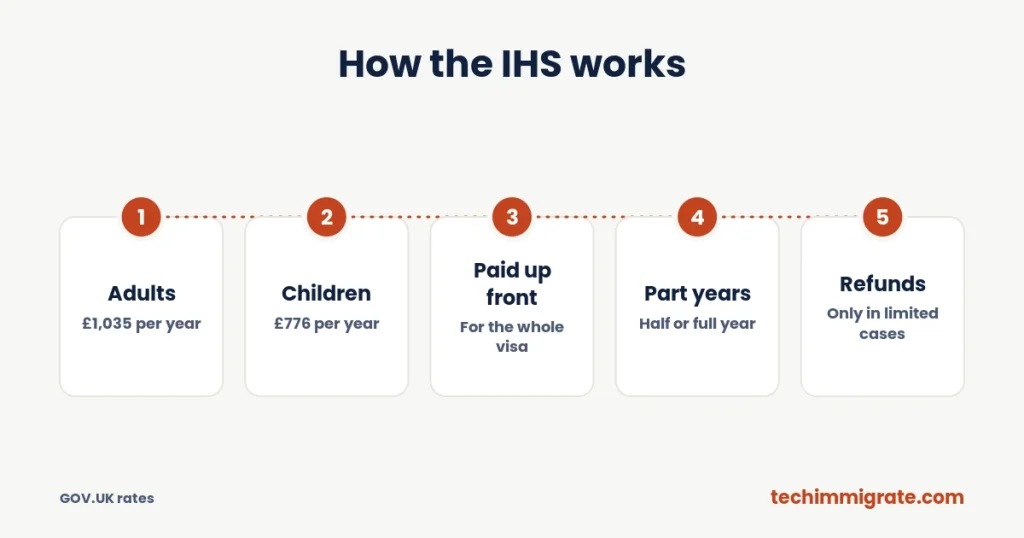
- The Immigration Health Surcharge for Skilled Worker visas is usually £1,035 per year for each adult.
- Children under 18 pay £776 per year. Adult dependants usually pay the same as the main applicant.
- You pay the full amount for the whole length of your visa when you apply, before your visa is decided.
- Part years are charged in half-year or full-year steps, depending on their length and where you apply from.
- Health and Care Worker visa holders and their dependants are exempt.
- You usually get a refund only if your application is refused or you are granted less time than you paid for. You do not get a refund if you settle early or leave early.
What the Immigration Health Surcharge Is
The Immigration Health Surcharge is a fee paid by most people applying for a UK visa for more than 6 months. It gives you access to the National Health Service on broadly the same basis as a UK resident. You may still need to pay for some things, such as prescriptions in England, dental treatment and eye tests, in the same way as other residents.
The surcharge is separate from the visa fee. You pay it as part of your online application, and your application cannot be processed until it is paid.
How Much the Surcharge Costs
GOV.UK sets two annual rates:
| Who | Annual rate |
|---|---|
| Skilled Workers and most other applicants | £1,035 |
| Children under 18 | £776 |
| Students, their dependants and Youth Mobility Scheme visa holders | £776 |
For Skilled Worker visas, the main applicant and any adult dependants usually pay £1,035 per year, and children under 18 pay £776 per year.
How Part Years Are Charged
Skilled Worker visas are often granted for a period that is not a whole number of years. GOV.UK sets out how part years are charged:
- 6 months or less, applying from outside the UK: no surcharge for that part year.
- 6 months or less, applying from inside the UK: half the yearly rate, which is £517.50 for adults.
- More than 6 months but less than a year: the full yearly rate, wherever you apply from.
- Up to 18 months: the yearly rate plus half the yearly rate.
- More than 18 months but less than 2 years: two full years.
The online application calculates the amount for you based on the dates of your visa, but it helps to understand the rules so that you can budget accurately.
Worked Examples
A single applicant on a 3-year visa
A software engineer applying from outside the UK for a 3-year Skilled Worker visa pays 3 × £1,035 = £3,105 in surcharge.
A single applicant on a 5-year visa
The same engineer applying for a 5-year visa pays 5 × £1,035 = £5,175.
A couple on 5-year visas
Two adults each pay £5,175, a total of £10,350.
A family of four on 5-year visas
Two adults pay £10,350, and two children each pay 5 × £776 = £3,880, a total of £7,760. The family's total surcharge is £18,110.
| Household | 3-year visas | 5-year visas |
|---|---|---|
| One adult | £3,105 | £5,175 |
| Two adults | £6,210 | £10,350 |
| Two adults, one child | £8,538 | £14,230 |
| Two adults, two children | £10,866 | £18,110 |
When You Pay
You pay the surcharge as part of your visa application, after you submit the online form and before you book or attend your identity appointment. If you do not pay, UK Visas and Immigration will email you. GOV.UK says you then have 10 working days to pay if you are inside the UK, or 7 working days if you are outside. If you still do not pay, your application will be refused.
Who Is Exempt
Most Skilled Worker visa holders must pay. The main exception is the Health and Care Worker visa, a type of Skilled Worker visa for eligible doctors, nurses, health professionals and adult social care professionals. Applicants on that route and their dependants do not pay the surcharge. Some other groups are exempt too, as set out on GOV.UK. Tech roles are not usually covered by the Health and Care Worker visa.
Extending or Switching
When you extend your Skilled Worker visa or switch from another visa, you pay the surcharge again for the new period. If the new visa overlaps with time you have already paid for, GOV.UK says you may get a partial refund. Overlaps of 6 months or more are refunded, rounded down to the nearest 6 months. Overlaps of less than 6 months are not refunded.
Refunds
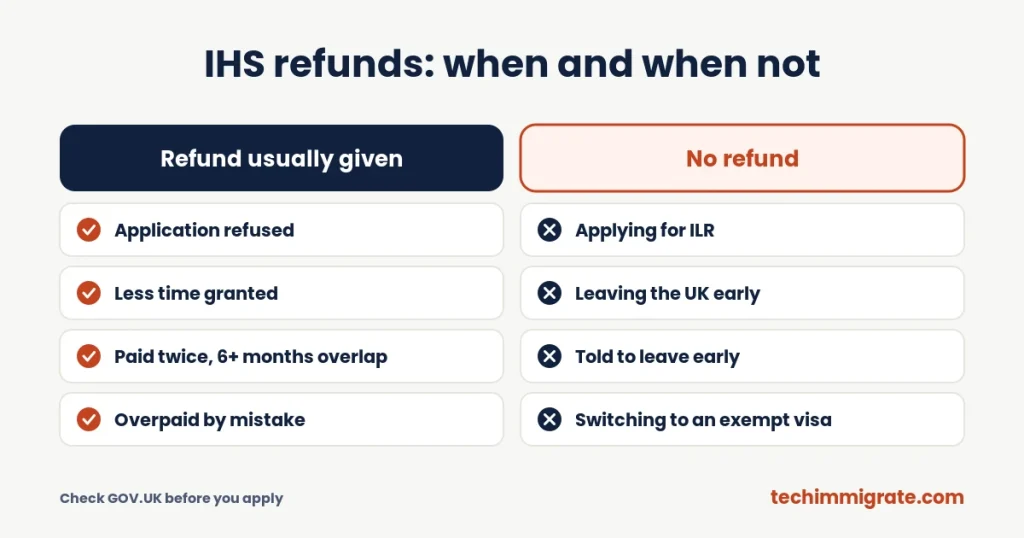
You usually get a full refund of the surcharge if your visa application is refused. You may get a partial refund if you are granted less time than you paid for. But GOV.UK says you will not get a refund if:
- You apply for indefinite leave to remain.
- You leave the UK before your visa ends.
- You are told to leave before your visa expires.
- You switch to a visa that is exempt from the surcharge.
This matters for planning. If you will be eligible to settle after 5 years, a visa that runs far beyond that point may mean paying surcharge you never use.
How the Surcharge Fits Into the Total Cost
The surcharge is one part of the cost of a Skilled Worker visa. For a single applicant applying from outside the UK for a visa of more than 3 years, the visa fee is £1,618. Add 5 years of surcharge at £5,175 and the total is £6,793, before any other costs. Your employer pays the certificate of sponsorship fee of £525 and the Immigration Skills Charge, which it cannot pass on to you. Our article on Skilled Worker visa fees covers every cost.
Usually £1,035 per year for each adult and £776 per year for each child under 18.
When you apply for your visa, for the full length of the visa, before your application is decided.
No. Applicants on the Health and Care Worker visa and their dependants are exempt.
No. GOV.UK says you will not get a refund if you apply for indefinite leave to remain.
Yes, for the new period. You may get a partial refund if you have paid twice for an overlapping period of 6 months or more.
Some employers choose to cover or reimburse it. It is not a legal requirement. Check your offer and any tax implications.
Choosing Your Visa Length With the Surcharge in Mind
The length of your Skilled Worker visa usually follows the dates on your certificate of sponsorship, which your employer sets. But you and your employer can think about the length together. Because the surcharge is paid up front and is not refunded if you settle early, a visa that runs well past your expected settlement date can mean paying for time you will not use. On the other hand, a short visa means extending sooner, which brings another visa fee and another surcharge payment. For most people planning to settle after 5 years, a first visa of up to 5 years, or a shorter visa followed by an extension that ends close to the 5-year point, keeps waste to a minimum. Talk to your employer early if you want a particular length.
Budgeting for the Surcharge
Because the surcharge is due at the start, it often lands at the same time as other big moving costs: flights, a rental deposit, the first month's rent and setting up a home. Plan for it as early as you can.
- Ask about employer support. Some tech employers cover or reimburse visa costs, including the surcharge, as part of a relocation package. Others offer a loan repaid through salary.
- Check the dates on your certificate of sponsorship. They decide the visa length and therefore the surcharge.
- Include every family member. The surcharge is charged per person, so a family's bill can be several times a single applicant's.
- Keep some money in reserve. You cannot claim most public funds on a Skilled Worker visa, so you need a buffer for the first few months.
What the Surcharge Gives You
Once you have paid the surcharge and your visa is granted, you can use the NHS in broadly the same way as a UK resident. That includes registering with a GP, hospital treatment, maternity care and mental health services. You may still pay for some things that other residents also pay for, such as prescriptions in England, NHS dental treatment and eye tests. Some services, such as assisted conception, may have different rules for visa holders. Register with a GP soon after you arrive, so that you can access care when you need it.
Dependants Who Join Later
If your partner or children join you later, they pay the surcharge when they apply, for the length of their own visa. Their visas usually end on the same date as yours, so a dependant who joins 2 years into a 5-year visa usually pays for about 3 years. Each adult dependant usually pays £1,035 per year and each child under 18 pays £776 per year. Our guide to the Skilled Worker dependant visa explains how dependants apply.
Children Turning 18
The lower rate of £776 per year applies to applicants under 18. The rate is based on your age when you apply. If your child is 17 when they apply, they usually pay the lower rate for the whole visa, even if they turn 18 during it. When they extend later as an adult, they will usually pay the adult rate. Plan for this if your children are close to 18.
Common Mistakes
- Forgetting the surcharge in your budget. It is often larger than the visa fee.
- Assuming the surcharge is refunded if you settle early. It is not.
- Not paying on time. Your application will be refused if you do not pay within the deadline.
- Assuming tech roles qualify for the Health and Care Worker exemption. They usually do not.
- Forgetting dependants. Each person pays.
- Ignoring part-year rules. They can add a half or full year to your bill.
Is the Surcharge Likely to Change?
The surcharge has risen several times since it was introduced, and the government can change it again. Any change is usually announced in advance and applies to applications made after the change. If you are planning a move or an extension, check the current rate on GOV.UK shortly before you apply, and budget a little extra in case of an increase.
How Skilled Worker Costs Compare With Global Talent
Both the Skilled Worker and Global Talent visas require the surcharge at the same rate of £1,035 per year for adults. The difference is in the visa fees. A Skilled Worker visa of more than 3 years from outside the UK costs £1,618, while the Global Talent visa costs £766 in total (£561 endorsement plus £205 visa). Global Talent also has no employer costs and no salary threshold. Our comparison of Global Talent and Skilled Worker explains the full trade-off.
The Surcharge and Settlement
When you apply for indefinite leave to remain, you do not pay the surcharge, because ILR is not time-limited. This is one of the financial benefits of settling. But you also do not get back any surcharge you paid for the rest of your last visa. If your visa runs for a year after your settlement date, that year's surcharge is lost. Our article on ILR fees explains the costs of settlement.
Questions to Ask Before You Pay
- How long will my visa be, based on my certificate of sponsorship?
- How many family members are applying, and what are their ages?
- Will my employer cover any of the cost?
- Am I likely to settle before my visa ends?
- Have I already paid surcharge for any of the same period?
- Do I have the money ready, so that I can pay within the deadline?
The Bottom Line
The Immigration Health Surcharge is a large, up-front cost for Skilled Worker visa holders and their families. It is £1,035 per year for adults and £776 per year for children, charged for the whole visa, with half-year and full-year steps for part years. It is rarely refunded. Plan your visa length, your budget and your family's applications with it in mind, and check GOV.UK for the current rates before you apply.
Getting Help
If your situation is unusual, for example because you are switching between visas with overlapping surcharge periods, or because a family member's age or circumstances are uncertain, check GOV.UK's surcharge pages carefully or ask a regulated immigration adviser before you pay.
A Worked Part-Year Example
Part-year rules can add more than people expect. Imagine a software engineer whose certificate of sponsorship covers 3 years and 2 months, applying from outside the UK. The first 3 years are charged at £1,035 each, £3,105 in total. The extra 2 months are 6 months or less, and because the application is made from outside the UK, there is no charge for that part year. The total is £3,105. If the same engineer were extending from inside the UK for the same period, the 2 months would be charged at half the yearly rate, £517.50, making £3,622.50. If the extra period were 8 months instead, a full extra year of £1,035 would be charged, wherever the application was made. These small differences can matter when you are budgeting for a whole family.
Employer Relocation Packages
Many UK tech employers that sponsor overseas workers offer some help with visa costs, but packages vary widely. Some pay the visa fee and surcharge in full. Some pay the main applicant's costs but not dependants'. Some offer an interest-free loan repaid from salary, and some offer nothing beyond the costs they are legally required to pay, such as the certificate of sponsorship and the Immigration Skills Charge. If an employer offers to pay your surcharge, ask whether it is a gift or a loan, whether you would have to repay it if you leave within a certain period, and whether there are tax implications. Get the answers in writing before you accept the offer.
Paying the Surcharge When You Change Employer
If you change employer on a Skilled Worker visa, you usually need to make a new application with a new certificate of sponsorship. That means paying a new visa fee and the surcharge for the new visa period. If your new visa overlaps with the period you already paid for, you may get a partial refund for overlaps of 6 months or more, rounded down to the nearest 6 months. Overlaps under 6 months are not refunded. Factor this into the cost of a job move. Our article on changing employer on a Skilled Worker visa explains the full cost.
How the Surcharge Is Paid in Practice
You pay the surcharge online, using a debit or credit card, as part of the visa application process on GOV.UK. You will receive an IHS reference number, which is linked to your application. Keep this reference safe, because you may need it if there is a problem with your application or if you are due a refund. If you apply with family members, each person has their own surcharge calculation, but you can usually pay for everyone in the same transaction as part of a linked application.
The Surcharge for Graduates Switching to Skilled Worker
If you are switching from a Graduate visa to a Skilled Worker visa, you pay the surcharge for the new Skilled Worker period. If your Graduate visa had time left, and you paid surcharge for that time, the overlap between the two visas may be refunded if it is 6 months or more, rounded down to the nearest 6 months. Graduates on the new entrant salary rules should also plan for the overall cost of the visa, since early-career salaries can make the up-front payment feel large. Our article on moving from a Graduate visa to Skilled Worker covers the switch.
What Happens if You Are Refused
If your Skilled Worker application is refused, GOV.UK says you will usually get a full refund of the surcharge. The refund is normally paid to the card you used, within a few weeks of the decision. The visa fee itself is usually not refunded. If your application is refused and you reapply, you will pay the surcharge again with the new application, and receive a refund for the refused one.
Private Health Insurance
Paying the surcharge gives you access to the NHS, so private health insurance is not required for a Skilled Worker visa. Some tech employers offer private medical insurance as a benefit, which can mean faster access to some treatments. It does not replace the surcharge, which you must still pay. If your employer offers private cover, check whether it includes your family and what it covers.
Keeping Records of Payment
Keep a copy of your surcharge payment confirmation and IHS reference number for every application, along with your visa decision. If you later switch or extend and believe you have paid twice for the same period, these records will help you claim a partial refund. They are also useful if there is ever a question about your access to NHS services.
Your Next Step
If you are a tech professional weighing up UK visa routes, compare the costs and freedoms of Skilled Worker with those of the Global Talent visa, which has lower visa fees and no employer tie. Our role-specific Global Talent guides explain what Tech Nation looks for in software developers, data and AI specialists, product managers, designers and more.
How We Checked This Article
We checked the surcharge rates, part-year rules, payment deadlines and refund rules against GOV.UK's Immigration Health Surcharge pages, and Skilled Worker fees against GOV.UK's Skilled Worker visa pages, in November 2026.
Tech Immigrate is independent of the Home Office. This article is general information, not legal or financial advice. Check GOV.UK before you apply.
We write practical guides for tech professionals applying for the UK Global Talent visa. Tech Immigrate is independent of Tech Nation and the Home Office, and our articles are general information, not legal advice. Rules and fees change, so always check gov.uk before you apply.


