Global Talent Exceptional Promise: Who It’s For and How to Qualify
Global Talent visa Exceptional Promise explained: who the route suits, what Tech Nation checks, evidence and letters, and how it affects settlement.


In this article
- What Exceptional Promise Actually Means
- Who Exceptional Promise Is For
- Exceptional Promise vs Exceptional Talent: The Short Version
- How Tech Nation Assesses Exceptional Promise
- What Good Exceptional Promise Evidence Looks Like
- Letters of Recommendation for Exceptional Promise
- Is Exceptional Promise Easier to Get?
- Exceptional Promise and Settlement
- Can You Move From Exceptional Promise to Exceptional Talent?
- How to Decide Whether You Are Ready to Apply
- Building Exceptional Promise Evidence in 12 Months
- A Fictional Example: Amara, a Backend Engineer
- Common Mistakes on Exceptional Promise Applications
- What the Visa Lets You Do
- Costs for an Exceptional Promise Applicant
- Exceptional Promise for Founders and Non-Technical Roles
- Your Next Step
- How We Checked This Article
Exceptional Promise is the part of the Global Talent visa built for people who are good, and getting better, but who are not yet household names in their field. If you are a few years into a tech career, have shipped real work and have started to be noticed outside your own team, it is the route most likely to fit you. It is also the route that people misunderstand most often, either because they assume it is a lower bar that anyone can clear, or because they assume they are too junior to try.
This guide looks at Exceptional Promise on its own terms. It explains who the route is designed for, what "promise" means to an assessor, how the evidence standard differs from Exceptional Talent, what happens to your settlement timeline, and how to tell whether you are ready to apply now or should spend another year building your case. It is written for the digital technology route, where Tech Nation is the endorsing body.
Key takeaways
- Exceptional Promise is for people who show the potential to become leaders in digital technology, usually earlier in their careers.
- The visa itself is the same as Exceptional Talent: no sponsor, no job offer, no salary threshold, and the same fees (£561 endorsement plus £205 visa).
- The main practical difference is settlement. Under the current rules, Exceptional Promise holders can apply for settlement after 5 years, compared with 3 years for Exceptional Talent.
- The evidence standard is lower in seniority but not lower in quality. Assessors still want proof of recognition beyond your employer.
- Most of your evidence should come from the last 5 years, which suits people in the early stage of a strong career.
- A weak Exceptional Promise application is refused just as quickly as a weak Exceptional Talent one, so treat the route as a different target, not an easier one.
What Exceptional Promise Actually Means
The Global Talent visa has two levels for most fields: Exceptional Talent and Exceptional Promise. Exceptional Talent is for people who are already recognised as leading talents in their field. Exceptional Promise is for people who are recognised as having the potential to become leading talents.
In the digital technology route, Tech Nation describes Exceptional Promise applicants as emerging leaders. They are typically at an earlier stage of their career, but they have already done things that set them apart from other people with similar experience. That might be a product that grew quickly, open source work used by other engineers, talks at respected events, a research contribution or a start-up that won investment.
The key word is potential. An assessor reading an Exceptional Promise application is asking a simple question: if this person continues on their current path, are they likely to become a recognised leader in UK digital technology? Your evidence has to make that answer an easy yes.
Who Exceptional Promise Is For
Exceptional Promise suits people who share a few traits, regardless of job title.
- You are early or mid-career. Many successful applicants have roughly 2 to 7 years of experience, although there is no fixed minimum or maximum.
- You have a track record of results. Not just tasks completed, but outcomes you can point to: users, revenue, adoption, performance, funding or citations.
- You have been noticed outside your employer. Recognition from people who do not work with you every day is the heart of the route.
- Your trajectory is upward. Promotions, growing responsibility, larger projects and more visible work all help to show where you are heading.
- You work in a technical or business role in digital technology. Engineers, data and AI specialists, product managers, designers, founders, cyber security specialists and tech sales leaders can all apply.
It is less suited to people who are very new to the industry, such as recent graduates with no professional track record, and to very senior people whose achievements would comfortably meet the Exceptional Talent standard. If you are senior, applying for Promise does not make an approval more likely, and it costs you two extra years before settlement.
Exceptional Promise vs Exceptional Talent: The Short Version
We have a full comparison of Exceptional Talent and Exceptional Promise in a separate article, and a guide to ways to qualify as an emerging leader. For this guide, the differences that matter most are these.
| Feature | Exceptional Promise | Exceptional Talent |
|---|---|---|
| Who it is for | Emerging leaders | Established leaders |
| Typical career stage | Earlier career | Senior or highly recognised |
| Evidence window | Mostly last 5 years | Mostly last 5 years |
| Visa length | Up to 5 years per grant | Up to 5 years per grant |
| Fees | £561 + £205 | £561 + £205 |
| Settlement under current rules | After 5 years | After 3 years |
| Job offer needed | No | No |
Everything about the visa itself is the same. You can work for any employer, be self-employed, start a company, change jobs freely and bring dependants. The difference is the standard of recognition and the time to settlement.
How Tech Nation Assesses Exceptional Promise
Tech Nation assesses every digital technology application against the same structure: one mandatory criterion and four optional criteria, of which you must meet at least two. What changes for Exceptional Promise is the level the assessor expects.
The mandatory criterion
For Exceptional Promise, you must show that you have been recognised as having the potential to be a leading talent in digital technology. In practice, this means evidence that people outside your company see you as someone who is going places. Letters from respected figures, press coverage of your work, invitations to speak, awards for rising stars and selection for competitive programmes can all help.
The optional criteria
You must also meet two of the following, at a level that matches your stage of career.
- Innovation. A track record of innovation as a founder or senior employee of a product-led digital technology company, or as an employee working on a new digital field or concept.
- Recognition outside your immediate occupation. Contributions to the field beyond your day job, such as mentoring, speaking, open source, community leadership or industry work.
- Significant contributions. Significant technical, commercial or entrepreneurial contributions to the field as a founder, senior executive, board member or employee.
- Academic contributions. Exceptional ability in the field through academic work, such as publications or research endorsed by experts.
For Exceptional Promise, assessors accept that your contributions may be at a smaller scale than those of an established leader. A feature that moved a key metric at a growing scale-up can count where an Exceptional Talent applicant might need to show impact across an entire company or sector. What does not change is the need for evidence that is specific, verifiable and clearly linked to you.

What Good Exceptional Promise Evidence Looks Like
The most common reason Exceptional Promise applications fail is not that the applicant is too junior. It is that the evidence describes activity rather than impact, or describes the employer's success rather than the applicant's role in it.
Strong evidence tends to share these features
- It names you. Your name appears in the press article, the release notes, the conference programme or the award announcement.
- It shows a result. Numbers, adoption, growth or external validation, not just effort.
- It comes from someone independent. A third party confirming your work carries more weight than your own description of it.
- It is recent. Most evidence should be from the last 5 years, which naturally suits people earlier in their careers.
- It is explained. A short note on each document tells the assessor what it proves and why it matters.
Weaker evidence tends to look like this
- Job descriptions and generic employer references.
- Certificates for courses or online training.
- Social media follower counts with no link to professional impact.
- Internal performance reviews that nobody outside the company has seen.
- Team awards where your individual contribution is unclear.
Our role-specific guides go through examples of strong and weak evidence for engineers, product managers, designers, data specialists and others, because what counts as "recognition" looks quite different in each role.
Letters of Recommendation for Exceptional Promise
You need three letters of recommendation from established, well-known people in digital technology who know your work. For an Exceptional Promise applicant, the letters do a specific job: they explain why the writer believes you have the potential to become a leader.
The best letters do three things. They explain who the writer is and why their opinion matters. They describe specific work you did and the impact it had. And they place you in context, saying how you compare with other people at your stage. A sentence such as "one of the strongest engineers I have worked with at this stage of their career" carries more weight when it is backed by an example.
At least one of your letters should come from someone outside your current employer, and ideally more. Letters from senior people who have only met you briefly are weaker than letters from respected people who have seen your work closely. Tech Nation may contact referees to check letters, and using AI to write them is not acceptable under its guidance.
Is Exceptional Promise Easier to Get?
Many people assume Exceptional Promise is an easier way in. It is better to think of it as a different target. The bar is set relative to your career stage, but the scrutiny is the same.
Public data shows how demanding the route is. Freedom of information figures reported by Edgewater Legal suggest that around 82% of decided Tech Nation applications were refused in 2025, and around 91% in 2026 up to July. The Migration Advisory Committee's review of talent routes, published on 17 November 2026, reported that endorsement rates on the standard routes fell from 74% in 2021 to 44% in 2025 across endorsing bodies. Those figures cover both levels.
What this means for you is that applying under Exceptional Promise is not a shortcut. If your evidence is thin, it will be refused. If your evidence is strong for your stage, Promise is the right label for it, and you should not reach for Exceptional Talent just because the settlement period is shorter.
Exceptional Promise and Settlement
Settlement is where the two levels differ in a way that affects your life plans.
Under the current rules
If you were endorsed under Exceptional Promise, you can currently apply for indefinite leave to remain after 5 years in the UK. Exceptional Talent holders can apply after 3 years. In both cases you must have earned money in your field, meet the continuous residence rules (no more than 180 days outside the UK in any 12-month period), pass the Life in the UK test and meet the English requirement.
Under the earned settlement reforms
The government's response to the earned settlement consultation, published on 2 November 2026, sets out a new system to be rolled out over 2027. It creates a 3-year path for people with very high incomes or in a Highest Talent Group, and confirms that recognised talent routes such as Global Talent are expected to keep a short path to settlement. The details of who falls into the Highest Talent Group are due to be defined after Migration Advisory Committee advice. It is not yet clear whether Exceptional Promise and Exceptional Talent will be treated the same under the new system.
Until the final rules are published, plan on the basis of the current 5-year Exceptional Promise timeline, and check GOV.UK before you rely on any shorter path.
Can You Move From Exceptional Promise to Exceptional Talent?
There is no formal upgrade process. However, some people who were first endorsed under Exceptional Promise later apply for a new endorsement under Exceptional Talent, because their career has grown and they want the shorter settlement period. This means a full new Stage 1 application, with new evidence, new letters and a new fee.
Whether this is worthwhile depends on timing. If you are already two or three years into your Exceptional Promise visa, the time spent preparing a new application may cancel out the benefit. If your career has taken off quickly after your first endorsement, it may make sense. Check the current rules on how time under each level counts before you decide.
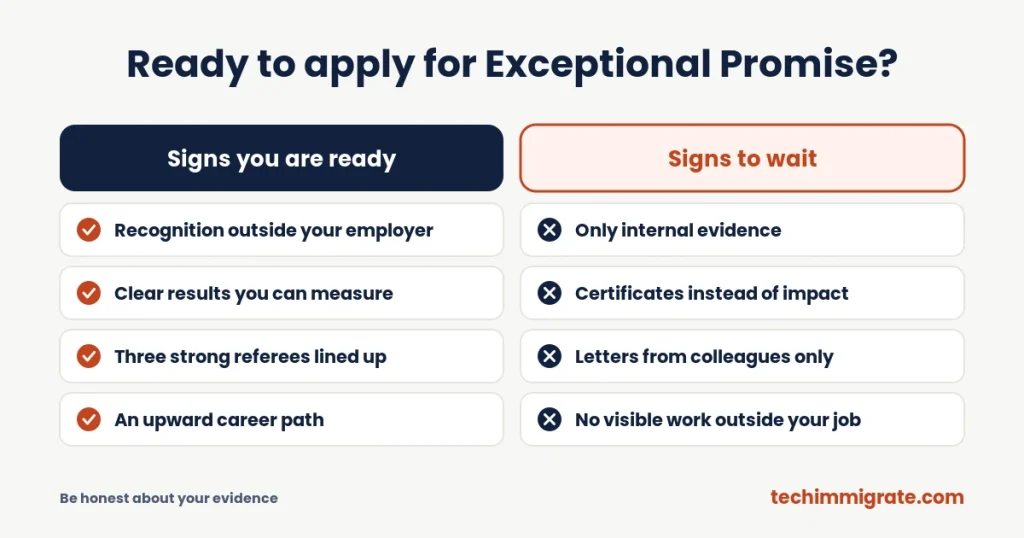
How to Decide Whether You Are Ready to Apply
Ask yourself these questions honestly.
- Can you name at least three pieces of evidence where someone outside your employer has recognised your work?
- Can you show clear results from at least two significant projects or contributions?
- Do you know three established people in the sector who would write a detailed, specific letter about you?
- Does your career show a clear upward path, with growing responsibility?
- Would an assessor reading your CV for two minutes understand why you stand out from other people with similar experience?
If you can answer yes to most of these, you are probably ready to start preparing. If not, the most useful thing you can do is spend the next 6 to 12 months building the missing pieces: speaking at a meetup, publishing a technical article, contributing to a well-used open source project, mentoring through a recognised programme, or leading a project with measurable results.
Building Exceptional Promise Evidence in 12 Months
If you are close but not quite there, a focused plan can make a real difference. Here is a realistic approach for a working professional.
Months 1 to 3: audit and plan
List everything you have done in the last 5 years. Mark each item by whether it shows recognition outside your employer, impact, or innovation. Identify the two optional criteria where you are strongest, and focus your effort there.
Months 3 to 6: create external visibility
Submit talks to meetups and smaller conferences. Write one or two in-depth technical or product articles for a respected publication or your company's engineering blog. Contribute to open source in a way that is visible and attributable to you.
Months 6 to 9: strengthen your impact story
Take ownership of a project with measurable outcomes. Collect evidence as you go: metrics, release notes, emails from customers or partners, and recognition from people outside your team.
Months 9 to 12: secure your letters and assemble
Approach potential referees early, and give them specific examples to draw on. Then assemble your 10 pieces of evidence, write your personal statement and prepare your CV.
A Fictional Example: Amara, a Backend Engineer
Amara has 4 years of experience as a backend engineer at a fintech scale-up. She led the rebuild of the payments retry system, which cut failed payments by a significant margin, and the company wrote about it on its engineering blog with her name on the post. She has spoken at two developer meetups and one regional conference, and she maintains a small open source library that a few hundred projects depend on.
She is not yet a recognised leader across the sector, so Exceptional Talent would be a stretch. But she has clear evidence of impact, recognition outside her employer and a strong upward trajectory. She applies under Exceptional Promise, using the innovation and significant contributions criteria, with letters from her former CTO, a conference organiser who saw her talk and a senior engineer at another company who uses her library.
This example is fictional and simplified. Every application is assessed on its own evidence.
Common Mistakes on Exceptional Promise Applications
- Treating Promise as a lower-effort route. The scrutiny is the same; only the level of seniority differs.
- Relying on employer achievements. The company's growth is not your achievement unless you show your specific role.
- Using only internal letters. Assessors want independent voices.
- Submitting generic certificates. Courses and training do not show leadership potential.
- Applying too early. A few strong pieces beat many weak ones. If you need more time, take it.
- Ignoring the settlement difference. If you clearly meet Exceptional Talent, applying for Promise costs you two extra years before settlement under the current rules.
What the Visa Lets You Do
Once endorsed and granted, an Exceptional Promise visa gives you the same freedoms as Exceptional Talent. You can work for any employer, change jobs without telling the Home Office, be self-employed, start a company, take on freelance work and study. You can bring your partner and children as dependants, and they can work too. You can extend the visa as many times as you like, in grants of up to 5 years.
You cannot claim most public funds, and you must keep earning money in your field if you want to settle. Time spent in the UK on the visa counts towards settlement, as long as you stay within the absence limits.
Costs for an Exceptional Promise Applicant
The costs are identical to Exceptional Talent. You pay £561 for the endorsement and £205 for the visa, a total of £766. On top of that, you pay the Immigration Health Surcharge, usually £1,035 per year for an adult. A five-year visa therefore costs about £5,941 up front for one person. Each dependant pays £766 plus their own surcharge. When you settle, the indefinite leave to remain fee is currently £3,226.
Exceptional Promise for Founders and Non-Technical Roles
Exceptional Promise is not just for engineers. Founders of early-stage start-ups often fit the route well, especially if the company has raised investment, joined a respected accelerator or won customers in a competitive market. Product managers, designers and tech sales professionals can also apply under the business side of the route, as long as their role is in a product-led digital technology company and they can show external recognition.
For non-technical applicants, the challenge is usually showing personal impact rather than team results. Metrics tied to features you owned, deals you closed or products you launched, backed by independent validation, are what make the case.
It is the level for people recognised as having the potential to become leading talents in their field, usually earlier in their careers.
The seniority bar is lower, but the quality of evidence expected is the same. Weak applications are refused under both levels.
Under the current rules, 5 years. Exceptional Talent holders can settle after 3 years. The earned settlement reforms may change this, so check GOV.UK.
No fixed minimum is set, but you need a track record of results and recognition. Many successful applicants have a few years of experience.
Yes. The fees are £561 for endorsement and £205 for the visa, plus the health surcharge.
Yes, by making a new Stage 1 application with new evidence. There is no automatic upgrade.
Your Next Step
If Exceptional Promise sounds like your route, the next step is to map your evidence against the criteria for your specific role. Our role-specific Global Talent guides show what strong Exceptional Promise evidence looks like for software developers, data and AI specialists, product managers, designers, founders and more, with worked examples and checklists.
How We Checked This Article
We checked the Exceptional Promise criteria against Tech Nation's applicant guidance and GOV.UK's Global Talent visa pages, the fees against GOV.UK's fee tables, and the settlement rules against GOV.UK's settlement guidance, in November 2026. Refusal rates come from freedom of information data reported by Edgewater Legal and from the Migration Advisory Committee's review of talent routes. Settlement reforms are from summaries of the earned settlement response of 2 November 2026.
Tech Immigrate is independent of the Home Office and Tech Nation. This article is general information, not legal advice. Check GOV.UK before you apply.
We write practical guides for tech professionals applying for the UK Global Talent visa. Tech Immigrate is independent of Tech Nation and the Home Office, and our articles are general information, not legal advice. Rules and fees change, so always check gov.uk before you apply.