Global Talent Visa Guidance UK: DIY vs Professional Help (Which Fits You?)
Global Talent Visa guidance UK compared: DIY, self-study guides and regulated advisers. See costs, risks and red flags, then pick the route that fits.

In this article
- What Global Talent Visa Guidance UK Covers
- Who Is Allowed to Give Immigration Advice in the UK?
- Global Talent Visa Guidance UK Option 1: DIY With Official Sources
- Global Talent Visa Guidance UK Option 2: Self-Study Guides (Including Ours)
- Option 3: A Regulated Adviser or Solicitor
- How to Check an Adviser Is Regulated
- Red Flags and Scams to Avoid
- Global Talent Visa Guidance UK Compared Side by Side
- What Each Option Costs in Practice
- Global Talent Visa Guidance UK Decision Guide: Which Fits You?
- When to Get Help: Timing Matters
- Mistakes People Make When Choosing Help
- What Self-Study Guides Add to Official Guidance
- How Tech Immigrate Fits In, and When It Does Not
- Global Talent Visa Guidance UK FAQ
- Your Next Step
- How We Checked This Article
Global Talent Visa guidance UK comes in three main forms: doing it yourself, using a self-study guide, or paying a regulated adviser or solicitor. The right mix depends on your case, your budget and how much risk you can carry.
This article compares all three in a fair way. We sell self-study guides, so we say plainly where a regulated adviser is the better choice.
Key takeaways
- Global Talent Visa guidance UK falls into three groups: DIY with official pages, self-study guides, and regulated advisers or solicitors.
- In the UK, the law says only qualified people may give immigration advice, and that means registered advisers, solicitors and similar regulated professionals.
- Tech Immigrate sells self-study guides with a checklist and planner. It does not give individual legal advice.
- Complex histories, past refusals or family complications usually call for a regulated professional.
- Red flags include guaranteed outcomes, claims of inside contacts and refusal to show a registration number.
What Global Talent Visa Guidance UK Covers
Global Talent Visa guidance UK covers everything from reading the official rules to getting advice on your own case. The three types differ in cost, personal attention and legal protection.
The route has two stages. First, Tech Nation decides whether to endorse you for digital technology. Then you apply to the Home Office for the visa. Both stages are online, and you can apply yourself.
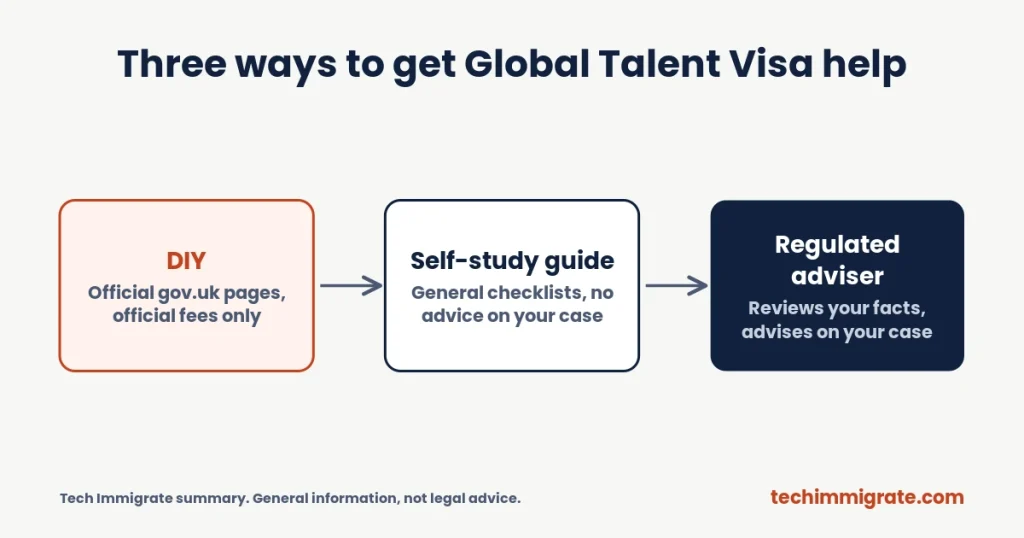
The three main options
Think of the options as a ladder of support, not a contest:
- DIY with official sources. You read gov.uk and Tech Nation guidance and write everything yourself.
- Self-study guides. You buy structured general information, such as checklists and planners, and still write everything yourself.
- Regulated adviser or solicitor. A qualified person reviews your facts and gives advice on your case.
Many applicants combine them. For example, someone may study a guide and then pay a solicitor for a one-off review.
What this article does not do
We cannot tell you which option you must pick. Nobody can promise an endorsement, and this page is general information only. For the rules themselves, start with the gov.uk Global Talent page.
Who Is Allowed to Give Immigration Advice in the UK?
In the UK, only qualified people may give immigration advice or services. The law is section 84 of the Immigration and Asylum Act 1999, and it says that no person may provide this advice unless they are a qualified person.
According to section 84 on legislation.gov.uk, a qualified person is a registered person, someone authorised by a designated professional body such as the solicitors' regulator, or someone acting under their supervision.
The regulator and its levels
The Immigration Advice Authority (IAA) regulates immigration advisers. Gov.uk says it has been renamed from the body many people still call the OISC. The register lists three levels of adviser.
Level 1 covers advice and assistance on simpler cases. Level 2 adds casework and more complex matters. Finally, Level 3 covers advocacy and tribunal appeals. Solicitors and barristers sit under their own regulators instead.
Why this matters to you
The rule protects you. Gov.uk warns that you cannot get your money back if an adviser is not regulated. You can read the official explanation in its guidance for people seeking immigration advice.
It also shapes what a publisher like us can do. We share general information in guides. We do not review your documents and tell you what to do. Anyone offering that service should show you their registration.
Global Talent Visa Guidance UK Option 1: DIY With Official Sources
DIY means you rely on gov.uk, Tech Nation's published guidance and your own judgement. It costs only the official fees, but it takes the most time and carries the most self-checking.
At the time of writing, the endorsement fee is £561 and the visa fee is £205, which makes £766 before the health surcharge. The surcharge is usually £1,035 per year for each person applying. Always confirm the figures on gov.uk, because they change.
When DIY fits
Applicants with straightforward histories often manage the process alone. Typical signs include a clear work record, no past refusals and plenty of outside evidence. You also need time to read the rules closely and ask for letters.
Where DIY goes wrong
The risks are quiet ones. You may misread a rule, reuse one document for two criteria, or send evidence from your employer when the rules ask for outside proof. Our guide to common Tech Nation endorsement mistakes lists the most common traps.
Nobody reviews your work before you pay, so mistakes can stay hidden until a refusal arrives. If you want a second opinion, you can add a guide, a peer review or a paid review later.
Global Talent Visa Guidance UK Option 2: Self-Study Guides (Including Ours)
A self-study guide is general information built for many people. It can save you time because someone has already organised the steps, but it is not advice about your case.
Tech Immigrate sells role-specific endorsement guides with an evidence checklist and planner. They sit inside a hub of role-specific guides. We are not a law firm, and we are not regulated to give immigration advice.
What a guide can do
A good guide can explain the criteria in plain words, so you spend less time decoding official wording. It can offer a checklist so you do not forget documents. It can show typical evidence for a role, and it can give you a plan with dates.
What a guide cannot do
A guide cannot read your documents and tell you what to submit, because it was written before it met your case. It cannot judge whether your history raises a risk. It also cannot promise a result, and any seller that does should raise doubt.
Want the guide for your role? See the guides.
How to judge any guide
Ask a few simple questions before you buy:
- Does it name its sources and show where it checked the rules?
- Can you see what it says it cannot do?
- Has the author avoided guarantees and success rates?
- Is a date of the last check shown?
Option 3: A Regulated Adviser or Solicitor
A regulated adviser or solicitor can look at your facts and give advice on your case. They carry professional duties, insurance or complaint routes, and a legal duty to act in your interests.
Costs vary widely. Firms publish different fees, and some give a fixed quote only after a call. Ask for a written scope and price before you agree.
Also ask what is included, such as evidence review, drafting letters and the visa stage. Some firms charge separately for each stage, so a low first quote may not cover the whole route.
When a regulated adviser is the better choice
Choose a regulated professional, rather than a guide, if any of these apply to you:
- A past visa refusal, a ban or a breach of immigration rules
- A criminal record or other character concerns
- Dependants with complex circumstances
- A switch from another visa where timing is tight
- A role where your evidence is thin or unusual
- Low confidence in handling a legal process alone
In those cases, general information is not enough. You need advice on your own facts.
What advisers do not change
An adviser cannot give Tech Nation a better case than the evidence supports. The endorsement panel decides on the evidence overall. A professional can organise and present your material, but they cannot guarantee an endorsement either.
How to Check an Adviser Is Regulated
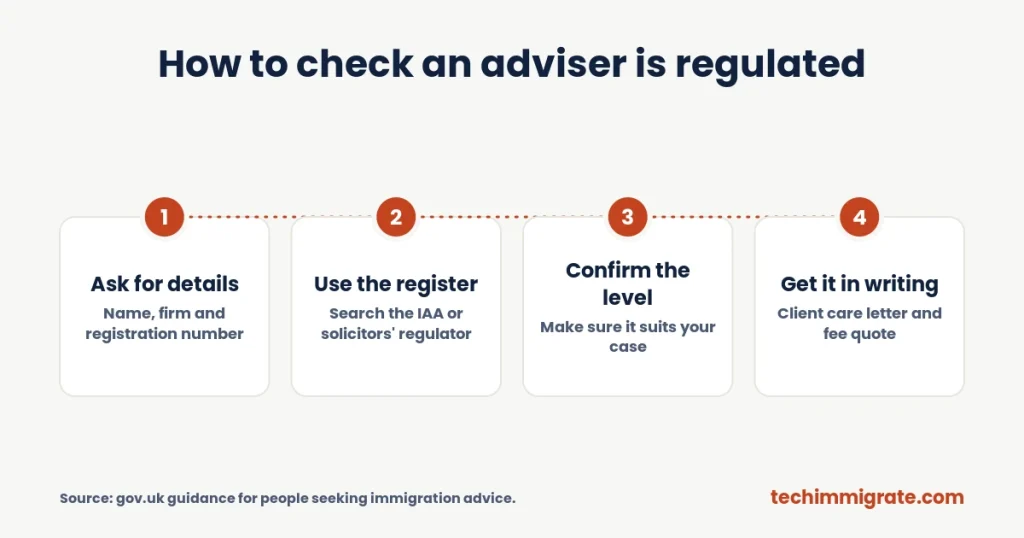
Checking takes a few minutes and protects your money. Use the official register, not the adviser's own website.
- Ask for the adviser's name, firm and registration or regulator number.
- For an IAA adviser, search the register on the IAA adviser register.
- For a solicitor, check the solicitors' regulator register.
- Confirm the level suits your case.
- Ask for a written client care letter and fee quote.
Gov.uk also links a Find an immigration adviser page, and a list of advisers who are banned. If you have a bad service, you can complain through the regulator.
Illustrative example (fictional)
Dana, a fictional data analyst, finds an adviser on social media. The adviser says "I know people at Tech Nation" and asks for payment in advance. Dana asks for a registration number, and the adviser changes the subject. Dana walks away and checks the official register instead.
Red Flags and Scams to Avoid
Most scams share a few features: they promise results, ask for fast payment and avoid checks. Treat any one of these as a reason to pause.
- A guarantee of endorsement or visa approval
- A claim of inside contacts at Tech Nation or the Home Office
- No registration number, or a number you cannot find on the register
- Pressure to pay quickly or in unusual ways
- A request to hold your passport or original documents
- An offer to write or buy documents, letters or "evidence" for you
- No written contract or fee breakdown
Fake or invented documents can put your whole case at risk. If something feels wrong, stop and report it. Tech Nation also says its own rules rule out AI-written or templated documents, so a service that sells ready-made letters adds risk.
Global Talent Visa Guidance UK Compared Side by Side
A decision table makes the trade-offs clear. Use it as a thinking aid, not as advice on your case.
| Factor | DIY | Self-study guide | Regulated adviser or solicitor |
|---|---|---|---|
| Cost | Official fees only | Fees plus the guide | Fees plus professional charges |
| Personal review | None | None | Yes, of your facts |
| Legal advice on your case | No | No | Yes |
| Time needed | Most | Less | Least on your side |
| Protection if things go wrong | None | Limited | Regulator complaint routes |
| Best for | Simple, clear cases | Organised self-starters | Complex or high-risk cases |
What Each Option Costs in Practice
Official fees are the same for every option, so the real difference is what you add on top. Start with the fixed costs, then add the extras.
For a main applicant on the endorsement route, the fees are £561 plus £205 at the time of writing, which makes £766. The health surcharge is usually £1,035 per year. Over a five-year grant, that adds up to £5,175 for one person.
Worked example (fictional)
Illustrative example (fictional): Sam applies alone for a five-year visa. The official costs are £766 plus £5,175, which comes to £5,941. A guide or an adviser would be extra. Each dependant pays their own visa fee and health surcharge as well, so family costs rise quickly.
Hidden costs to plan for
Think about the costs that do not show up in a fee table:
- Your time, which can run to many weeks of evidence work
- Printing, translation or certification of documents
- Travel for biometrics
- The cost of a refusal, such as a new fee if you must apply again
A cheap route that fails can cost more than a careful one. That does not mean you must hire someone, but you should count the cost of getting it wrong.
Global Talent Visa Guidance UK Decision Guide: Which Fits You?
The best fit depends on your history and your confidence. Work through the questions below.
Questions to ask yourself
- Do I have any refusal, ban or breach in my history?
- Is my situation unusual, for example a recent career change or a gap?
- Do I need advice about my family or timing?
- Am I comfortable reading rules and writing my own documents?
- Do I already hold strong evidence from outside my employer?
If you answered yes to 1, 2 or 3, speak to a regulated professional first. If you answered yes to 4 and 5, DIY or a guide may be enough.
Illustrative example (fictional)
Marcus, a fictional product manager, has a clean record and plenty of press coverage. He studies a guide, drafts his own documents and finishes in two months. Meanwhile, Leila, a fictional founder, had a refusal five years ago. She books a regulated solicitor before she starts anything.
Mixing the options
Many people mix them, and that is a sensible approach. You might use a guide to plan your evidence, then pay a regulated adviser for a single review. That gives structure and a professional check at a smaller cost than full service.
When to Get Help: Timing Matters
The best time to ask for professional help is before you send anything, not after a problem appears. Early advice can change your plan, while late advice can only repair it.
Consider three moments. Before you start, a regulated adviser can tell you if your history raises a risk. Before you submit, a review can catch errors in your evidence. After a refusal, an adviser can explain your options, including the review that you must request within 28 days.
Prepare before you speak to anyone
You save time and money by arriving organised. Bring these items to a first meeting:
- A short career timeline for the last five years
- A list of your evidence ideas, mapped to criteria
- Any past visa history, including refusals
- Your family situation and planned travel dates
- Your budget and your deadline
Our personal statement guide can also help you get your story straight before you pay for a review.
Mistakes People Make When Choosing Help
Most mistakes come from picking help by price or by promise instead of by fit. Avoid these common ones.
- Paying for a guarantee, which nobody can honestly give
- Skipping the register check because the adviser seems friendly
- Using a guide as if it were advice on your case
- Hiring a professional too late, after documents are already sent
- Trusting reviews or "success rates" that you cannot verify
First, decide what you need: information, a plan or advice. Then match the option to that need. For example, if you need information, a guide may be enough. If you need advice, only a regulated person can give it.
Questions to ask a regulated adviser
Come prepared to your first call. First, ask which register they sit on and their number. Then check who will handle your file and what the fee covers. Also find out how they treat evidence you cannot share, and what happens if Tech Nation refuses. A good adviser answers in plain words and puts it in writing.
What Self-Study Guides Add to Official Guidance
Official guidance tells you the rules, but it does not always show you how to apply them. A guide fills that gap with structure and examples.
For instance, the rules say you need at least two documents per criterion. A guide can show how to plan those documents, which proof to ask for and when. You can also read our articles on the Global Talent Visa criteria and benefits and costs for free.
Where we draw the line
Good information still has limits. We do not tell you which route to choose, whether your evidence is enough or whether to apply. Those are questions about your own case. If you want that kind of help, use a regulated adviser or solicitor. We would rather you get the right support than the cheapest support, because a wrong choice here can cost far more later.
How Tech Immigrate Fits In, and When It Does Not
Tech Immigrate publishes self-study material for digital technology applicants, and that is all. We do not give individual legal advice, review your case or act for you.
Our guides suit people who want a clear structure and are comfortable doing the work themselves. They give an evidence checklist and planner for each role, plus plain explanations of the criteria. If you want help with a refusal, a complex history or a family case, a regulated adviser is the better choice.
A fair test
Ask yourself one question: "Do I need information or advice?" This simple test saves many people from paying for the wrong thing. Information explains how the route works. Advice tells you what to do in your own case. We offer the first, and only qualified people can offer the second.
Global Talent Visa Guidance UK FAQ
No, you can apply yourself, because both stages are online. However, a regulated adviser or solicitor can review your facts and give advice on your case. Applicants with refusals, bans or complex family situations often choose one. Others manage alone with careful reading of the official rules.
Under section 84 of the Immigration and Asylum Act 1999, only qualified people may give immigration advice. That means registered advisers, people authorised by a designated professional body such as solicitors, and people they supervise. Check the register before you pay anyone.
No. A self-study guide offers general information for many readers, so it cannot review your documents or advise on your case. Tech Immigrate sells guides like this and does not give individual legal advice. For advice on your facts, use a regulated adviser.
Ask for their name, firm and registration number, then search the official Immigration Advice Authority register or the solicitors' regulator. Confirm their level fits your case. Ask for a written client care letter and fee quote before paying anything.
Warning signs include guaranteed results, claims of inside contacts, no registration number, pressure to pay fast and offers to supply documents or letters. Stop and check the official register if you see any of these. Gov.uk also lists banned advisers.
Your Next Step
You now know how Global Talent Visa guidance UK splits into three routes. Want the guide for your role? See the guides.
If a self-study route suits you, browse our guides hub for role-specific endorsement guides with an evidence checklist and planner. Popular starting points are the product managers guide, the business analysts guide and the software developers guide. If your case is complex, speak to a regulated adviser or solicitor first.
How We Checked This Article
We checked the route, fees, health surcharge and processing details on the gov.uk Global Talent page. We checked the legal rule on who may give immigration advice against section 84 of the Immigration and Asylum Act 1999 on legislation.gov.uk.
Adviser levels, the register and complaints come from the gov.uk guidance for people seeking immigration advice. Adviser and guide-seller pages helped us see how others describe the options. However, their fee claims stayed out, because we could not verify them.
Tech Immigrate is independent of Tech Nation and the Home Office. This article is general information, not legal advice, and nobody can guarantee an endorsement. Always confirm current rules on gov.uk before you apply.
We write practical guides for tech professionals applying for the UK Global Talent visa. Tech Immigrate is independent of Tech Nation and the Home Office, and our articles are general information, not legal advice. Rules and fees change, so always check gov.uk before you apply.