UK Global Talent Visa Digital Tech: 5 Steps to Get It (Step-by-Step Route)
UK Global Talent Visa Digital Tech explained: who counts, who does not, and the 5 steps from eligibility check to visa. Start with our free check.

In this article
- What Counts as the UK Global Talent Visa Digital Tech Route?
- What Does Tech Nation Mean by Digital Technology?
- Which Roles Qualify? Technical and Business Examples
- Illustrative Example (Fictional): Who Clears the First Hurdle?
- What Is Not Eligible for the UK Global Talent Visa Digital Tech Route?
- The 5 Steps to the UK Global Talent Visa Digital Tech Route
- Step 1: Check Your Eligibility
- Step 2: Choose Your Route
- Step 3: Build Your Evidence
- Where Do You Apply From, and Can You Switch Visas?
- Illustrative Example (Fictional): A Developer Maps Her Evidence
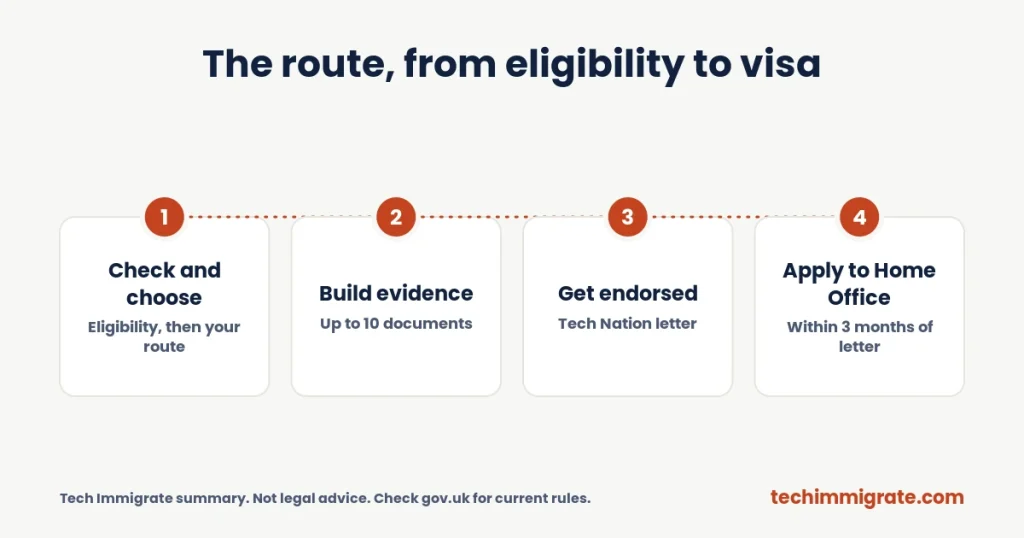
- Step 4: Get Endorsed by Tech Nation
- Step 5: Apply for the Visa
- Common Mistakes on the UK Global Talent Visa Digital Tech Route
- UK Global Talent Visa Digital Tech FAQ
- Your Next Step
- How We Checked This Article
The UK Global Talent Visa Digital Tech route is open to people who lead, or are about to lead, product-led digital technology work. You follow five steps: check eligibility, choose a route, build evidence, win Tech Nation endorsement, then apply to the Home Office.
This guide is for developers, product people, founders and other tech professionals who are unsure whether their job counts. It shows what Tech Nation means by digital technology and where the line falls.
Key takeaways
- Digital technology here means product-led work: you help build or grow software, hardware, data or platform products.
- Technical and business roles can both qualify, but consulting, outsourcing and IT support usually do not.
- The route has two stages: Tech Nation endorsement first, then a Home Office visa application.
- Meeting the criteria is necessary but not enough, because an independent panel decides overall.
- Your evidence should come from outside your employer and show impact on the wider industry.
- You must apply for the visa within 3 months of the endorsement letter.
What Counts as the UK Global Talent Visa Digital Tech Route?
The UK Global Talent Visa Digital Tech route is for leaders and emerging leaders in digital technology who can prove it with outside evidence. It has no job offer requirement. It also has no minimum salary and no language test, according to gov.uk.
The route runs in two stages. First, Tech Nation, the endorsing body, decides whether to endorse you. Then you apply to the Home Office for the visa itself, as the main Global Talent page explains.
Tech Nation's independent panel looks at your application overall. Meeting the listed criteria is necessary, but it does not guarantee a result. For that reason, many applicants spend more time on evidence than on any form.
Who is this route really for?
It suits people whose work shaped a digital product, platform or technology. That might be code you wrote, a product you launched or a company you grew.
The route also suits people at an earlier stage who show strong potential. Tech Nation calls them emerging leaders. We cover the split in Exceptional Talent vs Exceptional Promise.
What Does Tech Nation Mean by Digital Technology?
Tech Nation means work on product-led digital technology, so the question is less about your job title and more about what your employer sells. Tech Nation does not publish one tidy definition. Its guidance does return again and again to "product-led digital technology" work.
In practice, a product-led company earns its money from its own digital product. That could be software, hardware, data-processing technology or a platform. Solicitors who write about the route describe it the same way.
The gov.uk page gives example fields: fintech, gaming, cyber security and artificial intelligence. It also says both technical and business backgrounds can qualify.
A simple test for your employer
Ask three plain questions about the company you work for.
- Does it sell, or run, its own digital product or platform?
- Is that product the main way it makes money?
- Did you help build, launch, grow or sell that product?
If you answer yes to all three, you probably sit inside the digital technology definition. If not, the next sections show where the line falls.
Which Roles Qualify? Technical and Business Examples
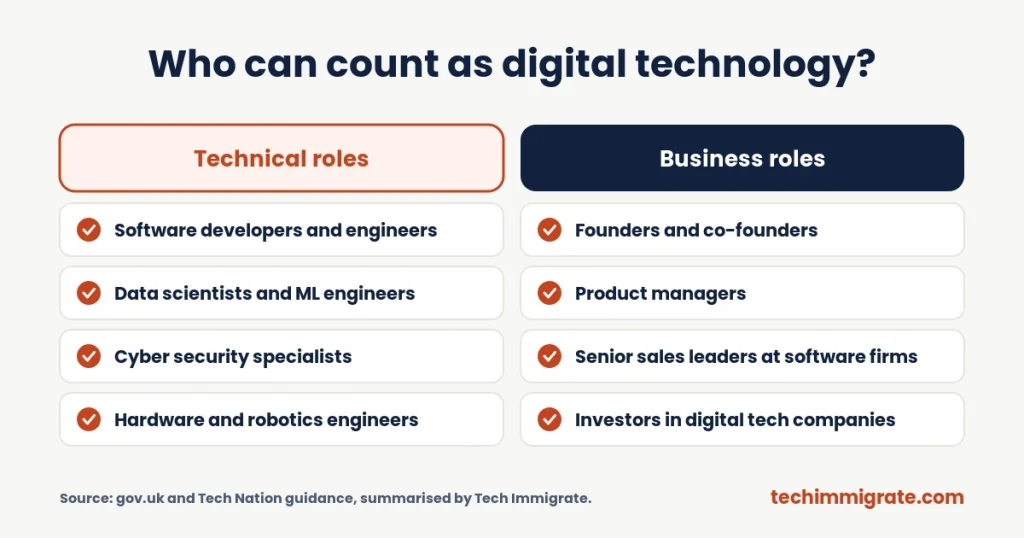
Both technical and business roles can qualify, as long as the work sits inside a product-led digital technology company. Tech Nation and the gov.uk page treat the two groups differently. The evidence you need changes with the group.
Technical applicants
Technical applicants build the technology. Examples that law firms and applicant guides list include:
- Software developers and engineers
- Data scientists and machine learning engineers
- Cyber security specialists
- DevOps and platform engineers
- Hardware and robotics engineers
- Game developers
- Product designers focused on user experience
Tech Nation's guidance notes that technical applicants often show open source work with real engagement on a reputable platform. Public code only helps if others use it.
Business applicants
Business applicants drive the commercial side of a digital technology business. Typical examples include:
- Founders and co-founders
- Product managers and heads of product
- Senior sales and growth leaders at software companies
- Investors who back digital technology companies
- Senior business analysts working on digital products
Tech Nation expects business applicants to show significant technical, commercial or entrepreneurial contributions as a founder or employee of a product-led digital technology company. A senior title alone does not do that. Role guides can help here, such as our guide for product managers.
Illustrative Example (Fictional): Who Clears the First Hurdle?
Three fictional people show how the employer test works in real life. None of them is a real applicant.
Illustrative example (fictional): Amara is a backend engineer at a payments app that sells its own software. She helped launch a fraud-detection feature. She sits clearly inside the product-led test.
Ben is a project manager at a consultancy. He delivers software projects for clients but never owns a product. His employer sells services, so his route looks much harder.
Chloe is a sales director at a cloud security vendor. She grew revenue for the vendor's own platform. She fits the business applicant group, although she still has to prove her impact with outside evidence.
What the example teaches
The job title does not decide the outcome. The product your work supports does.
Applicants in Ben's position often ask whether they can still qualify. Sometimes they can, if they also built products on the side or in an earlier role. That is a question to test with the free check, not to assume.
What Is Not Eligible for the UK Global Talent Visa Digital Tech Route?
Work that does not build or grow a product-led digital technology business is usually not eligible. Tech Nation's guidance says consulting roles often give little chance of industry-wide recognition. It also names IT support and infrastructure management as roles that are not product-led.
Law firms that write about the route add outsourcing, service delivery, ERP implementation and systems administration. Treat that list as a practical guide rather than official wording.
| Work type | Usually a fit? | Why |
|---|---|---|
| Engineer at a software product company | Yes, if the evidence is strong | Builds the product |
| Founder of a tech product startup | Yes, if the evidence is strong | Owns the product |
| Product manager at a platform business | Yes, if the evidence is strong | Shapes the product |
| IT support or helpdesk | Usually no | Not product-led |
| Outsourcing or consulting delivery | Usually no | Sells services, not a product |
| Corporate role in a non-tech firm | Usually no | Product is not digital technology |
Early career and narrow impact
Tech Nation also lists reasons for non-endorsement that are not about the job type. These include early-career profiles with limited impact and work that stays inside one organisation. Vague recommendation letters and claims that nobody can verify also appear.
So eligibility has two layers. Your work must be the right kind, and your evidence must prove it has reach.
The 5 Steps to the UK Global Talent Visa Digital Tech Route
The route has five steps, and each one has its own decision. Here they are at a glance.
| Step | What you do | Main output |
|---|---|---|
| 1 | Check eligibility | A clear view of your role and company |
| 2 | Choose your route | Exceptional Talent or Exceptional Promise |
| 3 | Build your evidence | Up to 10 documents, plus letters and a CV |
| 4 | Get endorsed | Tech Nation endorsement letter |
| 5 | Apply for the visa | Home Office decision |
The gov.uk and Tech Nation pages describe the same flow. We have simply grouped the actions in the order that most applicants find workable.
Step 1: Check Your Eligibility
Step 1 is to test your role, your employer and your evidence before you spend any money. Start with the product-led test above. Then ask whether you have proof of impact from outside your own company.
Write down your role, your employer's product and your biggest achievements in the last five years. Next, note who could confirm each one without working for your employer.
If the list looks thin, you do not need to give up. You may only need time to build visible work. Want the guide for your role? See the guides.
A quick self-check
Read each line and answer yes or no. Three or more nos suggest you need more time to build visible work.
- My employer sells its own digital product or platform.
- I helped build, launch, grow or sell that product.
- Someone outside my company has written about, used or praised my work.
- I can show results from the last five years.
- I can name three experts who know my work well.
What to bring to this step
- Your current CV
- A list of products you worked on
- Names of possible referees
- Links to public work, talks or articles
Step 2: Choose Your Route
Step 2 is to pick between Exceptional Talent and Exceptional Promise. Talent is for established leaders. Promise is for emerging leaders who show strong potential.
Both routes use the same structure. You need the mandatory criterion plus two of four optional criteria. The mandatory criterion is recognition as a leading or emerging talent in digital technology, within the last five years.
The two routes differ in length of stay and settlement. Applicants on Talent can reach settlement after 3 years, and those on Promise after 5 years.
How applicants usually decide
Applicants in this situation often compare their years of impact with the language of each route. Strong senior evidence points toward Talent. Fast-rising careers with fewer years of results often point toward Promise.
Choosing wrongly does not end your chances, but it can weaken your story. Our criteria guide sets out the mandatory and optional criteria in full, so we do not repeat them here.
Step 3: Build Your Evidence
Step 3 is where most of the work happens, because your evidence carries the application. The rules allow up to 10 documents. Each can run to 3 A4 sides, and you need at least 2 documents per criterion.
A single document cannot serve two criteria. Evidence should also fall within the last five years and cannot be shrunk or placed in a collage.
Letters, CV and statement
You also need 3 recommendation letters. They must come from established experts who have known your work for at least 12 months. Letters support your evidence but cannot replace it. Our guide to recommendation letters explains how referees can write useful ones.
Your CV can run to 3 sides. The personal statement is part of the application, so draft it with the same care as the evidence.
What good evidence looks like
Tech Nation's guidance says documents must not be written by AI or built from templates. For recognition, evidence should come from outside your employer. Internal awards do not count. LinkedIn or Medium posts on their own do not count either.
Good evidence is specific. A named customer result, an independent article or a verified usage figure all beat a general claim.
Where Do You Apply From, and Can You Switch Visas?
You can apply from outside the UK, or from inside it if you want to extend or switch from another visa. The main gov.uk page sets out both options. Which one applies depends on where you are when you apply, so check the current wording before you plan.
Inside the UK, the visa decision usually takes longer. Some applicants plan their evidence work around the expiry date of their current permission. Others apply well before it, because endorsement alone can take up to 8 weeks.
What about the prestigious prize route?
Some people skip endorsement by winning a prize on the official list. The prize must be named on that list, and an award from the same institution is not enough. Most digital tech applicants do not take this route, so we focus on endorsement here.
Illustrative Example (Fictional): A Developer Maps Her Evidence
Illustrative example (fictional): Dana is a senior developer at a software company that sells its own product. She wants to map her evidence before she picks documents.
Dana lists what she has. An open source library with strong community use fits the innovation criterion. A conference talk she gave fits the criterion for recognition outside the day job. Her lead role on a product release fits the contribution criterion.
She then checks each item. Does it come from outside her employer? Does it show impact? Is it recent enough? The items that fail go into a "later" pile.
A fictional timeline
Dana spends two months collecting and checking documents. She asks three referees in month three. She submits in month four and waits about 6 weeks for the endorsement outcome. Then she has 3 months to apply for the visa.
That is only an illustration, and real timelines vary. The point is that the endorsement clock and the visa clock are separate, and the second one has a hard limit.
Why this order works
Mapping first stops you from adding weak documents just to reach ten. In practice, ten strong documents beat ten padded ones.
Step 4: Get Endorsed by Tech Nation
Step 4 is to submit your application and evidence for endorsement, which usually takes 5 to 8 weeks. You apply through the official process and pay the endorsement fee. At the time of writing, that fee is £561.
Tech Nation's independent panel then reviews your case. Because the panel decides overall, a complete tick-list is not enough. The panel wants to see leadership and real impact.
If the answer is no
If Tech Nation refuses you, an endorsement review is available. It is free, you must ask within 28 days, and you cannot add new evidence. The other option is a fresh application with a new fee.
Before you refile, read our list of Tech Nation endorsement mistakes. Most weak applications share a few repeat problems.
Step 5: Apply for the Visa
Step 5 is to apply to the Home Office within 3 months of the date on your endorsement letter. The Global Talent appendix to the immigration rules states this deadline. If you miss it, the endorsement cannot support your visa application.
At the time of writing, the visa fee is £205, so the main applicant total before health charges is £766. The Immigration Health Surcharge is £1,035 per year, or £776 per year for under-18s. Dependants pay their own visa fee and surcharge. Check gov.uk for current figures before you budget.
Why the order of the steps matters
Each step feeds the next one. Weak eligibility checks lead to the wrong route, and the wrong route leads to a mismatched evidence set. Then a rushed endorsement leaves little time to plan the visa stage.
For that reason, applicants in this situation often work backwards from the visa date. They pick a target month, then set deadlines for the evidence, the letters and the endorsement submission. This keeps the 3-month window from catching them out.
Decision times
The visa decision usually takes 3 weeks from outside the UK. From inside the UK, it usually takes 8 weeks. There is no points system for this visa, so you do not have to count points.
Common Mistakes on the UK Global Talent Visa Digital Tech Route
The most common mistakes come from weak evidence, not from missing forms. Applicant communities report patterns such as these. This is applicant-reported material, not official guidance.
- Relying on internal awards or company emails as recognition
- Using the same document for two criteria
- Applying with a consulting or service-delivery role and no product story
- Submitting letters that praise you but give no detail
- Leaving the visa application until the 3-month window is nearly gone
What applicants say about the panel
Applicants in community forums often say the panel rewards clear, specific proof over long documents. Treat that as a pattern that applicants report, not as official guidance. Tech Nation has not said it scores documents by length or by number.
How to avoid them
Run a short audit before each step. Ask what the panel would see if it knew nothing about you. If the answer is unclear, add context or swap the document.
UK Global Talent Visa Digital Tech FAQ
People who lead, or are emerging leaders, in product-led digital technology can qualify. Technical roles such as engineers and data scientists fit, as do business roles such as founders and product managers. You still need strong evidence, and the Tech Nation panel decides overall.
No. The gov.uk page says you do not need a job offer. There is also no minimum salary or language requirement. You do need Tech Nation endorsement first, and you must apply for the visa within 3 months of the endorsement letter.
Usually not. Tech Nation's guidance says consulting roles often offer little chance of industry-wide recognition, and it names IT support and infrastructure work as not product-led. Applicants in these roles often need a separate product story to be considered.
It is a business that earns its money from its own digital product, such as software, hardware, a data technology or a platform. Tech Nation does not publish a single formal definition, so applicants should explain clearly how their company's product works.
Endorsement usually takes 5 to 8 weeks. The visa then takes about 3 weeks from outside the UK, or 8 weeks from inside it. Building evidence often takes longer than both, so allow time before you apply.
Your Next Step
You now know who counts as digital technology and how the five steps fit together. Next, test your own profile against them. Want the guide for your role? See the guides.
Then pick the role guide closest to your work. Our role-specific endorsement guides include an evidence checklist and planner. Start at the guides hub, or go straight to the software developers guide, the data and AI specialists guide or the startup founders guide.
How We Checked This Article
We read the gov.uk page for the digital technology route, the main Global Talent page on gov.uk and the Global Talent appendix to the immigration rules, which sets out the 3-month window. We also read Tech Nation's "what to consider" guidance for the role limits and refusal reasons. Law firm and applicant guides helped us build the role examples, and we label them as examples, not official lists.
Tech Immigrate is independent of Tech Nation and the Home Office. This article is general information, not legal advice, and nobody can guarantee an endorsement. Always confirm current rules on gov.uk before you apply.
We write practical guides for tech professionals applying for the UK Global Talent visa. Tech Immigrate is independent of Tech Nation and the Home Office, and our articles are general information, not legal advice. Rules and fees change, so always check gov.uk before you apply.