How to Get a UK Work Permit: A Step-by-Step Guide for Tech Workers
How to get a UK work permit today: which visa route fits, the core requirements, how to apply, what it costs and how to start work with your eVisa.


In this article
- Step 1: Understand What "Work Permit" Means Today
- Step 2: Choose the Right Route
- Step 3: Check the Core Requirements
- Step 4: Apply Online
- Step 5: Get Your eVisa and Start Work
- Why the Term Work Permit Still Causes Confusion
- Thinking About Your Long-Term Goal
- The Skilled Worker Route in More Detail
- The Global Talent Route in More Detail
- The High Potential Individual Route
- The Scale-up Route
- The Global Business Mobility Routes
- The Graduate Route
- The Innovator Founder Route
- Finding a Sponsor
- Preparing Your Documents
- Understanding the Costs
- Proving Your Identity
- Arriving in the UK
- Right to Work Checks
- Staying Compliant After You Start
- Mistakes People Commonly Make
- Planning for Settlement
- Where to Get Reliable Information
- Final Thoughts
- Comparing Sponsored and Unsponsored Routes
- How Employers See Sponsorship
- What Happens if You Lose Your Job
- Bringing Your Family
- Changing Routes Later
- A Short Example
- Questions to Ask Before You Accept a Job Offer
- Keeping Your Plans Flexible
- A Note on Scams
- Your Next Step
- How We Checked This Article
People around the world search for a "UK work permit", but the UK does not issue a document by that name any more. Instead, the right to work comes from your immigration permission, which is now held as an eVisa. For most people coming to work in tech, that permission comes from one of a small number of visa routes: Skilled Worker, Global Talent, High Potential Individual, Scale-up, Global Business Mobility, Graduate or Innovator Founder. Each route has its own rules, costs and path to settlement.
This guide explains how to get permission to work in the UK step by step: how to choose a route, what you need before you apply, how the application works, what happens after you arrive and how to avoid common mistakes. It is written for tech professionals, but the principles apply widely.
Key takeaways
- The UK no longer issues "work permits". Your right to work comes from your visa, held as an eVisa.
- Most tech workers use Skilled Worker, which needs a job offer from a licensed sponsor, or Global Talent, which needs no sponsor but needs endorsement.
- Other routes include High Potential Individual, Scale-up, Global Business Mobility, Graduate and Innovator Founder.
- Costs usually include a visa fee, the Immigration Health Surcharge and, for some routes, an endorsement fee.
- Standard decisions usually take about 3 weeks from outside the UK and about 8 weeks from inside.
- Settlement eligibility depends on the route. Some routes do not count towards settlement at all.
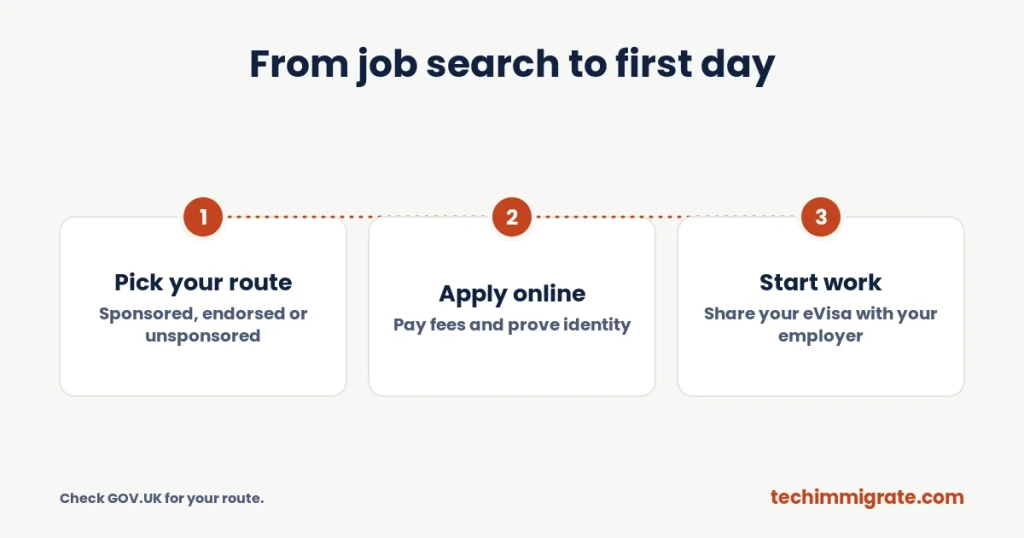
Step 1: Understand What "Work Permit" Means Today
Before 2008, the UK ran a work permit scheme where employers applied for a permit and workers then applied for entry clearance. That system was replaced by the points-based system, and later by the current routes. Today, when people say "work permit", they usually mean a work visa. Your visa conditions say whether you can work, for whom and in what role.
Step 2: Choose the Right Route
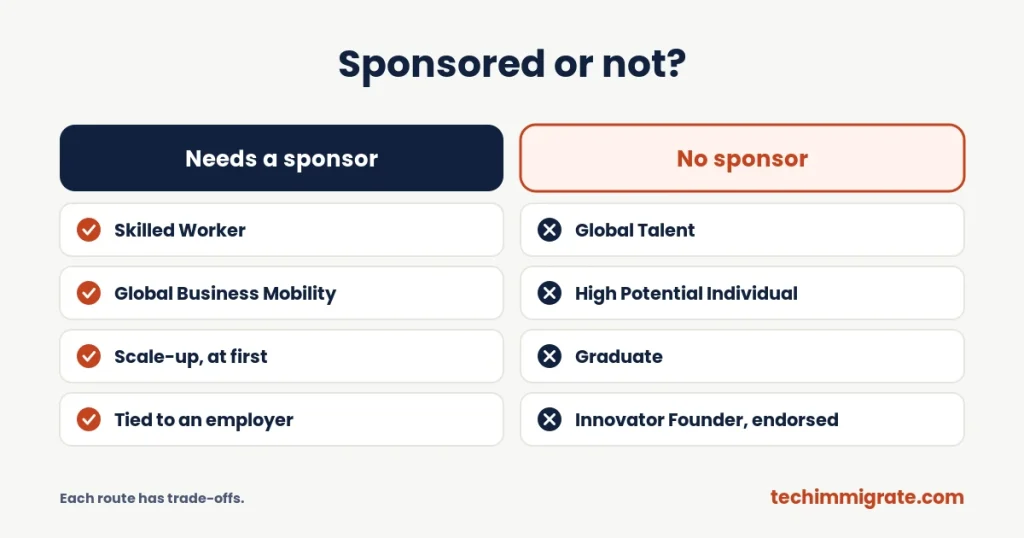
| Route | Needs a job offer? | Needs a sponsor? | Counts to settlement? |
|---|---|---|---|
| Skilled Worker | Yes | Yes | Yes |
| Global Talent | No | No, endorsement instead | Yes |
| High Potential Individual | No | No | No |
| Scale-up | Yes, for the first 6 months | Yes, initially | Yes |
| Global Business Mobility | Yes, intra-company | Yes | No |
| Graduate | No | No | No |
| Innovator Founder | No, own business | Endorsement | Yes |
Step 3: Check the Core Requirements
Most work routes look at some combination of: a job offer from a licensed sponsor, an eligible occupation, a salary threshold, English language, maintenance funds, a valid passport and a tuberculosis test if you are from a listed country. Global Talent instead looks at your record of achievement through an endorsing body such as Tech Nation.
Step 4: Apply Online
Applications are made online on GOV.UK. You pay the visa fee and Immigration Health Surcharge, then prove your identity with the UK Immigration: ID Check app or at a visa application centre.
Step 5: Get Your eVisa and Start Work
Once approved, your permission is recorded as an eVisa in your UKVI account. Your employer checks your right to work using a share code. Follow your visa conditions from day one.
No. The right to work comes from your visa, which is now held digitally as an eVisa.
The Skilled Worker visa, which needs a job offer from a licensed sponsor.
Yes, on routes like Global Talent, High Potential Individual and Graduate, if you qualify.
Usually about 3 weeks from outside the UK and about 8 weeks from inside, on the standard service.
No. Graduate, High Potential Individual and Global Business Mobility do not count towards settlement.
Why the Term Work Permit Still Causes Confusion
The phrase work permit is still common in job adverts, recruitment emails and immigration discussions around the world. Some countries still run permit systems where the employer applies first and the worker follows. That is not how the UK works now. In the UK, a sponsoring employer may need to assign a certificate of sponsorship, but the worker makes the visa application and holds the permission. Understanding this difference matters, because it tells you who does what. Your employer cannot apply for a visa on your behalf, and you cannot apply for a sponsored visa without your employer's input. Both sides have a role, and the timing needs to work for both.
Thinking About Your Long-Term Goal
Before picking a route, ask yourself what you want from your time in the UK. If you want a short period of international experience, a temporary route like the High Potential Individual visa might be enough. If you want to build a career and eventually settle, you need a route that counts towards settlement, such as Skilled Worker or Global Talent. If you want to start a business, Innovator Founder is designed for that. Your long-term goal should shape your first choice, because switching later can be expensive and some time does not count towards settlement.
The Skilled Worker Route in More Detail
Skilled Worker is the main route for people with a job offer in a skilled role. Your employer must hold a sponsor licence and assign you a certificate of sponsorship. The role must be on the list of eligible occupations, and the salary must meet the general threshold and the going rate for the occupation, unless you qualify for a reduction. You must also meet the English requirement. The visa can be granted for up to five years and extended. Time on Skilled Worker usually counts towards settlement, although the rules for settlement are changing under the earned settlement model.
The Global Talent Route in More Detail
Global Talent is designed for leaders and potential leaders in fields including digital technology. Instead of a sponsor, you need an endorsement from an approved body, which for tech is Tech Nation. You apply for endorsement first, then for the visa. Once granted, you can work for any employer, be self-employed or run a business. There is no salary threshold and no need for a job offer. The trade-off is that endorsement is demanding and refusal rates have been high, so preparation matters. Our role-specific guides explain how strong applicants approach it.
The High Potential Individual Route
The High Potential Individual visa is for recent graduates of universities on a list of top global institutions. You do not need a job offer or a sponsor. The visa usually lasts two years, or three for PhD holders, and it cannot be extended. It does not count towards settlement. Many people use it as a stepping stone: they come to the UK, find a role, and switch to Skilled Worker or Global Talent. Check the eligible university list carefully, as it is based on rankings and changes over time.
The Scale-up Route
The Scale-up visa is for people with a job offer from a fast-growing UK business that has been authorised as a scale-up sponsor. You must work for that sponsor for the first six months. After that, you can work for any employer without sponsorship, as long as you meet the income requirements when you extend. The route counts towards settlement. It is less common than Skilled Worker, because fewer businesses qualify as scale-up sponsors, but it offers more flexibility after the first six months.
The Global Business Mobility Routes
Global Business Mobility covers several routes for people moving within a multinational group, setting up a UK branch or delivering a contract. The most common for tech workers is the Senior or Specialist Worker route, used for intra-company transfers. These routes do not count towards settlement on their own. They suit people on fixed-term assignments rather than those planning to settle. If you want to stay longer, you may need to switch to another route later.
The Graduate Route
The Graduate visa is for people who have completed an eligible degree in the UK on a Student visa. It lets you work without a sponsor for a limited period. It cannot be extended and does not count towards settlement. Many graduates use it to find a sponsored role and then switch to Skilled Worker, or to build a record that could support a Global Talent application. The length of the Graduate visa is changing, so check the current rules on GOV.UK.
The Innovator Founder Route
If your plan is to start a business in the UK, the Innovator Founder visa may fit. You need endorsement from an approved endorsing body, which assesses whether your business idea is innovative, viable and scalable. You do not need a job offer, and you can work for your own business. The route counts towards settlement. It is demanding, and the endorsement assessment focuses heavily on your business plan and your ability to deliver it.
Finding a Sponsor
For sponsored routes, finding an employer with a licence is the first hurdle. The Home Office publishes a register of licensed sponsors, which you can search by company name and location. Being on the register does not mean a company will sponsor every role, but it does mean they have the ability. Many large tech companies, consultancies and banks hold licences, as do many smaller startups. When you apply for jobs, ask early whether sponsorship is available for the role.
Preparing Your Documents
Whatever route you choose, prepare your documents early. You will usually need a valid passport, evidence of English or an exemption, a tuberculosis test if you live in a listed country, and any route-specific documents such as a certificate of sponsorship or an endorsement letter. Some documents, such as degree verification or criminal record certificates, can take weeks to arrive. Make a list and work through it before you start the online form.
Understanding the Costs
Costs vary by route but usually include a visa fee and the Immigration Health Surcharge, which is charged for each year of the visa. Some routes also have an endorsement fee. Sponsored routes involve costs for the employer, such as the Immigration Skills Charge and the certificate of sponsorship fee, which the employer must pay. Build a full budget, including travel and settling-in costs, before you apply. Our separate fee guides break down the numbers for each route.
Proving Your Identity
After applying, you usually prove your identity either through the UK Immigration: ID Check app or at a visa application centre. The app works for many biometric passports and lets you complete the process from home. If you need an appointment, book early, especially in busy periods. The decision time usually starts once you have proved your identity and uploaded your documents.
Arriving in the UK
When you arrive, your permission will usually be held as an eVisa linked to your passport. Make sure your UKVI account is set up and your passport details are up to date before you travel. At the border, you may be asked about your job or your plans. Carry key documents such as your certificate of sponsorship reference or endorsement letter in case you are asked.
Right to Work Checks
Your employer must check your right to work before you start. For most visa holders, this is done online using a share code from your UKVI account. The employer enters the code and your date of birth, and the system shows your permission and conditions. Generate a share code specifically for right to work, as share codes are purpose-specific.
Staying Compliant After You Start
Once you are working, follow your visa conditions. On sponsored routes, tell your employer about changes such as a new address or a change in your job. Your employer must report certain changes to the Home Office. On unsponsored routes, you have more freedom but still need to follow the conditions, such as restrictions on working as a sports professional or claiming public funds.
Mistakes People Commonly Make
The most common mistakes are choosing a route that does not match long-term goals, applying without checking a job's eligibility for sponsorship, underestimating costs, and leaving document preparation too late. Another frequent issue is assuming that a job offer automatically means sponsorship. Always confirm with the employer before relying on a role for your visa.
Planning for Settlement
If you want to settle, choose a route that counts towards settlement and keep good records from day one. Keep payslips, tax records and evidence of your time outside the UK. The government is introducing earned settlement, which will change qualifying periods and requirements for many people. Our settlement articles explain what this may mean for you.
Where to Get Reliable Information
GOV.UK is the official source for visa rules, fees and processing times. Immigration rules and guidance change often, so check the date on anything you read. Forums can be helpful for applicant-reported experiences, but they are not authoritative. If your case is complex, consider speaking to a regulated immigration adviser or solicitor.
Final Thoughts
Getting permission to work in the UK is more structured than many people expect. The key is choosing the right route for your situation, preparing thoroughly and understanding what each route allows. With the right preparation, many tech professionals move to the UK each year and build long careers here.
Comparing Sponsored and Unsponsored Routes
The biggest choice most tech workers face is between a sponsored route and an unsponsored one. Sponsored routes like Skilled Worker are often easier to qualify for if you already have a job offer, because the main tests are about the job and the salary rather than your personal record. The downside is dependence on one employer. If you lose your job, you usually have a limited time to find a new sponsor or leave. Unsponsored routes like Global Talent give you far more freedom: you can change jobs, freelance, start a company or take a career break without asking anyone. The price of that freedom is a harder assessment up front. Many people start sponsored and move to an unsponsored route later, once they have built a stronger record in the UK.
How Employers See Sponsorship
From an employer's point of view, sponsoring a worker involves cost, paperwork and ongoing compliance duties. The employer pays the Immigration Skills Charge, the certificate fee and often legal fees. They must keep records, report certain changes and allow Home Office audits. Some employers are happy to do this for the right candidate. Others avoid it unless they cannot fill a role locally. Understanding this helps you approach conversations with employers. If you can show that you already have the right to work, or that sponsorship would be straightforward, you may find more doors open.
What Happens if You Lose Your Job
On a sponsored route, losing your job usually means your sponsor reports the change and the Home Office may shorten your permission. You then need to find a new sponsor and apply again, switch to another route or leave the UK. Applicant-reported experiences suggest the notice you receive can vary, so act quickly if your job ends. On unsponsored routes like Global Talent, losing a job does not affect your visa, which is one of the main reasons people value that route.
Bringing Your Family
Most long-term work routes allow you to bring a partner and dependent children. Each family member makes their own application and pays their own visa fee and Immigration Health Surcharge. Partners on dependant visas can usually work for any employer. Children can attend state schools. Some routes, such as certain temporary routes, have stricter rules on dependants, so check before you plan a family move.
Changing Routes Later
It is common to change routes during your time in the UK. You might arrive as a graduate, switch to Skilled Worker, and later move to Global Talent. Most switches can be made from inside the UK, but some routes do not allow it. Plan ahead, because each switch involves new fees and new requirements, and time on some routes does not count towards settlement. Keeping your long-term goal in mind helps you make sensible choices at each step.
A Short Example
Consider a fictional data engineer with five years of experience abroad. They receive a job offer from a UK fintech that holds a sponsor licence. The employer assigns a certificate of sponsorship, the engineer applies for a Skilled Worker visa from abroad, proves their identity at a visa centre and receives a decision in about three weeks. A few years later, with a stronger record of public contributions and leadership, they apply for Global Talent to gain more flexibility. This path is common and shows how routes can work together over time.
Questions to Ask Before You Accept a Job Offer
Before accepting an offer that depends on a visa, ask a few practical questions. Does the employer hold a sponsor licence, and have they sponsored people before? Which occupation code will they use, and does the salary meet the threshold for that code? Who pays the visa fee, the health surcharge and any priority fee? Will they cover costs for your family? What happens if the visa takes longer than expected? Clear answers protect you from surprises, and a confident, experienced sponsor will usually be happy to explain their process. If an employer seems unsure about sponsorship, treat that as a signal to slow down and check the details carefully before resigning from your current job.
Keeping Your Plans Flexible
Immigration rules in the UK change regularly, with several statements of changes each year. Fees rise, thresholds move and new routes open while others close. The best protection is to keep your plans flexible, keep your documents organised and check GOV.UK before each application. Build a little extra time and money into every step. People who plan with a margin tend to cope far better when the rules shift underneath them.
A Note on Scams
Because the term work permit is so widely searched, it is also widely used by scammers. Be cautious of anyone who offers to sell you a UK work permit, asks you to pay for a job offer or promises guaranteed visas. Genuine sponsors do not charge workers for a certificate of sponsorship, and the Immigration Skills Charge must be paid by the employer. Official applications are made on GOV.UK. If an offer seems too good to be true, check the company on the register of licensed sponsors and confirm the role directly with the employer before paying anything.
Your Next Step
If you have a strong record in tech, the Global Talent visa lets you work in the UK without a sponsor. Our role-specific Global Talent guides explain what Tech Nation looks for.
How We Checked This Article
We checked route rules against GOV.UK's work visa overview, Skilled Worker and Global Talent pages in November 2026.
Tech Immigrate is independent of the Home Office. This article is general information, not legal advice. Check GOV.UK before you apply.
We write practical guides for tech professionals applying for the UK Global Talent visa. Tech Immigrate is independent of Tech Nation and the Home Office, and our articles are general information, not legal advice. Rules and fees change, so always check gov.uk before you apply.