
UK Skilled Worker Visa: Requirements When Applying From Nigeria and Abroad
UK Skilled Worker visa requirements when applying from Nigeria or abroad: sponsor, salary, English, TB test, costs, timeline and scams to avoid.


In this article
- What the Skilled Worker Visa Is
- Requirement 1: A Job Offer From a Licensed Sponsor
- Requirement 2: The Job Must Be at the Right Skill Level
- Requirement 3: Salary
- Requirement 4: English at B2
- Requirement 5: Money to Support Yourself
- Requirement 6: Tuberculosis Test
- Requirement 7: Criminal Record Certificate, for Some Jobs
- What It Costs When Applying From Nigeria
- Costs Your Employer Pays
- How to Apply From Nigeria Step by Step
- A Realistic Timeline
- How to Spot Skilled Worker Visa Scams
- Bringing Your Family
- Settlement and the Earned Settlement Reforms
- Is Global Talent a Better Fit?
- Finding UK Employers That Sponsor
- Document Checklist
- If You Already Work Remotely for a UK Company
- Common Mistakes
- Take the Right Route for Your Career
- How We Checked This Article
The UK Skilled Worker visa is one of the most searched work routes from Nigeria, and for good reason. It offers a legal way to live and work in the UK with a sponsoring employer, bring your family, and, under the current rules, settle after 5 years. But it is also a route surrounded by misinformation, fake job offers and agents charging large fees for things that should cost nothing.
This guide explains the real requirements for the UK Skilled Worker visa when you are applying from Nigeria or elsewhere outside the UK. It covers who qualifies, the salary and skill rules, the English requirement, what it costs in practice, the steps specific to applying from Nigeria such as the tuberculosis test, and how to spot the scams that target applicants. It is written for tech professionals, but the core rules apply to every occupation.
Key takeaways
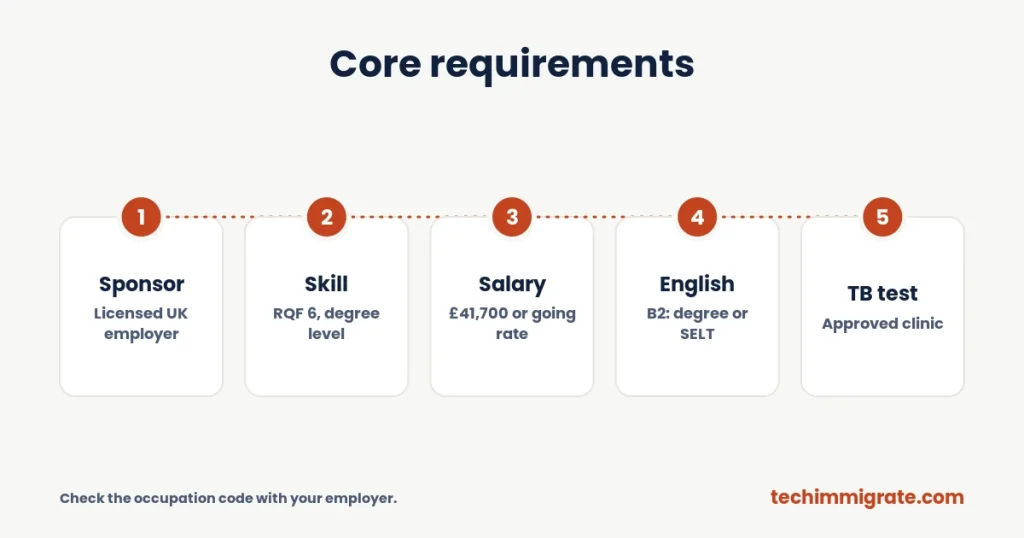
- You need a genuine job offer from a UK employer with a sponsor licence, and a certificate of sponsorship from that employer.
- Most new roles must be at RQF level 6, roughly degree level, and pay at least £41,700 or the going rate for the occupation, whichever is higher. New entrants can qualify at £33,400.
- New applicants need English at B2. Nigeria is not on the list of majority English-speaking countries, so most people use a degree taught in English or an approved test.
- From outside the UK, the visa fee is £819 for up to 3 years or £1,618 for more than 3 years, plus the health surcharge of £1,035 per year.
- Applicants who have lived in Nigeria for 6 months or more need a tuberculosis test certificate from an approved clinic.
- Decisions on applications made outside the UK usually take around 3 weeks.
- Paying anyone for a job offer or certificate of sponsorship is a warning sign. Genuine sponsors cannot charge you for sponsorship.
What the Skilled Worker Visa Is
The Skilled Worker visa lets you come to the UK to do an eligible job for an approved employer. It replaced the old Tier 2 (General) visa in December 2020. The key feature is sponsorship: you cannot apply on your own. A UK employer must offer you a job, hold a sponsor licence from the Home Office, and assign you a certificate of sponsorship.
Once you have the visa, you can:
- work for your sponsor in the job described in your certificate;
- do some additional work in certain circumstances;
- bring your partner and children as dependants, unless your role is in a restricted category;
- study, subject to some conditions;
- travel in and out of the UK;
- apply to settle after meeting the qualifying period.
You cannot change employer without a new application, and you cannot claim most public funds.
Requirement 1: A Job Offer From a Licensed Sponsor
The single most important requirement is a genuine job offer from an employer on the Home Office register of licensed sponsors. The register is published on GOV.UK and lists every organisation that can sponsor Skilled Workers.
The job must be real. The Home Office checks whether the role genuinely exists, whether you have the skills to do it, and whether the employer needs it filled. Roles created to get someone a visa, or offers from organisations with no real business, are refused, and the sponsor can lose its licence.
For tech professionals in Nigeria, common sponsored roles include software developers, data engineers, cyber security specialists, IT business analysts and project managers. UK employers do recruit internationally for these roles, especially in fintech, health tech and consultancy, but competition is strong.
Requirement 2: The Job Must Be at the Right Skill Level
Since 22 July 2025, most new Skilled Worker applications must be for jobs at RQF level 6 or above, which is broadly equivalent to degree level. Each job has an occupation code, and the Home Office publishes which codes are eligible.
Most professional tech roles are already at this level:
| Occupation code | Role | Going rate |
|---|---|---|
| 2134 | Programmers and software development professionals | £54,700 |
| 2133 | IT business analysts, architects and systems designers | £54,900 |
| 2131 | IT project and programme managers | £58,200 |
| 2135 | Cyber security professionals | £48,500 |
Medium-skilled roles, such as many technician and support roles, are no longer eligible for new applicants unless they are on a temporary list. If you are offered a role, ask the employer which occupation code they will use.
Requirement 3: Salary
You must be paid at least the higher of:
- the general salary threshold, which is £41,700 a year; or
- the going rate for your occupation, such as £54,700 for programmers and software developers.
Some applicants can be paid less. New entrants, such as people under 26, recent graduates or those working towards a recognised professional qualification, can qualify with a salary of at least £33,400, or 70% of the going rate. People with a relevant PhD may also qualify at a lower rate.
Salaries are based on guaranteed basic pay for up to 48 hours a week. Bonuses, allowances and overtime usually do not count.
For many applicants in Nigeria, the salary requirement is the biggest filter. A UK employer must be willing to pay a London or UK-level salary from day one, which usually means they see you as a strong, experienced hire.
Requirement 4: English at B2
From 8 January 2026, new Skilled Worker applicants need English at B2 level of the Common European Framework of Reference. You can usually prove this in one of three ways:
- Nationality. If you are a national of a majority English-speaking country on the Home Office list. Nigeria is not on that list, even though English is an official language.
- A degree taught in English. A bachelor's degree or higher, taught in English, with confirmation from Ecctis that it is equivalent to a UK degree and was taught in English. Many Nigerian university degrees meet this standard.
- An approved English test. A Secure English Language Test (SELT) from an approved provider, taken at an approved centre, at B2 level or above in all four skills.
If you use a degree from a Nigerian university, start the Ecctis process early, because it can take several weeks and needs your transcripts and certificate.
Requirement 5: Money to Support Yourself
You must usually show you have at least £1,270 in your bank account, held for 28 days in a row, with day 28 within 31 days of your application. If your partner and children are coming, you need £285 for your partner, £315 for the first child and £200 for each additional child.
You do not need to show these funds if your employer certifies maintenance on your certificate of sponsorship, confirming they will support you for your first month. Many larger tech employers do this, so ask before you start moving money.
If you hold funds in a Nigerian bank account, the balance will be converted to pounds at the exchange rate on the date of your application. Exchange rates move, so keep a buffer above the minimum to avoid falling short. Bank statements must come from a financial institution that the Home Office accepts and must show your name, account number and the balance on each day.
Requirement 6: Tuberculosis Test
If you have lived in Nigeria for 6 months or more and are coming to the UK for more than 6 months, you need a tuberculosis (TB) test certificate from a Home Office-approved clinic. The same rule applies to Ghana, Kenya, Pakistan, India and many other countries on the list.
- Only clinics approved by the Home Office can issue a valid certificate. Approved clinics have operated in cities including Lagos, Abuja and Kano, but check GOV.UK's TB test pages for the current list before booking.
- The certificate is usually valid for 6 months from the date of your chest X-ray, so time it so that it is still valid when you apply.
- Each family member coming with you needs their own certificate. Children have different testing arrangements.
Requirement 7: Criminal Record Certificate, for Some Jobs
Some Skilled Worker roles, especially in health, education and social care, need a criminal record certificate from every country you have lived in for 12 months or more in the last 10 years. Most tech roles do not need one, but check your role's occupation code. In Nigeria, police clearance certificates are issued by the Nigeria Police Force.
What It Costs When Applying From Nigeria
The Home Office fees are the same wherever you apply from outside the UK:
| Item | Cost |
|---|---|
| Visa fee, up to 3 years | £819 |
| Visa fee, more than 3 years | £1,618 |
| Immigration Health Surcharge, per adult per year | £1,035 |
| Immigration Health Surcharge, per child per year | £776 |
On top of these, budget for:
- the TB test, set by the approved clinic;
- an English test or Ecctis statement;
- document translations, if needed;
- optional priority services at the visa application centre;
- flights and initial accommodation in the UK.
For a single applicant on a 3-year visa, Home Office fees and IHS total £3,924. For a family of four, the total is around £14,142. Fees are paid in pounds, so the naira cost depends on the exchange rate, and many banks add charges for international card payments. Our full guide to Skilled Worker visa fees breaks down every cost.
Costs Your Employer Pays
Your sponsor pays a certificate of sponsorship fee of £525 and the Immigration Skills Charge, which is £1,320 per year for large sponsors and £480 per year for small sponsors. These costs are the employer's legal responsibility and cannot be passed on to you. Some employers also pay your visa fee and IHS as a benefit, but they do not have to.
How to Apply From Nigeria Step by Step
- Secure a job offer from a licensed UK sponsor.
- Receive your certificate of sponsorship reference number from the employer.
- Prepare your English evidence, either an Ecctis statement for your degree or a SELT result.
- Book and complete your TB test at an approved clinic.
- Gather your documents, including your passport, bank statements if needed, and any criminal record certificate.
- Apply online on GOV.UK, up to 3 months before your start date.
- Pay the visa fee and IHS.
- Attend the visa application centre to give your fingerprints and photograph, and submit documents.
- Wait for a decision. Applications made outside the UK usually get a decision within about 3 weeks.
- Travel to the UK and access your eVisa through your UKVI account.
A Realistic Timeline
From accepting an offer to arriving in the UK, most applicants should plan for 2 to 3 months:
- Weeks 1 to 2. Accept the offer, agree a start date, and receive the certificate reference.
- Weeks 2 to 6. Complete the TB test, English evidence and document gathering.
- Week 6. Submit the application and attend the visa application centre.
- Weeks 7 to 9. Wait for a decision.
- Weeks 9 to 12. Arrange flights and accommodation, and travel.
If you need an Ecctis statement or English test, start those as soon as you begin job hunting, so they do not delay you once an offer arrives.
How to Spot Skilled Worker Visa Scams
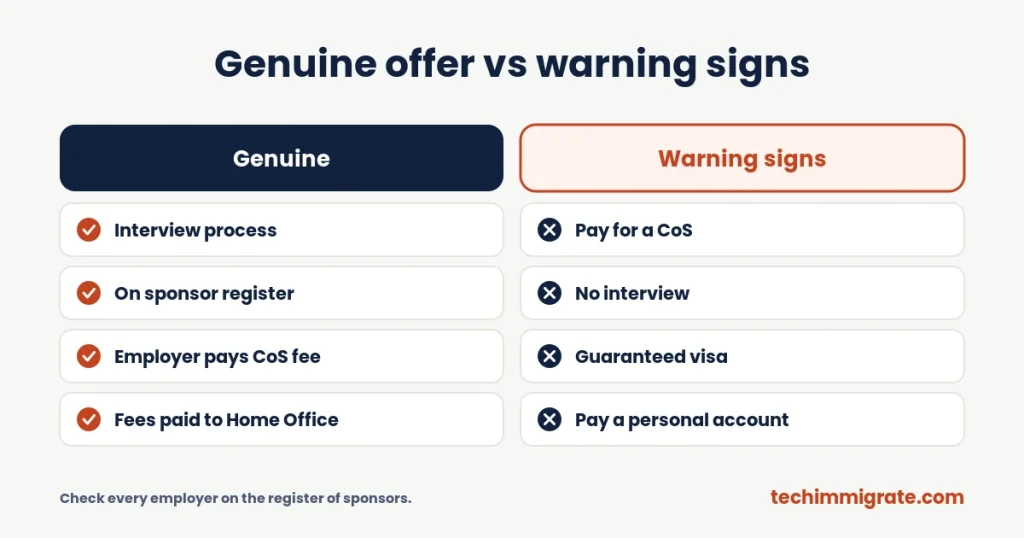
The Skilled Worker route attracts scammers, and applicants in Nigeria are frequently targeted. Common warning signs include:
- Being asked to pay for a certificate of sponsorship. Sponsors pay the certificate fee. Nobody should sell you one.
- Job offers without an interview. Genuine employers interview candidates, even for overseas roles.
- Offers from employers not on the register of licensed sponsors. Check the register on GOV.UK.
- Agents promising guaranteed visas. Only the Home Office decides visa applications.
- Pressure to pay quickly. Scammers often create urgency to stop you checking the offer.
- Requests to pay into personal accounts. Legitimate fees are paid to the Home Office online.
The care sector has seen serious abuse, with people paying large sums for jobs that did not exist or were not as promised. It is also illegal in the UK to give immigration advice without being regulated. If someone offers paid immigration advice, check that they are a regulated adviser or solicitor.
Bringing Your Family
Most Skilled Workers can bring their partner and children under 18. Each family member pays the same visa fee and IHS as the main applicant, and each needs their own TB test certificate if they have lived in Nigeria. Your partner can work for almost any employer in the UK, and your children can attend state schools free of charge.
Care workers and senior care workers cannot bring new dependants. Our guide to the Skilled Worker dependant visa explains the family rules in detail.
Settlement and the Earned Settlement Reforms
Under the current rules, Skilled Workers can apply for indefinite leave to remain after 5 years. The government's response to the earned settlement consultation, published on 2 November 2026, sets out a different framework: a 10-year default, a 5-year path for people earning at least £50,271, a 3-year path for the highest earners, and new requirements such as English at B2 and no debts to public bodies. These changes are expected to be implemented over 2027.
For tech workers on salaries above £50,271, the impact may be limited. For those on lower salaries, the path to settlement could be much longer. Our guide to the new ILR rules for Skilled Worker visa holders explains the changes.
Is Global Talent a Better Fit?
For experienced tech professionals in Nigeria, the Global Talent visa is worth comparing. It needs no job offer, no sponsor and no minimum salary. Instead, you need an endorsement from Tech Nation showing that you are a leader or emerging leader in digital technology. Once endorsed, you can work for any employer, freelance or start a business, and people endorsed under exceptional talent can settle after 3 years under the current rules.
The Global Talent route is harder to qualify for, because the evidence standard is high, but it removes your dependence on a single employer. Read our guide to the Global Talent visa from Nigeria to see how Tech Nation reads evidence from Nigerian companies and communities, and our comparison of Global Talent vs Skilled Worker.
Finding UK Employers That Sponsor
Finding a sponsor is often the hardest part. Practical approaches include:
- Search the register of licensed sponsors for tech companies in your field, then check their careers pages.
- Use job boards that let you filter for visa sponsorship, but verify every employer on the register.
- Target companies with a history of international hiring, such as large fintechs, consultancies and global tech firms with UK offices.
- Build a visible track record. Open-source contributions, a portfolio, technical writing and certifications help you stand out to employers who receive many applications.
- Network with UK-based professionals, especially people who have made the move from Nigeria, through LinkedIn and community groups.
Remote roles with UK companies can also lead to sponsorship later, once an employer knows your work.
Document Checklist
Before you attend the visa application centre, check that you have:
- a valid passport with a blank page, and any previous passports showing UK travel history;
- your certificate of sponsorship reference number, job title, occupation code and salary;
- your English evidence: an Ecctis statement and degree certificate, or your SELT reference number;
- your TB test certificate, valid on the date you apply;
- bank statements covering 28 days, unless your employer certifies maintenance;
- a criminal record certificate, if your role needs one;
- for dependants, marriage and birth certificates, and their own TB certificates.
Keep originals with you on the day, and a digital copy of everything you upload.
If You Already Work Remotely for a UK Company
Many tech professionals in Nigeria already work remotely for UK companies, either as contractors or through employer-of-record platforms. If your employer values your work, ask whether they hold a sponsor licence or would consider getting one. Moving an existing remote team member to the UK can be easier for an employer than hiring a stranger, because they already know your skills. The role must still meet the skill level and salary rules, and the employer must be willing to pay a UK salary once you relocate.
Common Mistakes
- Paying for a job or certificate. This is the most common route into a scam.
- Applying without checking the occupation code and salary. A role below the skill level or salary will be refused.
- Assuming English is covered because Nigeria uses English. You still need evidence, such as an Ecctis statement or a SELT.
- Letting the TB certificate expire. Time the test so it is valid on your application date.
- Moving money in the 28-day period. If your balance drops below the required amount on any day, the funds may not count.
- Forgetting dependants' TB tests and fees. Each family member needs their own.
No. You need a job offer and a certificate of sponsorship from a UK employer with a sponsor licence.
Usually £41,700 or the going rate for your occupation, whichever is higher. New entrants can qualify at £33,400.
It depends on your nationality, not where you apply from. Nigeria is not on the majority English-speaking list, so Nigerian nationals need evidence such as a degree taught in English with Ecctis confirmation, or an approved SELT at B2.
Yes, if you have lived in Nigeria for 6 months or more and are coming for more than 6 months.
£819 for up to 3 years or £1,618 for longer, plus £1,035 per year IHS, plus TB and English test costs.
Usually around 3 weeks after you attend the visa application centre.
Usually yes, unless your role is a care worker or senior care worker role.
Be very careful. Genuine sponsors cannot charge you for sponsorship, and paid immigration advice must come from a regulated adviser.
Take the Right Route for Your Career
The Skilled Worker visa can be a solid route to the UK for tech professionals in Nigeria, as long as you have a genuine offer from a licensed sponsor and the salary meets the rules. If you have built a strong profile in tech and want more freedom, Global Talent may be a better fit. Our role-specific Global Talent guides explain what Tech Nation looks for and how to build an application from Nigeria or anywhere else.
How We Checked This Article
We checked eligibility, salary, English and cost rules against GOV.UK's Skilled Worker visa pages, the TB test guidance and the register of licensed sponsors in November 2026. Going rates are from the Immigration Rules Appendix Skilled Occupations as reported at the time of writing. Settlement reforms are from law firm summaries of the earned settlement response of 2 November 2026.
Tech Immigrate is independent of the Home Office. This article is general information, not legal advice. Check GOV.UK before you apply.
We write practical guides for tech professionals applying for the UK Global Talent visa. Tech Immigrate is independent of Tech Nation and the Home Office, and our articles are general information, not legal advice. Rules and fees change, so always check gov.uk before you apply.


