Global Talent Visa Scoring: There Is No Points System, So Here Are 7 Ways to Strengthen Your Case
Global Talent Visa scoring does not exist. Learn how Tech Nation really assesses cases, and 7 ways to strengthen your evidence. Start with a free check.

In this article
- Why There Is No Global Talent Visa Scoring System
- Where the Global Talent Visa Scoring Myth Comes From
- How Global Talent Visa Scoring Really Works: Criteria and Judgement
- What the Panel Looks at Beyond the Criteria
- 7 Ways to Strengthen Your Case Instead of Chasing Global Talent Visa Scoring
- Illustrative Example (Fictional): Two Applicants, One Job Title
- A Self-Check That Is Not a Score
- Common Myths About Global Talent Visa Scoring
- Do Salary, Degrees and Awards Help Your Case?
- How to Check the Rules Yourself
- Beware of Points Calculators and "Extra Points" Promises
- What Happens at the Visa Stage?
- Common Mistakes When People Look for Points
- What If Your Application Is Refused?
- Global Talent Visa Scoring FAQ
- Your Next Step
- How We Checked This Article
Global Talent Visa scoring does not exist. Tech Nation does not add up points for your evidence, so you cannot collect "extra points." A panel judges your whole case against set criteria, so the quality of your evidence is what counts.
If you came here for a points trick, there is none. But there are real ways to make a case stronger, and this guide shows seven of them.
Key takeaways
- The Global Talent Visa has no points system that scores your evidence. Nobody can sell you extra points.
- Tech Nation's panel decides overall. You need the mandatory criterion plus two of four optional criteria.
- The Skilled Worker visa uses points, which is why the myth spreads.
- A valid endorsement is the whole requirement at the visa stage. Nothing you add changes that.
- Strong cases use independent, specific, recent and well-mapped evidence.
- Nobody can guarantee an endorsement, and good applicants are refused too.
Why There Is No Global Talent Visa Scoring System
There is no score for your Global Talent application, and no total you can raise. Tech Nation's independent panel reads your case and decides overall whether to endorse it.
That is the firm answer. You will see "extra points" in blog titles, in videos and in forum chats. They are a figure of speech. No form, rule or calculator gives you a number out of a maximum for your evidence.
What the panel actually does
The panel checks that you meet the mandatory criterion and two of the four optional criteria. Then it judges the case as a whole. Meeting each criterion is necessary, but it does not guarantee a result.
At the time of writing, the endorsement stage costs GBP 561. A decision usually takes 5 to 8 weeks. Check gov.uk for current details.
The one place the word "points" appears
The Home Office Immigration Rules do use the word. Rule GT 4.1 says an applicant needs 70 points, and an endorsement letter from the endorsing body awards them. You can read the Global Talent rules on gov.uk.
So at the visa stage, a valid endorsement is all or nothing. You do not build up points by adding certificates, salary or awards. It is a label on the paperwork, not a scoring game.
Where the Global Talent Visa Scoring Myth Comes From
The myth comes from other UK visas that really do use points, plus years of loose language online. Both make "how many points do I need?" sound sensible when it is not.
The Skilled Worker visa is the best-known case. Under the wider points-based system, applicants earn points for things such as a sponsored job offer, the skill level of the job, English and salary. A points-based immigration overview from Latitude Law lists these factors.
Three reasons the myth sticks
First, people mix up routes. Someone who researched the Skilled Worker visa expects a points table everywhere. Second, some websites and calculators use points to sell services. Third, some law-firm and university pages say the Global Talent route sits inside the points-based system. That is technically true, but it only means the endorsement counts as the full 70 points.
Why it matters
If you chase points, you may waste money on weak documents. You may also pad your file with items that do not meet the rules. Strong, honest evidence beats a long list of small items.
How Global Talent Visa Scoring Really Works: Criteria and Judgement
Tech Nation assesses criteria, not points. You show one mandatory criterion and two of four optional criteria, and then the panel weighs the whole case.
The mandatory criterion is recognition as a leading or emerging talent in digital technology in the last 5 years. The four optional criteria are:
- Innovation in a product-led company or with a new product or technology.
- Recognition for work outside your day job.
- Significant technical, commercial or entrepreneurial contribution to a product-led digital technology business.
- Academic contribution, such as research published or endorsed by an expert.
Our Global Talent Visa criteria guide explains each one in detail.
The evidence rules
You can send up to 10 documents, each up to 3 A4 sides. You need at least 2 documents per criterion, and one document cannot count for two criteria. Evidence should come from the last 5 years.
You also need three recommendation letters from established experts who have known your work for 12 months or more. Letters support the evidence, but they cannot replace it. Your CV can run to 3 sides, and you add a personal statement.
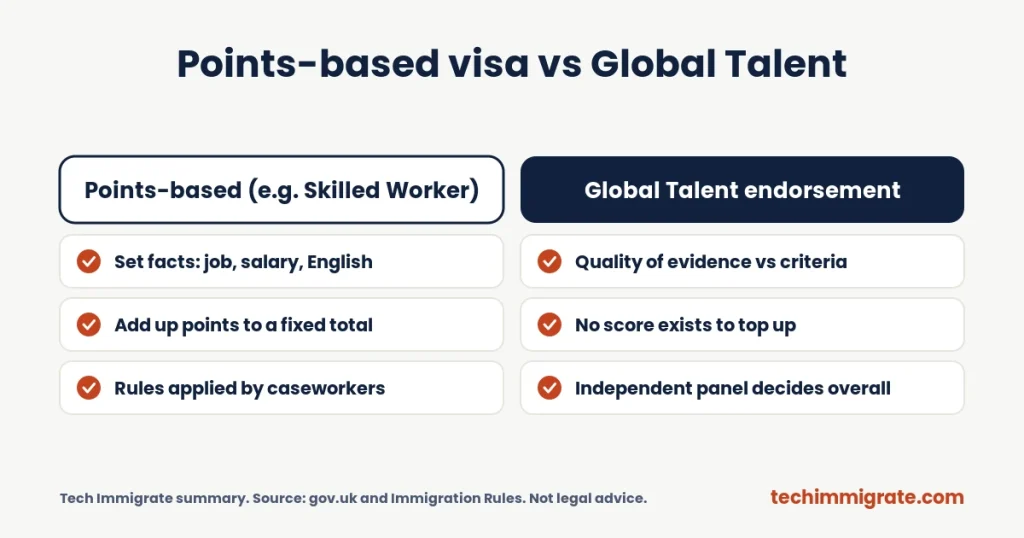
Points system or criteria assessment?
| Point | Points-based visa (for example Skilled Worker) | Global Talent endorsement |
|---|---|---|
| What is checked | Set facts, such as job, salary, English | Quality of your evidence against criteria |
| Result | Add up points to a fixed total | Panel decides overall |
| Can you "top up"? | Yes, by meeting more factors | No score exists to top up |
| Who decides | Rules applied by caseworkers | An independent expert panel |
What the Panel Looks at Beyond the Criteria
Gov.uk says endorsing bodies also look at wider factors beyond the criteria. These include your career history, the strength of your recommendation letters, how you will contribute to UK digital technology and the commercial impact of your work.
So a file is more than a tick list. The panel reads the story that your documents tell together. A neat story with clear proof beats a long list of loose items. You can see the wording on the See the guides.
Judgement means some uncertainty
Because people make the decision, some uncertainty is normal. Some lawyers argue that assessments can feel subjective, and that strong evidence can still be marked down as promotional or internal. That is one lawyer's view, not official guidance, but it explains why careful presentation matters. See Sterling Law's note on subjective Tech Nation assessments.
What this means for you
Accept that you cannot control the outcome. You can control how clear, independent and checkable your evidence is. That is where the next section helps.
In short, replace the question "how do I get more points?" with a better one. Ask which of my documents would a stranger trust, and why? Then fix the weakest ones first.
7 Ways to Strengthen Your Case Instead of Chasing Global Talent Visa Scoring
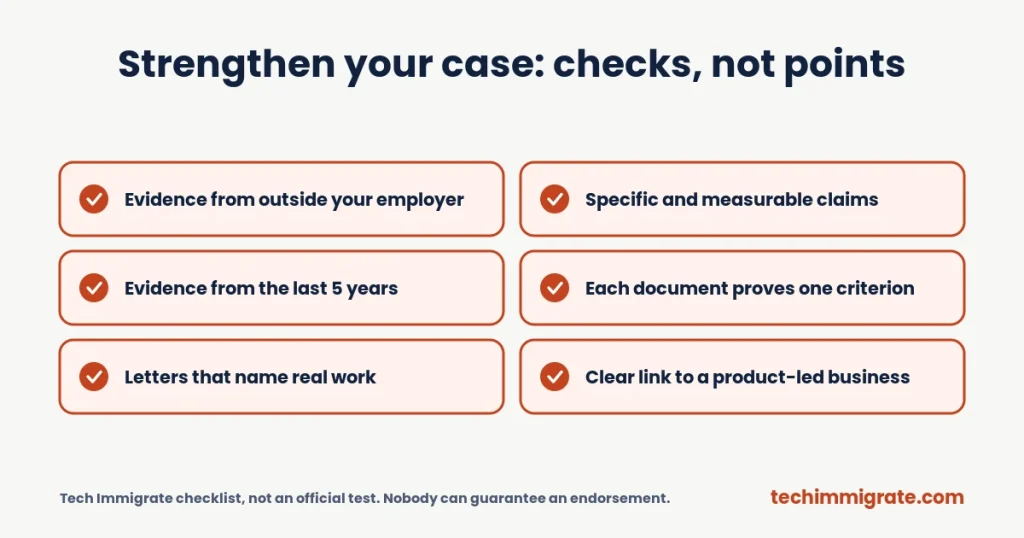
The seven levers below make evidence stronger, but none of them is a formula or a guarantee. Think of them as quality checks, not points to collect.
Way 1: Make your evidence independent
Recognition must come from outside your employer. Tech Nation's rules say internal awards do not count, and a LinkedIn or Medium post on its own does not count either. Ask yourself who said this, and whether they have no stake in your success.
Way 2: Make it specific and measurable
Claims like "led a big project" carry little weight. Claims like "cut checkout failures by a third across two million sessions" give the panel something to check. Use real numbers, dates and names of products, and show where they come from.
Way 3: Keep it recent
All evidence should come from the last 5 years. Older wins may still help your story, but they cannot count as evidence. Check the date on every document before you include it.
Way 4: Match each document to one criterion
Each document should serve one criterion, and no document can be reused. Before you finish, list your documents and write which criterion each proves. If two documents prove the same thing, one of them is wasted.
Way 5: Write letters that name real work
Three letters are required, from experts who have known your work for 12 months or more. The best letters name a project, explain what you did and say why it mattered. Our guide to recommendation letters covers this in more depth.
Way 6: Show the product-led link
The company and the work must sit in a product-led digital technology business. So show the product, the users and your part in it. Public code can help here, if outside users rely on it.
Way 7: Present it cleanly and honestly
Tech Nation's guidance bars AI-written and templated documents, shrunk pages and collages. Write in your own words and keep each document readable within 3 A4 sides. Clean, honest evidence is easier to trust.
Illustrative Example (Fictional): Two Applicants, One Job Title
Illustrative example (fictional): Meera and Sam are both machine learning engineers with five years of experience. They do the same work, but their files look very different.
Sam sends ten documents. Most come from his employer: an internal award, a performance review, a company blog post and a slide deck. Two letters come from managers at the same firm, and both praise him in general terms.
Meera's file
Meera sends fewer, stronger items. One is a conference programme that shows her talk was chosen by a review panel. Another is an outside report on a product she helped build, with user figures. A third is an open-source library with outside users and issue threads.
Her letters come from three experts at different firms. Each names a system and says what she did. She maps each document to one criterion.
What this shows
Meera does not "score higher" in any sense. Her file is simply easier to trust and to check. Even so, nobody can promise how any panel will decide, and this fictional case is not a prediction.
A Self-Check That Is Not a Score
You can test the strength of your file with a checklist. Treat it as a way to find gaps, not as a number. Do not add anything up.
- Does each document come from outside your employer, where recognition is needed?
- Is each one dated within the last 5 years?
- Can a stranger check the facts and numbers in it?
- Is each document used for one criterion only?
- Do you have at least 2 documents for each criterion?
- Do your three letters name specific work and come from experts who know you?
- Is every document within 3 A4 sides, in your own words?
If you answer "no" to any item, fix that item first. A quick check of the criteria can also show where applicants in your situation often start.
Common Myths About Global Talent Visa Scoring
Most myths about scoring come from half-true claims, so it helps to set each one against the facts. Here are the ones that appear most often.
- Myth: more documents mean more points. Fact: you can send up to 10, and quality matters more than count.
- Myth: a high salary adds points. Fact: nothing is scored, and pay is not a criterion by itself.
- Myth: a famous referee adds points. Fact: letters support evidence, and detail matters more than fame.
- Myth: a PhD gives a head start. Fact: academic track record is one wider factor, not a score.
- Myth: you can reach a pass mark. Fact: no pass mark exists, because the panel decides overall.
Why these myths feel true
Each one has a grain of sense. Pay can show seniority, and a PhD can lead to papers. A famous referee may know your work well. But in each case, the value comes from the evidence, not from a number attached to it.
Do Salary, Degrees and Awards Help Your Case?
They can help your story when they meet the evidence rules, but they do not add up to a score. Think of them as supporting facts rather than points.
Salary is a good example. A high salary shows that an employer values you. However, it does not show impact on a product or recognition outside your firm. Advisers often say that pay alone is a weak proof of innovation.
Degrees and awards
A degree can help show your background, and it may sit in your CV. A degree is not a criterion, though. Awards help when an independent body gave them, and when the selection was real.
A prize from your own employer does not count as recognition. A prize from a well-run outside contest can. So ask who ran the contest and how the winners were chosen.
Where they fit best
Use pay, degrees and awards to support one of your criteria, where they truly prove something. Otherwise, leave them in the CV, which has up to 3 sides of space.
How to Check the Rules Yourself
You can check the rules yourself in a few minutes, and you should. Official pages are free, short and more reliable than any summary, including ours.
- Open the gov.uk Global Talent digital technology page and read the eligibility section.
- Read the Tech Nation guidance on the mandatory and optional criteria.
- Note the evidence limits: 10 documents, 3 A4 sides each, at least 2 per criterion.
- Check the current fees and timings on gov.uk.
- Read the Immigration Rules section for Global Talent if you want the legal wording.
When rules change
Tech Nation updates its guidance from time to time. So check the date on any page, and treat older blog posts with care. When two sources disagree, trust gov.uk and Tech Nation first.
Beware of Points Calculators and "Extra Points" Promises
Be careful with any service, tool or video that promises extra points. No official points calculator exists for the endorsement stage, so any number it shows is made up.
Red flags include claims such as "we guarantee 100 points," "a secret scoring sheet" or "a success rate" with no source. Nobody outside the panel can know how it will decide. Tech Immigrate does not claim any insider knowledge of Tech Nation's assessors.
How to judge advice
Ask where the advice comes from. Good guidance points to gov.uk or Tech Nation's own published rules and says clearly when something is an opinion. Weak guidance sounds certain about things that nobody can know.
Ask about fees and refunds
Also read what a service will do if you are refused. Fees for endorsement and visa are paid to the authorities, and they are not refundable by anyone else. Our costs guide lists the fees and the other costs to plan for.
What Happens at the Visa Stage?
After you win an endorsement, the visa stage is mostly a check of your identity and paperwork. You apply to the Home Office within 3 months of the endorsement date.
At the time of writing, the visa fee is GBP 205, so the main applicant pays GBP 766 in fees in total before the health surcharge. The Immigration Health Surcharge is GBP 1,035 per year, or GBP 776 per year for under-18s. Dependants pay their own visa fee and surcharge.
Timings to plan around
Visa decisions usually take 3 weeks from outside the UK and 8 weeks from inside the UK. Because the endorsement letter expires, do not wait too long to apply. Check gov.uk for current fees and timings before you plan.
Common Mistakes When People Look for Points
Most mistakes come from treating the case as a puzzle to game. Applicants report these patterns, though they are not official guidance.
- Padding the file. Ten loose items weaken a case that two strong ones could carry.
- Using internal proof. Awards and posts from your own employer do not count.
- Counting salary as proof. High pay can show seniority, but it does not prove impact on its own.
- Reusing one document. A document can serve only one criterion.
- Generic letters. Praise without detail adds little.
- Old evidence. Items outside the last 5 years do not count.
For a longer list, read our guide to Tech Nation endorsement mistakes.
What If Your Application Is Refused?
If Tech Nation refuses your endorsement, you have two options. You can ask for a free review within 28 days, or you can make a fresh application with a new fee.
The review checks the decision against the evidence you sent, and you cannot add new evidence. A fresh application lets you improve the file, but it costs the endorsement fee again.
Think before you choose
Read the refusal reasons closely. If the problem is a rules error, a review may fit. If the problem is thin evidence, a stronger new file may fit better. Either way, no choice is guaranteed to work.
Global Talent Visa Scoring FAQ
No points system scores your evidence. Tech Nation's panel assesses criteria and decides overall. The Immigration Rules mention 70 points, but a valid endorsement letter awards all of them at the visa stage, so you cannot add or lose points through your evidence.
The Immigration Rules require 70 points, and a valid endorsement letter provides them in full. In practice, you do not count points. You focus on getting the endorsement, which needs the mandatory criterion plus two of four optional criteria.
Tech Nation's independent panel decides overall. You must meet the mandatory criterion and two optional criteria, with evidence that follows the rules. The panel also looks at wider factors such as career history, letters and commercial impact. Meeting the criteria does not guarantee an endorsement.
No, because nothing is scored. A high salary or an award can support your story if it meets the evidence rules. Internal awards from your employer do not count for recognition, so independent proof matters more than the size of the prize.
No. Nobody can guarantee an endorsement, and good applicants are refused too. Strong, independent, specific and recent evidence gives your case the best chance of being understood. If you are refused, you can ask for a free review within 28 days.
Your Next Step
Want the guide for your role? See the guides. Look for gaps in independence, dates and detail.
Next, choose the guide that fits your role. Tech Immigrate's role-specific endorsement guides include an evidence checklist and planner. Begin with the guides hub, or go to the software developers guide, the data and AI specialists guide or the product managers guide.
How We Checked This Article
We read the Global Talent digital technology, eligibility and apply pages on gov.uk. We also read the Global Talent section of the Immigration Rules on gov.uk, including the 70-point rule. Law-firm and adviser pages, such as Latitude Law and Sterling Law, informed the points comparison and the views on subjectivity. Tech Nation's own site did not open for us, and adviser or applicant views are labelled as views.
Rules change over time. Tech Immigrate is independent of Tech Nation and the Home Office. This article is general information, not legal advice, and nobody can guarantee an endorsement. Always confirm current rules on gov.uk before you apply.
We write practical guides for tech professionals applying for the UK Global Talent visa. Tech Immigrate is independent of Tech Nation and the Home Office, and our articles are general information, not legal advice. Rules and fees change, so always check gov.uk before you apply.