Next Steps After Global Talent Visa Endorsement: 8-Step Checklist to the Visa and Beyond
Next steps after Global Talent Visa endorsement: an 8-step checklist covering the 3-month deadline, fees, biometrics, dependants and settlement. Plan yours.

In this article
- Next Steps After Global Talent Visa Endorsement: The 8-Step Overview
- Step 1: Read Your Endorsement Letter and Note the Deadline
- Step 2: Choose Where You Apply From
- Step 3: Gather Your Visa Documents
- Step 4: Apply Online and Pay the Fees
- Step 5: Prove Your Identity and Attend Biometrics
- Step 6: Wait for the Decision
- Step 7: Travel, Prove Your Status and Start Work
- Step 8: Next Steps After Global Talent Visa Approval for Family, Records and Settlement
- Next Steps After Global Talent Visa: Timeline From Letter to Settlement
- What Changes If the Visa Is Refused?
- Budget Your Money for the Visa Stage
- A 12-Week Calendar to Stay on Track
- Mistakes to Avoid After Endorsement
- Next Steps After Global Talent Visa FAQ
- Your Next Step
- How We Checked This Article
Next steps after Global Talent Visa endorsement start with one deadline: you must apply for the visa within three months of the date on your endorsement letter. After that, you pay, prove your identity, wait for a decision and plan your arrival.
This checklist is for people who have just been endorsed, or who are close. It follows the official gov.uk steps in order and shows where applicants often slip.
Key takeaways
- Your visa application must reach the Home Office no more than 3 months after the date on your endorsement letter.
- The next steps after Global Talent Visa endorsement are: read the letter, choose where you apply, gather documents, pay, prove identity, wait, travel and plan settlement.
- Gov.uk says decisions usually take 3 weeks from outside the UK and 8 weeks from inside the UK.
- Dependants apply separately and pay their own visa fee and health surcharge.
- Keep records from day one, because settlement and extensions can ask for proof.
Next Steps After Global Talent Visa Endorsement: The 8-Step Overview
The next steps after Global Talent Visa endorsement follow a clear order, and each step has a gov.uk page behind it. Use the table as a map, then read each step below.
| Step | Action | Key point |
|---|---|---|
| 1 | Read your endorsement letter | Note the date and your route |
| 2 | Choose where you apply | Outside or inside the UK |
| 3 | Gather documents | Passport, translations, test if needed |
| 4 | Apply and pay | Visa fee plus health surcharge |
| 5 | Prove your identity | App or visa application centre |
| 6 | Wait for the decision | About 3 or 8 weeks |
| 7 | Travel and start work | Follow the decision letter |
| 8 | Plan family, records and settlement | Keep proof from day one |
Endorsement is not a visa. It is the first of two stages, and the Home Office still decides the second. Gov.uk calls the second stage the visa application.
Why order matters
Each step feeds the next one. For example, the date on your letter sets your deadline. Your location sets your application route and your wait time. A small slip early on can cost weeks later.
Step 1: Read Your Endorsement Letter and Note the Deadline
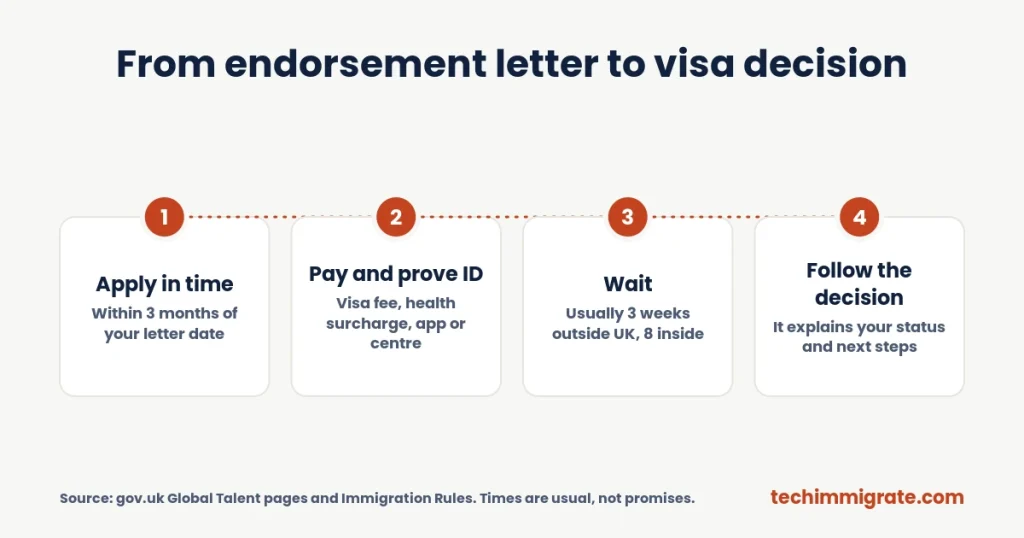
Your endorsement letter is the key document, and its date starts a three-month clock. The Immigration Rules say an application must be made no more than 3 months after the date on the letter.
Open the letter today and write down three things: the date, the route named (Exceptional Talent or Exceptional Promise) and your reference. Then put your deadline in your calendar with a reminder at six weeks.
Why the route matters later
The route on your letter affects settlement. The rules give 3 years for Exceptional Talent and 5 years for Exceptional Promise in digital technology. Our guide to Exceptional Talent vs Exceptional Promise explains the difference.
Illustrative example (fictional)
Amara, a fictional data engineer, receives her endorsement letter on 3 March. She marks 3 June as her last day to apply. She plans to submit by mid-May, so she has a buffer if a document is missing.
Step 2: Choose Where You Apply From
Where you are when you apply decides your route, your wait and your travel limits. You have two main choices: apply from outside the UK, or switch from inside the UK.
If you are outside the UK, you can apply from any country where you have permission to live for at least 6 months. Gov.uk says you will usually get a decision within 3 weeks.
Applying from inside the UK
If you are already in the UK on another visa, you may be able to switch. Gov.uk says you must apply within 3 months of getting the endorsement. Some visas, such as visit visas and short-term student visas, do not allow switching.
A Student visa holder must meet extra rules. For example, your sponsored course must be finished, or you must have studied a PhD full-time for at least 24 months. Check the gov.uk page on switching to this visa for your case, and speak to a regulated adviser if your visa history is complex.
Travel limits while you wait
If you apply from inside the UK, gov.uk says you must not travel outside the UK, Ireland, the Channel Islands or the Isle of Man until you get a decision. Plan trips around that rule.
Step 3: Gather Your Visa Documents
The visa stage asks for fewer documents than the endorsement stage, but missing one can still stall your case. Gov.uk lists a short set for most people.
- A valid passport or other document that shows your identity and nationality
- Tuberculosis test results, if you come from a country that requires them
- A certified translation of any document not in English or Welsh
- Written permission from your funder, if you had a UK study award in the past year
Always check the live list for your situation on the gov.uk documents page. Rules can differ for each person.
A simple pre-application checklist
Before you open the online form, check these items:
- Your passport is valid and has space or a recent photo page
- Your endorsement letter is saved as a file
- Any translations are certified
- You know your planned travel and start dates
- Your payment method works for UK fees
Step 4: Apply Online and Pay the Fees
You apply online, and you pay the visa fee and the Immigration Health Surcharge (IHS) as part of the application. Gov.uk lets you save your progress and return to the form.
At the time of writing, the visa fee for a main applicant on the endorsement route is £205. The endorsement fee you already paid was £561, which makes £766 across both stages. The IHS is usually £1,035 per year, or £776 per year for under-18s.
How the health surcharge works
The IHS pays for NHS access. Gov.uk says you can start using the NHS free of charge from the date your visa starts. The amount depends on how long your visa lasts, because you pay per year of permission.
For a five-year grant, a main applicant would pay five times the yearly rate. Our page on Global Talent Visa benefits and costs walks through the full cost picture.
Choosing your visa length
The rules let you request up to five years on each application. Think about your plans before you choose, because a shorter grant means an earlier extension and extra fees.
If you get less time than you asked for, gov.uk says you can get a partial IHS refund. Check the gov.uk refund rules for the detail.
Step 5: Prove Your Identity and Attend Biometrics
After you submit, you prove who you are. Gov.uk gives two ways: use the "UK Immigration: ID Check" app to scan your identity document, or give your fingerprints and photo at a visa application centre.
Biometrics are free. If you go to a centre, you may be able to collect your passport on the day of the appointment, according to gov.uk. Book early, since slots can fill up in busy places.
What can go wrong
Common problems include a damaged passport chip, a blurry scan or a missed appointment. Take your time with the app, and follow the prompts exactly. If the app fails, the application centre is the backup.
Keep proof of everything
Save your payment receipt, your application number and your appointment confirmation. These small records help if you need to ask for an update or fix an error.
Step 6: Wait for the Decision
Gov.uk says you will usually get a decision within 3 weeks if you are outside the UK, and within 8 weeks if you are inside the UK. You may be able to pay for a faster decision, but those services change, so check gov.uk.
Decisions come by email or letter, and the message explains what to do next. These times are guides, not promises.
What to do while you wait
Stay calm and avoid risky moves. Do not buy non-refundable flights until you have a decision. Keep your phone and email open, because the Home Office may ask for more information.
Illustrative example (fictional)
Jonas, a fictional software developer, applies from abroad and attends his biometrics in week one. He waits three weeks, then receives an email with his decision. Because he waited to book flights, he did not lose money on a change.
Step 7: Travel, Prove Your Status and Start Work
After a positive decision, you follow the instructions in the decision message. Gov.uk says the message explains what you will get to prove your immigration status and what you need to do next.
Many people now prove status online. Gov.uk explains that an eVisa is an online record you view through a UK Visas and Immigration (UKVI) account. You can also get a share code to prove your status when you work, rent or travel.
Can you start work straight away?
The Global Talent visa lets you work in the UK without a sponsoring employer, and gov.uk lists work as a permitted activity. Check the start date in your decision, because your permission begins on the date it states, not on the day you apply.
The visa has a condition of no access to public funds. That means most benefits are not available to you.
Your first weeks in the UK
Set up your UKVI account early. Save a share code for your employer or landlord when needed. Register with a GP, because your health surcharge covers NHS access.
Step 8: Next Steps After Global Talent Visa Approval for Family, Records and Settlement
The last step looks ahead: your family, your records and your path to settlement. Do not leave these until year three.
Dependants
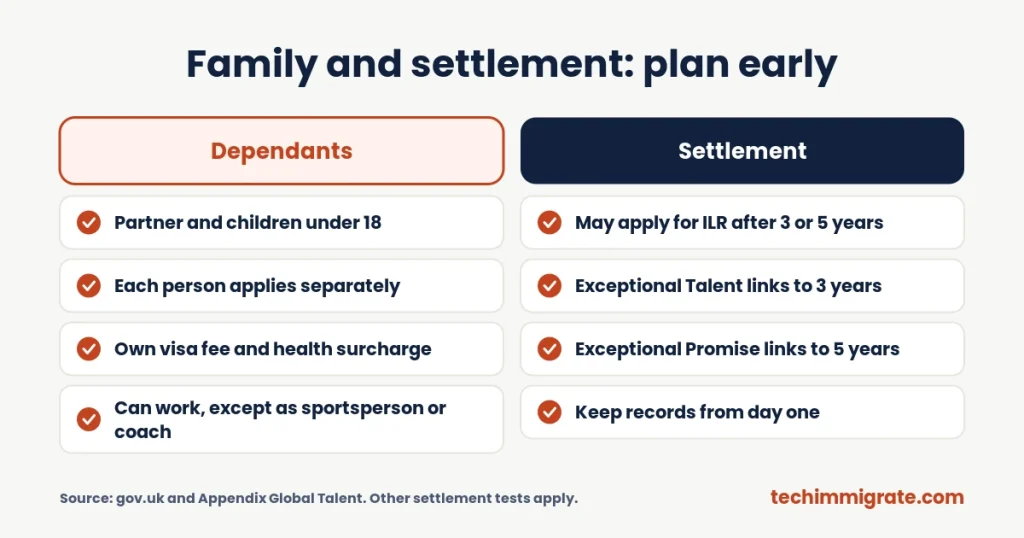
Gov.uk says dependants include your husband, wife, civil partner or unmarried partner, and your child under 18. Each person applies separately, as a partner or as a child, and each pays their own visa fee and health surcharge.
Dependants can work, except as a sportsperson or coach, and they can study. They cannot claim most benefits. Read the gov.uk page on partners and children before you book anything.
Settlement after 3 or 5 years
Gov.uk says you may be able to apply for indefinite leave to remain after 3 or 5 years, depending on your field. In digital technology, the rules link this to your route: 3 years for Exceptional Talent and 5 years for Exceptional Promise.
Settlement also has other tests, such as continuous residence, English language and the Life in the UK test. The Immigration Rules in Appendix Global Talent list them. They can change, so check the current version nearer the time.
Records to keep from day one
Keep records now, so you are not hunting for papers later:
- Dates of every trip outside the UK
- Payslips, contracts or invoices that show earnings in your field
- Evidence of your address history
- Copies of every visa decision and payment receipt
- Your endorsement letter and evidence pack
Gov.uk says an extension asks you to show earned income in your expert field during your stay, with proof such as payslips. You can read the extension rules on the extend your visa page.
Next Steps After Global Talent Visa: Timeline From Letter to Settlement
A simple timeline shows how the pieces fit. Dates are examples only, and your own dates depend on your letter and your decision.
| Stage | Typical timing | Source of timing |
|---|---|---|
| Apply for the visa | Within 3 months of the letter | Immigration Rules |
| Decision from outside the UK | Usually 3 weeks | Gov.uk |
| Decision from inside the UK | Usually 8 weeks | Gov.uk |
| Visa grant | Up to 5 years each time | Immigration Rules |
| Settlement (Talent) | After 3 years | Immigration Rules |
| Settlement (Promise) | After 5 years | Immigration Rules |
Treat this as a planning aid. Always confirm the live rules on gov.uk before you act.
What Changes If the Visa Is Refused?
If your visa application is refused, your options depend on where you applied and why. Your refusal letter explains the reasons and the routes open to you.
The health surcharge
Gov.uk says you get a full IHS refund if your visa application is refused. Refunds usually arrive within 6 weeks of the decision, and reviews or appeals can extend that time.
Administrative review
If you applied from outside the UK, you may be able to ask for an administrative review. Gov.uk says you must apply within 28 days of the decision, and the fee is £80. The review can take 12 months or more.
A review checks whether the refusal was correct. It does not let you add a new case. If you send another application, gov.uk says your review request is withdrawn. Read the administrative review page for details.
Applying again
You might apply again. Remember that the rules require an application within 3 months of the endorsement letter, so a delay may mean you need a new endorsement. A regulated adviser can help you decide, because the right step depends on your facts.
Budget Your Money for the Visa Stage
Plan your costs before you press submit, because the health surcharge is the largest part. Add up the visa fee, the surcharge and any extras such as translations, test fees and travel.
Illustrative example (fictional): Lena, a fictional product manager, requests a five-year visa. Her visa fee is £205, and five years of surcharge at £1,035 comes to £5,175. Together that is £5,380 at the time of writing, plus any translation or travel costs. Her endorsement fee of £561 was already paid.
Costs to put in your plan
- The visa fee for each person applying
- The health surcharge for each person, for each year of permission
- Certified translations of documents not in English or Welsh
- A tuberculosis test, if your country needs one
- Flights, which are best booked after the decision
Dependants pay their own visa fee and surcharge, so add those lines for each person. Leave a buffer, because a small extra cost can add up. Fees change, so confirm the current amounts on gov.uk before you pay.
A 12-Week Calendar to Stay on Track
A simple calendar keeps you ahead of the three-month limit. Think of the weeks after your letter as three blocks of about four weeks each.
| Weeks | Focus | Tasks |
|---|---|---|
| 1 to 2 | Read and plan | Note the deadline, choose your route, list documents |
| 3 to 4 | Prepare | Order translations, book any test, save files |
| 5 to 6 | Apply | Submit online, pay, start identity checks |
| 7 to 10 | Wait | Track emails, avoid risky travel, prepare to move |
| 11 to 12 | Spare time | Fix problems before the three months end |
The last two weeks are a safety margin, not a plan. If you aim to apply in week 6, you give yourself time to fix a problem. Applying on the last day leaves no room for error.
Mistakes to Avoid After Endorsement
Most problems at this stage come from timing and small errors, not from the rules themselves. Avoid these common slips.
- Waiting past the 3-month deadline
- Booking non-refundable flights before a decision
- Travelling while an in-UK application is pending
- Forgetting to save the endorsement letter and receipts
- Letting dependants apply without their own documents
- Skipping record keeping until settlement time
Each one is easy to prevent with a calendar and a folder. Our checklist works best when you start it the day you read your letter.
When to ask a regulated adviser
Most people can follow these steps alone, because the forms are online and the rules are public. However, a regulated adviser or solicitor is the right choice if you have a past refusal, a complex visa history or a tight deadline. Only qualified people may give immigration advice in the UK, so check the register before you pay anyone. This article is general information and cannot replace advice on your own case.
Next Steps After Global Talent Visa FAQ
The Immigration Rules say you must apply no more than 3 months after the date on your endorsement letter. Gov.uk repeats this for people switching inside the UK. Put the date in your calendar when you receive the letter, and aim to apply well before the final week.
Gov.uk says you will usually get a decision within 3 weeks if you apply from outside the UK and within 8 weeks if you apply from inside the UK. These are usual times, not promises. You may be able to pay for a faster decision.
Yes, your partner and children under 18 can apply as dependants. Each person applies separately and pays their own visa fee and health surcharge. Dependants can work, except as a sportsperson or coach, and they can study. Check the gov.uk page for the full definition.
Gov.uk says you may be able to apply for indefinite leave to remain after 3 or 5 years, depending on your field. In digital technology, Exceptional Talent links to 3 years and Exceptional Promise to 5 years. Other tests apply, so confirm the current rules.
Your refusal letter explains your options. If you applied from outside the UK, you may be able to ask for an administrative review within 28 days, for a fee of £80. You get a full health surcharge refund if the visa is refused.
Your Next Step
You now have a clear picture of the next steps after Global Talent Visa endorsement. If you are still before the endorsement stage, read the criteria guide.
For help building your evidence in the first place, explore the guides hub. It lists role-specific endorsement guides with an evidence checklist and planner. Product people can start with the product managers guide. Designers can use the UX and product designers guide. Tech sales professionals can read the tech sales guide.
How We Checked This Article
We checked the deadline, decision times, identity steps, documents, dependants, extension rules, refund rules and administrative review against the relevant gov.uk Global Talent pages and the gov.uk pages on the health surcharge and visa reviews. We checked the three-month rule and the 3 and 5 year settlement periods against Appendix Global Talent of the Immigration Rules.
Some details, such as exact start dates and arrival documents, were not spelled out on the pages we read, so we point you to your decision message. Fees and timings change, which is why we say "at the time of writing".
Tech Immigrate is independent of Tech Nation and the Home Office. This article is general information, not legal advice, and nobody can guarantee an endorsement. Always confirm current rules on gov.uk before you apply.
We write practical guides for tech professionals applying for the UK Global Talent visa. Tech Immigrate is independent of Tech Nation and the Home Office, and our articles are general information, not legal advice. Rules and fees change, so always check gov.uk before you apply.