Emerging Leader Tech Nation: 7 Ways to Qualify Before You Feel Ready
Emerging leader Tech Nation explained: what promise means, what evidence early-career applicants use, and 7 ways to build it. Check your starting point.

In this article
- What Emerging Leader Tech Nation Means
- Who Counts as an Emerging Leader Tech Nation Accepts?
- What "Promise" Means to the Panel
- Emerging Leader Tech Nation Criteria and Evidence Rules
- 7 Ways to Qualify as an Emerging Leader Tech Nation Recognises
- How to Build Recognition in 6 to 12 Months, Legitimately
- Illustrative Example (Fictional): A Backend Engineer's Year
- Which Optional Criteria Suit Early-Career Applicants?
- What the Mandatory Criterion Asks of Early-Career Applicants
- How Different Roles Can Show Promise
- Emerging Leader Tech Nation vs Exceptional Talent
- Settlement Is 5 Years on the Emerging Leader Route
- Do You Need to Feel Ready? An Honest Answer
- Common Mistakes Emerging Leaders Make
- A Short Checklist Before You Apply
- Your First 30 Days: A Simple Starting Plan
- Emerging Leader Tech Nation FAQ
- Your Next Step
- How We Checked This Article
Emerging leader Tech Nation is the plain name for the Exceptional Promise route of the Global Talent Visa. It is for people early in a digital technology career who show real potential to lead. You do not need to be famous, but you do need proof.
This guide is for early-career engineers, product people, data specialists and founders. It shows what the panel looks for and how to build recognition honestly. It makes no promise of a result, because nobody can give one.
Key takeaways
- Exceptional Promise is the emerging leader route. Exceptional Talent is for established leaders.
- Both routes need one mandatory criterion plus two of four optional criteria.
- Promise means evidence of growth and early impact, not a long career.
- Recognition must come from outside your employer. Internal awards and your own posts do not count.
- Settlement after the promise route normally takes 5 years, against 3 for the talent route.
- Building legitimate evidence can take months, so plan early and keep records.
What Emerging Leader Tech Nation Means
An emerging leader is someone with strong early signs of leadership in digital technology. Tech Nation calls this route Exceptional Promise.
The official gov.uk page for digital technology says you must be a leader or a potential leader. Potential leaders are people who show promise but have not yet built a long record. Advisers sometimes call them "emerging leaders," which is how many applicants search for the route.
How the two stages work
First, you get an endorsement from Tech Nation. Then you apply to the Home Office for the visa. The panel decides overall whether to endorse, so ticking each box does not guarantee a result.
At the time of writing, the endorsement fee is GBP 561 and the visa fee is GBP 205. Check gov.uk for current prices, because fees change.
Who Counts as an Emerging Leader Tech Nation Accepts?
The route is aimed at people early in their careers, and the gov.uk guidance says this usually means under five years of experience in the field. Career stage matters more than age.
Advisers add more detail. Some say you should have graduated in the last five years. Others say that a clear career change can reset the clock. These are adviser views, not official rules, so read the current guidance before you decide.
Roles that often fit
Applicants in these situations often look at the promise route:
- Software engineers with two to four years of strong work.
- Data and AI specialists who moved from research into industry.
- Junior product managers who shipped a real product.
- Founders at an early stage with a live product.
- Security analysts who now find and report real flaws.
Roles that do not fit
Tech Nation's endorsement covers product-led digital technology work. Consulting and outsourcing roles, corporate roles and junior investor roles are generally excluded. Check the See the guides on which roles are covered.
What "Promise" Means to the Panel
Promise means a believable path to leadership, shown by work you have already done. It does not mean a good plan or a big idea.
Think of it as three questions the panel may ask, since it reads the whole case. Has this person done real work in a product-led company? Do outsiders recognise that work? Do experts who know the person back them in detail?
Why proof beats potential
Because potential is hard to measure, the panel looks at what you have already done and what other people say about it. That is why the evidence rules matter more than your job title.
Tech Nation's own rules say that evidence for recognition must come from outside your employer. Internal awards do not count. Blog posts and LinkedIn posts do not count on their own.
Emerging Leader Tech Nation Criteria and Evidence Rules
You need the mandatory criterion plus two of four optional criteria. The mandatory criterion asks for recognition as a leading or emerging talent in digital technology in the last 5 years.
The four optional criteria are:
- Innovation in a product-led company or with a new product or technology.
- Recognition for work outside your day job.
- Significant technical, commercial or entrepreneurial contribution to a product-led business.
- Academic contribution, such as research that is published or endorsed by an expert.
Our Global Talent Visa criteria guide explains each one in more depth.
The evidence pack
In total, your evidence pack holds up to 10 documents, each up to 3 A4 sides. You need at least 2 documents for each criterion. One document cannot serve two criteria, and all evidence should come from the last 5 years.
You also need three recommendation letters from established experts who have known your work for 12 months or more. Letters support the evidence. They cannot replace it. You add a CV of up to 3 sides and a personal statement.
Rules that trip up early-career applicants
Tech Nation says that documents must not be written by AI or built from templates. It also bars shrunk pages and collages. These rules are easy to break when you are nervous and short of evidence.
7 Ways to Qualify as an Emerging Leader Tech Nation Recognises
The seven ways below are ideas for building real evidence, not a formula. Pick the ones that fit your work, and drop the rest.
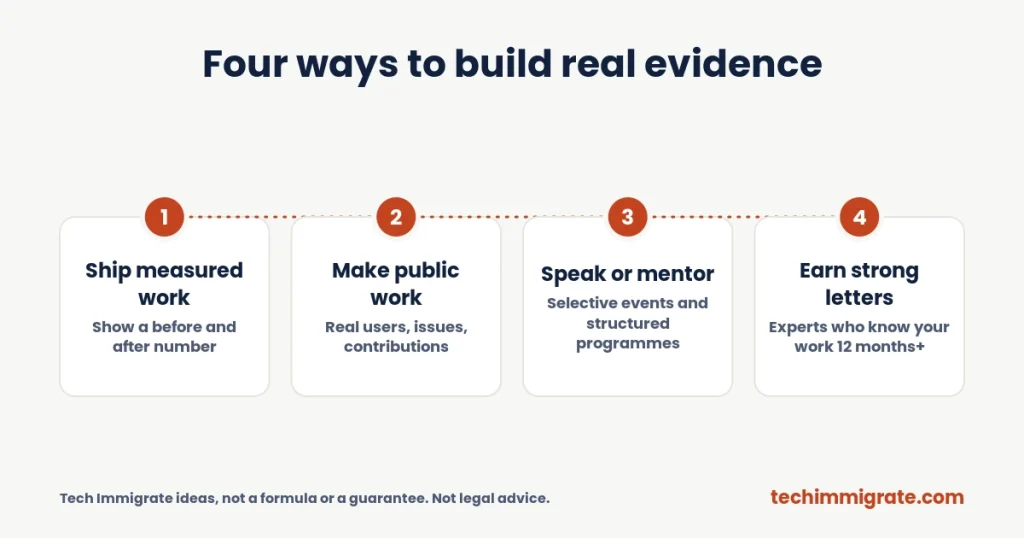
Way 1: Ship work with a clear, measured result
Start with your day job. Pick one project where your work changed a number: speed, cost, revenue, uptime or users. Write down the before and after.
Because the company must be product-led, keep the product front and centre. Also keep proof that is checkable, such as a dashboard export or a product page. Your employer's help is fine for facts, but the recognition itself must come from outside.
Way 2: Make public work that strangers use
Open-source code, a tool, a dataset or a guide can show real use, if people use it. External users are the proof. Stars alone say little, but real users, issues and contributions say a lot, since they show who relies on the work.
Applicants usually show it with usage data, issue threads and a short note on their own part.
Way 3: Speak, teach or mentor through selective programmes
Talks at events that select speakers count for more than open meetups, because selection is a form of review. Mentoring counts when it sits in a structured programme, but it does not count as a casual chat. Keep the call for speakers, the acceptance, and the event page.
Way 4: Win or place in competitions run by others
A hackathon or challenge run by an outside body can be strong evidence. The win should rest on judging by independent people. Keep the rules page, the judges' list and your result, so the panel can check them.
Way 5: Earn outside coverage
Independent coverage of your work can help. Think of a trade site, a conference blog or a university news page that wrote about you or your product, rather than a post you wrote. A post you wrote yourself does not count.
Way 6: Build a research or expert link
If you have a thesis, a paper or a reviewed conference talk, it may fit the academic criterion. A supervisor or expert can endorse research that is not yet published. Reviewed research is the usual evidence here, and a supervisor's letter can add weight.
Way 7: Earn strong letters from people who saw your work
Choose experts who know your work in detail and have known it for 12 months or more. Ask each one to name a project, say what you did and say why it mattered. Our guide to recommendation letters explains how to ask.
How to Build Recognition in 6 to 12 Months, Legitimately
Six to twelve months is enough to build some evidence, but it is not enough to promise a result. Treat this timeline as a rough guide only.
| Months | Focus | Example output |
|---|---|---|
| 1 to 2 | Audit what you have | A list of work, results and proof |
| 2 to 4 | Fix the gaps | A talk submission, a public release, a letter request |
| 4 to 8 | Build outside proof | A selected talk, coverage, a competition entry |
| 8 to 12 | Draft the file | Evidence pack, letters, personal statement |
Do it for real, or not at all
Do not buy awards, trade favours for coverage or invent a mentoring scheme. Because the panel checks that recognition is genuine, a weak or fake item can damage a good file. The honest route is slower, but it is the only route that lasts.
Keep records as you go
Save emails, links, screenshots and dates as soon as things happen. It is far easier to gather proof in the moment than two years later.
Illustrative Example (Fictional): A Backend Engineer's Year
Illustrative example (fictional): Arjun is a backend engineer with three years of experience at a payments product company. He wants to know where he stands.
He starts with an audit. One project stands out, because his team cut payment failures after he rebuilt a retry service. A small open-source library of his also has a few outside users. Public speaking is new to him, though.
His plan
Arjun picks the contribution criterion and the recognition criterion. For contribution, he writes a clear note on the retry project, with dashboard data. For recognition, he submits a talk to a conference that selects its speakers.
He also asks two senior engineers and a former manager at another firm for letters. Each letter will name a specific system, so the panel sees real detail. Arjun keeps all his records in one folder.
What he does not do
Arjun skips his company's internal award. Likewise, he does not write a long blog about himself and call it coverage. Most of all, he does not promise himself a result. This case is fictional and only shows the thinking.
Which Optional Criteria Suit Early-Career Applicants?
Early-career applicants often lean on contribution and recognition, because those two build fastest from daily work. Academic and innovation evidence can fit too, but each needs the right background.
The table below is a general guide. It is not advice for your case.
| Your situation | Criteria that often fit | Why |
|---|---|---|
| Strong results at a product company | Technical or commercial contribution | Your daily work is the proof |
| Selective talks, open-source use | Recognition outside your job | Outsiders have noticed your work |
| Early-stage founder with a live product | Innovation | A new product shows the idea |
| Thesis or reviewed paper | Academic contribution | Review or an expert backs the research |
Why two strong criteria beat four weak ones
You only need two optional criteria. So spend your effort on the two where you can show the most proof. Each one needs at least 2 documents, and a thin third criterion adds risk without much gain.
What the Mandatory Criterion Asks of Early-Career Applicants
The mandatory criterion asks you to show recognition as an emerging talent in digital technology, based on the last 5 years. In plain words, someone outside your own team must have noticed your work.
This is where many early-career files feel thin. Your optional criteria prove specific things. The mandatory criterion ties them together into one story: this person is already well regarded, and the trend is upward.
How to build that story
Pick one clear theme, such as payments reliability, open data tools or product growth. Then show how your evidence points the same way. A tight story is easier to read than a scattered one.
Your personal statement helps here, because it links each claim to its evidence.
How Different Roles Can Show Promise
Each role leaves a different trail of proof, so look for the trail your job already leaves. These are examples of what applicants often use, not rules.
Engineers and data specialists
Engineers often use shipped systems, open-source use and selective talks. Data specialists may add reviewed research or public datasets. In both cases, numbers help: users, latency, cost saved or error rates cut.
Product managers and founders
Product managers can show launches, adoption and revenue effects, with outside proof such as press or partner statements. Founders can show a live product, paying users and outside backing. Both should avoid claims that nobody outside the company can check, because the panel cannot credit them.
Emerging Leader Tech Nation vs Exceptional Talent
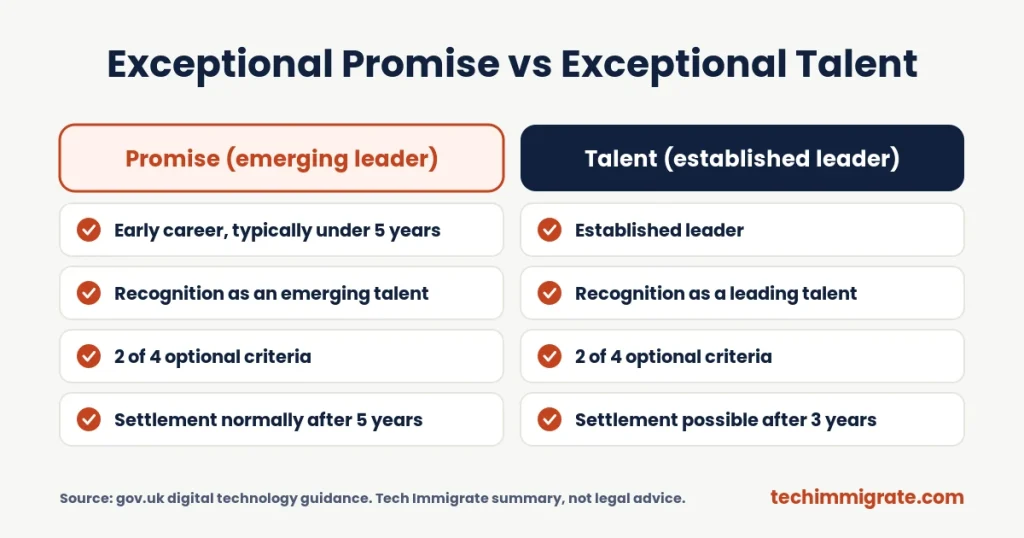
The two routes use the same criteria list, but they differ in the career stage they expect and in the settlement time. The talent route suits established leaders and the promise route suits emerging ones.
| Point | Exceptional Promise | Exceptional Talent |
|---|---|---|
| Career stage | Early career, typically under 5 years | Established leader |
| Mandatory criterion | Recognition as an emerging talent | Recognition as a leading talent |
| Optional criteria | 2 of 4 | 2 of 4 |
| Settlement | Normally after 5 years | Possible after 3 years |
Read our full comparison of Exceptional Talent vs Exceptional Promise for more.
Can Tech Nation move you to the other route?
Some advisers say Tech Nation can assess you under a different route than the one you chose. That is an adviser report, and the panel's choice depends on your evidence. So pick the route that honestly matches your stage.
Settlement Is 5 Years on the Emerging Leader Route
People who get a Global Talent visa through the promise route normally need 5 years before they can apply for settlement. Those on the talent route may qualify after 3 years, according to the gov.uk guidance.
The visa itself can be granted for up to 5 years. You choose the length when you apply. Settlement has its own rules on residence, earnings and tests, so read the current Home Office guidance before you plan.
What that means for planning
Five years is a long horizon. So think about whether your plans fit the route, and then keep your records tidy for later steps.
Do You Need to Feel Ready? An Honest Answer
You do not need to feel ready, but you do need evidence that stands up. Feeling ready and having proof are not the same thing.
Many early-career people feel they have done too little, yet that feeling is often wrong. Often they have done more than they think, but they have not written it down. So an audit of your work is the cheapest first step.
What nobody can promise
Nobody can promise an endorsement. Tech Nation's panel decides on the full case, and refusals happen to good applicants. If you are refused, a free review is possible within 28 days, with no new evidence allowed. Otherwise you can make a fresh application with a new fee.
Common Mistakes Emerging Leaders Make
Most early-career files fail by showing activity instead of recognition. Applicants report these patterns, though they are not official guidance.
- Using internal awards. Recognition must come from outside your employer.
- Counting your own posts. LinkedIn and Medium posts alone do not count.
- Weak letters. Generic praise from a famous name adds little.
- Reusing one document. Each document serves one criterion.
- Choosing the wrong company type. The work must sit in a product-led business.
- Padding the file. Ten strong documents beat ten loose ones.
For more, read our guide to Tech Nation endorsement mistakes.
A Short Checklist Before You Apply
Use this list to test your file honestly. It is general information, not advice for your case.
- Confirm that your role is in a product-led digital technology company.
- Check that your evidence comes from the last 5 years.
- List two documents for each of your two optional criteria.
- Make sure outside parties, not your employer, gave the recognition.
- Line up three experts who have known your work for 12 months or more.
- Write the personal statement in your own words.
- Keep every page within 3 A4 sides.
Your First 30 Days: A Simple Starting Plan
If you feel stuck, start small. In the first 30 days, you only need to learn where you stand, so no big move is needed yet.
First, write down every project from the last five years, with one line on the result. Then mark each item that an outside person has seen, used or praised. Finally, circle the two criteria where you have the most marked items.
What the audit tells you
If you circled two criteria with solid proof, you may be closer than you thought. If you circled nothing, that is useful too. Then you know where to put the next six months, and you can avoid wasting money on a weak application.
Also check your timing. Evidence should come from the last 5 years, so very old wins may no longer help. When in doubt, ask whether a stranger could verify the item today.
Emerging Leader Tech Nation FAQ
An emerging leader is a person with early signs of leadership in digital technology. Tech Nation's route for them is called Exceptional Promise. It suits people early in their careers, usually with under five years of experience, who can show real work and outside recognition.
Gov.uk says the promise route is for people early in their careers, typically with under five years of experience. There is no fixed minimum. Advisers add other detail, such as graduation dates, but those are views, so check the current guidance.
Not necessarily. Both routes use the same mandatory criterion and two of four optional criteria. The difference is the career stage the panel expects. Early-career applicants still need real, checkable evidence from outside their employer.
Settlement normally takes 5 years on the Exceptional Promise route, against 3 years on Exceptional Talent. Settlement also depends on other Home Office rules, so confirm the current requirements on gov.uk before you plan around it.
Sometimes people build some evidence in that time, but nobody can promise it will be enough. Recognition from outside your employer takes real work. Start with an audit, keep records, and judge honestly whether your file is ready.
Your Next Step
Want the guide for your role? See the guides. Then audit your last five years of work against the four criteria.
Next, pick the role guide that matches your work. Tech Immigrate's role-specific endorsement guides include an evidence checklist and planner. Begin with the guides hub, or go to the software developers guide, the product managers guide or the startup founders guide.
How We Checked This Article
We read the Global Talent digital technology, eligibility and apply pages on gov.uk. We also read adviser summaries from Lewis Silkin and other law firms. Tech Nation's own current site did not open for us. Statements on adviser views are labelled as such, and applicant patterns are reports, not official guidance.
Rules change over time. Tech Immigrate is independent of Tech Nation and the Home Office. This article is general information, not legal advice, and nobody can guarantee an endorsement. Always confirm current rules on gov.uk before you apply.
We write practical guides for tech professionals applying for the UK Global Talent visa. Tech Immigrate is independent of Tech Nation and the Home Office, and our articles are general information, not legal advice. Rules and fees change, so always check gov.uk before you apply.