Global Talent Visa Processing Timeline: 3–9 Months, Stage by Stage
Global Talent Visa processing timeline explained: preparation, endorsement, visa decision and arrival, with a stage table. Plan your dates with confidence.

In this article
- How Long Does the Global Talent Visa Processing Timeline Take in Total?
- Global Talent Visa Processing Timeline: Stage-by-Stage Table
- Stage 1: How Long Does Preparation Take?
- Stage 2: How Long Does the Tech Nation Endorsement Decision Take?
- Stage 3: The Visa Application and the Three-Month Window
- Stage 4: Biometrics and Identity Checks
- Stage 5: Visa Decision and Arrival
- What Delays the Global Talent Visa Processing Timeline?
- A Fictional End-to-End Timeline
- How to Plan Around Your Job and Notice Period
- How Do Dependants Change the Timeline?
- How to Build Your Own Timeline Backwards
- What to Do While You Wait
- How Do You Know If You Are Ready to Start the Clock?
- Global Talent Visa Processing Timeline FAQ
- Your Next Step
- How We Checked This Article
The Global Talent Visa processing timeline usually runs about 3 to 9 months from first evidence to arrival. Gov.uk says an endorsement decision usually takes 5 to 8 weeks, and a visa decision usually takes 3 weeks from outside the UK or 8 weeks from inside it.
Most of the variation comes from your own preparation, not from the queue. This guide is for tech professionals who need to line up notice periods, leases and family plans around real dates.
Key takeaways
- Expect roughly 12 to 28 weeks of active stages, plus time for any delays and travel.
- Preparation is the most flexible stage. Applicants often need 4 to 12 weeks to gather evidence and letters.
- Tech Nation usually decides in 5 to 8 weeks. The Home Office then usually decides in 3 weeks (outside the UK) or 8 weeks (inside the UK).
- Your endorsement does not extend your current stay. Only a granted visa does.
- Build a buffer, and do not resign or sign a lease until the visa is in your hands.
How Long Does the Global Talent Visa Processing Timeline Take in Total?
The full Global Talent Visa processing timeline is the sum of four stages: preparation, endorsement, visa decision and arrival. In practice, the active stages add up to about 12 to 28 weeks, and a buffer takes it towards nine months.
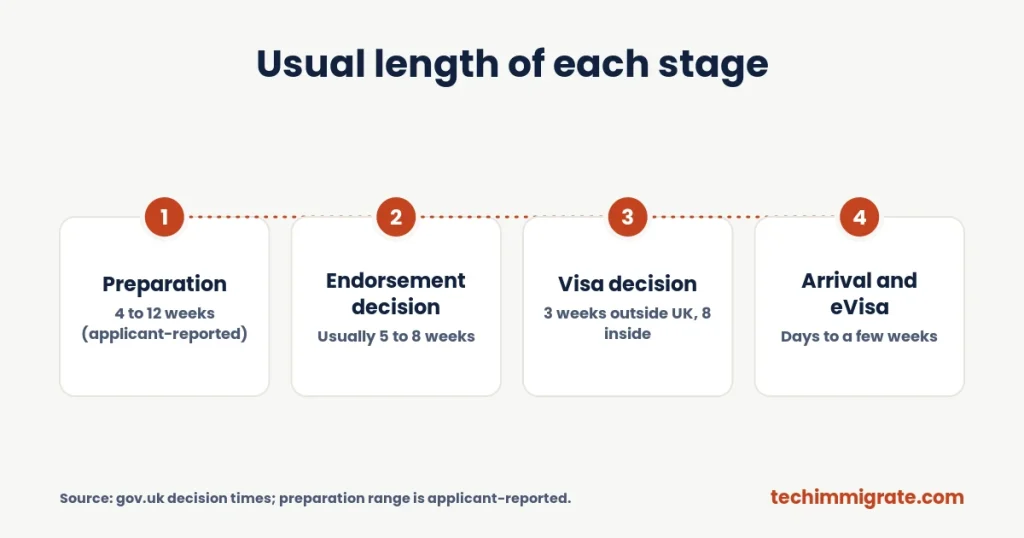
Here is where those numbers come from. Preparation is 4 to 12 weeks, based on what applicants typically report. Endorsement is 5 to 8 weeks and the visa decision is 3 or 8 weeks, both from gov.uk. The low end is 4 + 5 + 3 = 12 weeks. The high end is 12 + 8 + 8 = 28 weeks.
Those are service standards, not promises. Gov.uk says "usually", and individual cases can take longer. For that reason, a sensible plan adds a buffer of a few weeks on top.
The headline numbers at a glance
Think of the route as two official clocks with your own preparation in front of them. The first clock is the Tech Nation endorsement. The second is the Home Office visa decision.
You control the length of the preparation stage. You do not control the two clocks, but you can avoid the mistakes that make them run longer.
Global Talent Visa Processing Timeline: Stage-by-Stage Table
This table shows each stage, its usual length and what you do during it. Use it as a planning sheet, and confirm the official figures on gov.uk before you commit to dates.
| Stage | Usual length | What happens | Who controls it |
|---|---|---|---|
| 1. Preparation | 4 to 12 weeks (applicant-reported) | You choose criteria, gather evidence, get letters, write the statement | You |
| 2. Endorsement application | Same day to submit | You apply online and pay the fee | You |
| 3. Endorsement decision | 5 to 8 weeks | Tech Nation's panel reviews the file | Tech Nation |
| 4. Visa application | 1 to 3 days to complete | You apply within 3 months and pay fees and the health surcharge | You |
| 5. Identity check and biometrics | Often within days or weeks of applying | You prove identity and give fingerprints and a photo, as the application directs | You and the Home Office |
| 6. Visa decision | 3 weeks outside the UK, 8 weeks inside | The Home Office checks the endorsement and your background | Home Office |
| 7. Arrival and eVisa | Days to a few weeks | You travel and set up your digital immigration status | You |
Reading the table correctly
The "usual length" column mixes official and unofficial figures. Endorsement and visa decision times come from gov.uk, while preparation is a typical range, not a rule.
Also note that stages 4 and 5 overlap. You often book the identity step while the application is still open, so they rarely add much time on their own.
Stage 1: How Long Does Preparation Take?
Preparation usually takes 4 to 12 weeks, and it is the stage where applicants gain or lose the most time. The range is wide because evidence quality matters more than speed.
Four jobs fill this stage:
- Map your work to one mandatory criterion and two optional criteria. Our criteria guide explains how.
- Collect evidence from the last five years, with at least two documents per criterion.
- Ask three recommenders to write letters. They need to have known your work for 12 months or more.
- Draft the personal statement and CV.
Why letters set the pace
Recommenders are busy people, so letters often take longer than any other task. Give each one a clear brief, a draft outline of your evidence and a polite deadline.
Tech Nation's guidance does not allow AI-written or templated documents. As a result, each letter needs the recommender's own voice, and that takes time. If you want help choosing recommenders, read our recommendation letters guide.
Illustrative example (fictional)
A fictional backend developer, working full time, spends week one listing her projects. In weeks two and three she pulls evidence from outside her employer, such as conference talks and open-source work. She asks recommenders in week three and receives the last letter in week seven.
She then spends two weeks on her statement and CV and one week on a final review. Her preparation takes about ten weeks, which sits inside the typical range. Another applicant with a ready portfolio could finish in four weeks. Neither speed says anything about the outcome.
Stage 2: How Long Does the Tech Nation Endorsement Decision Take?
Gov.uk says you will usually get an endorsement decision within 5 to 8 weeks. Tech Nation reviews your application for the Home Office, and its panel decides overall whether to endorse.
Meeting each criterion is necessary, but it is not enough on its own. The panel judges the whole picture, so a quick decision is not a good sign, and a slow one is not a bad sign.
What happens while you wait
Nothing is asked of you in most cases, so the main task is patience. If Tech Nation needs something, it will contact you, and you should reply promptly.
Do not send extra evidence unprompted. The application is a closed file, and adding material can confuse the record.
When should you treat a decision as late?
Count from the day you submit a complete application. If you pass 8 weeks, check your email and spam folder first. Then check the contact route on gov.uk.
Applicants sometimes assume a late decision means trouble. In reality, queues, holidays and complex files can all add days, and no one outside the process can tell you why.
Stage 3: The Visa Application and the Three-Month Window
You must apply for the visa within three months of your endorsement. Gov.uk also says the earliest you can apply is three months before you travel, so plan the dates together.
Most people apply within days of endorsement. That keeps things simple and leaves a wide margin before the endorsement window closes.
What you need ready
Have your passport, your endorsement reference and your payment method to hand. You also need the details of any dependants who apply with you. Our benefits and costs page covers fees, so this article stays on timing.
At the time of writing, the endorsement fee is GBP 561 and the visa fee is GBP 205. The Immigration Health Surcharge is usually GBP 1,035 per year. Check gov.uk for current figures before you pay.
Applying at the same time as endorsement
Gov.uk says you can submit both applications together. However, the visa application can be refused if the endorsement is refused, so many applicants prefer to wait. Applicants in this situation often weigh a short saving in time against a larger fee risk.
Stage 4: Biometrics and Identity Checks
Biometrics and identity checks usually add days, not weeks, but they depend on how you apply and where you live. The visa application tells you exactly how to prove your identity.
Some applicants use a phone app for the identity check. Others book an appointment at a visa application centre. Applicants report that appointment slots can be scarce in some cities, so book as soon as the application allows.
Why this stage causes surprises
The decision clock often does not start in a way people expect. A decision time of 3 weeks usually counts from a complete application, including the identity step.
For example, a fictional applicant submits on Monday but cannot find a slot for 10 days. The decision time then starts later than she assumed. She planned her resignation date around Monday, and that plan was wrong by more than a week.
Stage 5: Visa Decision and Arrival
The Home Office usually decides within 3 weeks from outside the UK and within 8 weeks from inside the UK. Gov.uk also lists faster decisions for an extra fee.
A faster service shortens the wait. It does not change how the case is assessed, and not every route or place offers it. Check the current price and rules on gov.uk, because they change.
Inside the UK or outside?
The 8-week standard applies when you switch from another UK visa. The 3-week standard applies when you apply from abroad.
If you are in the UK on a current visa, do not let it run out while you wait. Gov.uk says an endorsement application does not extend your stay. Only a successful visa application does, so work backwards from your expiry date. Our mistakes guide lists other timing traps.
eVisa instead of a card
Gov.uk says biometric residence permits have been replaced by eVisas, a digital record of your status. As a result, you may not wait for a physical card at all. Instead, you create a UK Visas and Immigration account and view your status online.
Keep your login details safe and check that your name and dates are correct. Employers and landlords will ask you to share your status through that account.
What Delays the Global Talent Visa Processing Timeline?
Most delays come from five causes: weak or missing evidence, slow letters, incomplete forms, booking trouble and busy periods. Many of them are within your control.
Here is a checklist to run through before you submit:
- Evidence gaps. Fewer than two documents on a criterion, or evidence that the panel cannot verify.
- Late letters. One recommender goes quiet and you have to find a replacement.
- Form errors. Names that do not match the passport, wrong dates or missing travel history.
- Appointment trouble. No slot for the identity step near you.
- Busy periods. Holiday seasons and high demand can stretch decisions.
What a refusal does to your plan
A refusal resets the endorsement stage. Gov.uk allows an endorsement review, which is free, and you must request it within 28 days. You cannot add new evidence to a review. Otherwise a fresh application means a new fee and a new wait.
For that reason, applicants often spend an extra week in preparation to avoid several weeks of rework.
A Fictional End-to-End Timeline
This worked example shows how the stages can fit together for one applicant. It is a fictional case, so your dates will differ.
Illustrative example (fictional)
A fictional data engineer lives outside the UK and has a three-month notice period.
| Week | What happens |
|---|---|
| 1 to 8 | Gathers evidence, asks recommenders, drafts statement |
| 9 | Submits the endorsement application |
| 10 to 16 | Waits. Endorsement arrives in week 16 (a 7-week wait) |
| 17 | Applies for the visa and books the identity step |
| 18 to 20 | Visa decision arrives in week 20 (about 3 weeks) |
| 21 to 24 | Serves the last of his notice, books flights, sorts housing |
| 25 | Arrives and sets up his digital status |
His total is about 25 weeks, or just under six months. If his preparation had run to 12 weeks, and his decisions had come at the slow end, the total could have passed 28 weeks. The point is the shape, not the numbers.
How to Plan Around Your Job and Notice Period
Plan around the visa, not the other way round: give notice only once the visa is granted, unless your employer knows about your plans. The risk is simple. If you resign early and the application fails, you have no job and no visa.
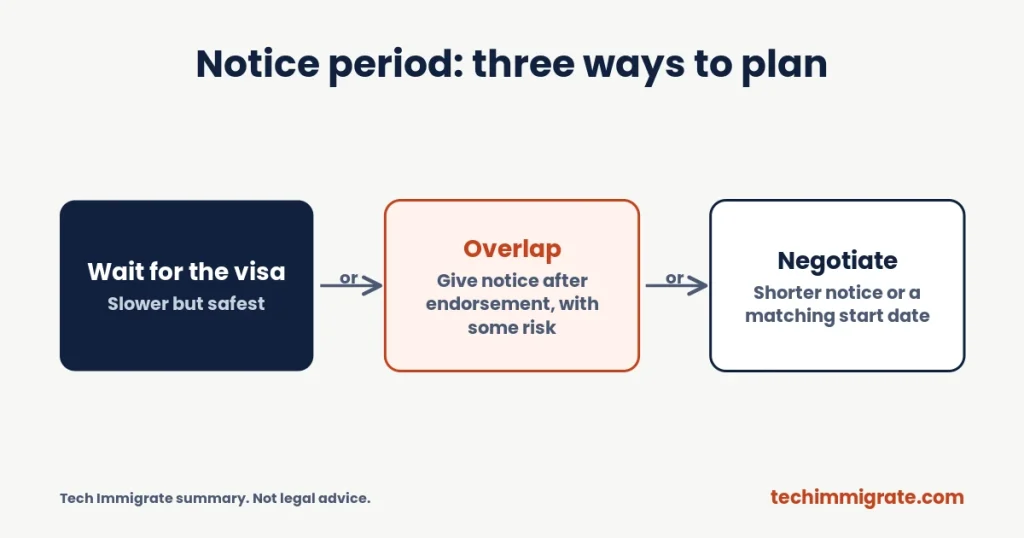
Applicants in this situation often use one of three approaches:
- Wait for the visa. Serve your notice after approval. This is slower but safest.
- Overlap. Give notice after endorsement, accepting some risk at the visa stage.
- Negotiate. Ask for a shorter notice period or a start date that matches your expected arrival.
Other dates to line up
Housing is the next big one. Short-term lets protect you from a deposit you cannot recover, and flights with flexible dates protect you from a delay.
Children's school terms, partners' jobs and your current visa expiry also matter. Write every date on one page and set the earliest and latest arrival around the three-month windows.
How Do Dependants Change the Timeline?
Partners and children apply separately, so they add a few tasks but should not add a stage. Gov.uk says each person applying pays their own visa fee and health surcharge.
Applicants with families often apply for everyone on the same day, so the decisions arrive close together. However, you should check the current dependant guidance on gov.uk, because it sets the rules for how partners and children apply and prove their relationship.
Gather certificates early. Marriage and birth documents sometimes need translation or certified copies, and that can take a week or two. Also check every passport, since a child's passport can expire sooner than yours.
How to Build Your Own Timeline Backwards
The easiest method is to start from your ideal arrival date and subtract each stage. This shows you the latest date you can submit the endorsement, and it exposes problems early.
- Pick your target arrival date.
- Allow two weeks for travel and housing.
- Subtract 3 weeks (outside the UK) or 8 weeks (inside the UK) for the visa decision, plus a few days for the identity step.
- Take off 8 weeks for the endorsement decision, which is the slow end of the usual range.
- Finally, deduct your preparation time. Use 12 weeks if you are unsure, because evidence and letters rarely run faster than planned.
Illustrative example (fictional)
A fictional product manager wants to start a new role on 1 June. He works back: two weeks for travel gives mid-May, three weeks for the visa gives late April, and eight weeks for endorsement gives early March. Twelve weeks of preparation then points to early December as his start line.
If that start line has already passed, he has two choices. He can move the arrival date, or he can shorten preparation by using evidence he already holds. Either way, he decides with real dates in front of him.
What to Do While You Wait
Use the waiting weeks for tasks that do not depend on the decision. That keeps your plan moving and avoids a rush when the result arrives.
- Keep copies of every document you submitted, in one folder.
- Check your passport has enough validity, and renew it if not.
- Gather dependants' documents, such as marriage and birth certificates.
- Save for the Immigration Health Surcharge, which is paid up front for the whole visa.
- Set up a UK bank plan, but do not move money you cannot afford to lose.
- Keep your public work visible, with no new claims that conflict with your application.
Do not do these things
Do not contact individual panel members, and do not pay anyone who promises a faster endorsement. Nobody outside Tech Nation can speed the panel's decision, and nobody can guarantee an endorsement.
How Do You Know If You Are Ready to Start the Clock?
You are ready when every criterion has at least two documents, three letters are in hand and your statement matches your evidence. If any of these is missing, the clock is better left unstarted.
Run a quick test. Could a stranger read each document and see why it matters, without your explanation? If not, tighten it. Then check your evidence against the criteria again.
Deciding between speed and strength
The endorsement fee is not refundable, so a rushed submission costs money as well as time. Spending two more weeks on a stronger file is often cheaper than a second application.
Global Talent Visa Processing Timeline FAQ
Most applicants should plan for roughly 3 to 9 months. That covers 4 to 12 weeks of preparation, a usual 5 to 8 week endorsement decision, and a visa decision of usually 3 weeks outside the UK or 8 weeks inside it, plus a buffer.
Gov.uk gives decision times from a complete application, so treat the clock as starting once you have paid, submitted and finished the identity step. A missing appointment can therefore push the start date back. Check your confirmation email for the date you submitted.
Gov.uk lists faster decisions for the visa stage for an extra fee, where available. It does not change how the case is judged. For the endorsement stage, the best way to save time is a complete, well-organised application.
Gov.uk says you can submit both applications together. However, the visa can be refused if the endorsement is refused. Applicants often wait for the endorsement so they do not risk the visa fee on an uncertain result.
Eight weeks is a usual time, not a guarantee. Check your email and spam folder, then use the contact route on gov.uk. Keep your current visa valid, because an endorsement application does not extend your stay.
Your Next Step
A clear timeline starts with a clear evidence plan. Our role-specific endorsement guides give you an evidence checklist and planner, so your preparation stage stays near the short end. Start at the guides hub, or pick your role: software developers, data and AI specialists, product managers or startup founders.
Want the guide for your role? See the guides.
How We Checked This Article
We checked the timings, fees, the three-month window, the review rule and the eVisa change on the gov.uk pages for the digital technology route, the application page, the Global Talent overview and the biometric residence permit page. We also compared the stages with several published guides from law firms, universities and advisers. Preparation ranges and appointment comments are applicant-reported, not official.
Tech Immigrate is independent of Tech Nation and the Home Office. This article is general information, not legal advice, and nobody can guarantee an endorsement. Always confirm current rules on gov.uk before you apply.
We write practical guides for tech professionals applying for the UK Global Talent visa. Tech Immigrate is independent of Tech Nation and the Home Office, and our articles are general information, not legal advice. Rules and fees change, so always check gov.uk before you apply.