Exceptional Talent vs Exceptional Promise: Which Global Talent Route Fits Your Career?
Exceptional Talent vs Exceptional Promise compared from the Immigration Rules themselves: the wording that differs, what each route means for settlement and family, and a decision rule to choose the route your evidence supports.

In this article
- What Most Exceptional Talent vs Exceptional Promise Comparisons Miss
- How Tech Nation Decides Exceptional Talent vs Exceptional Promise
- Exceptional Talent vs Exceptional Promise: Where the Rules Actually Differ
- After Endorsement: How Exceptional Talent vs Exceptional Promise Changes Settlement
- How to Build Your Case for Each Route: The Evidence That Leads
- How to Measure Which Route Your Evidence Supports
- The Decision Rule: Let Your Evidence Pick the Route, Not the Settlement Clock
- What Real Outcomes Show, and Their Limits
- Frequently Asked Questions About Exceptional Talent vs Exceptional Promise
- Your Next Step
- How We Checked This Article
Exceptional Talent vs Exceptional Promise is the choice between applying as a recognised leader or as an emerging one. Both routes use the same test of one mandatory and two optional criteria, and the same fee. The big difference comes later: gov.uk says leaders can settle after 3 years, and potential leaders after 5.
Key takeaways
- Both routes use 1 mandatory criterion plus 2 of 4 optional criteria. Tech Nation’s guide caps the proof at 10 documents.
- The Immigration Rules set a continuous 3-year period before settlement for Exceptional Talent and 5 years for Exceptional Promise.
- Exceptional Promise has one extra condition: you must be at an early stage in your career. Tech Nation says this usually means less than 5 years in technology.
- The wording of the optional criteria differs. Only the Talent list names senior executives and board members, and only Talent accepts research that is published rather than expert-endorsed.
- A partner needs 5 years as a dependant to settle under Appendix Global Talent. That holds even when the main applicant settles after 3.
What Most Exceptional Talent vs Exceptional Promise Comparisons Miss
Most comparisons of Exceptional Talent vs Exceptional Promise say two things. Talent is for people with more than 5 years in tech, and Talent settles faster. Both points are true, but they leave out most of what shapes the decision.
They rarely show where the official wording of the two routes differs. They also skip the settlement rules that affect your family. And they give no way to test which route your evidence supports. This guide fills those gaps, using the rules themselves.
First, the ground rules. Every rule below comes from three official sources. They are the gov.uk eligibility page for digital technology, Tech Nation’s application guide and the Immigration Rules, Appendix Global Talent.
When we interpret how assessors might read your case, we say so. Treat that as an informed inference, not a settled fact, because Tech Nation does not publish its scoring. Rules change, so check gov.uk before you apply.
How Tech Nation Decides Exceptional Talent vs Exceptional Promise
The process is the same for both routes. You apply to the Home Office for an endorsement. That is Tech Nation’s formal confirmation that you are a leader or potential leader in digital technology. The Home Office then sends your file to Tech Nation, and gov.uk says a decision usually takes 5 to 8 weeks.
The fees match too. Gov.uk’s Global Talent page lists £561 for the endorsement and £205 for the visa, so £766 in total. Each partner or child pays £766 as well, plus a healthcare surcharge of usually £1,035 per person per year.
The test itself also matches in shape. You must meet one mandatory criterion, which is recognition in the last 5 years. Then you must meet two of four optional criteria, with at least two documents for each. The difference lies in the level of recognition you must prove.
Recognition Level, Not Structure, Divides the Two Routes
Tech Nation’s guide puts that level into one phrase. A leader shows “sustained” recognition, while a potential leader shows “emerging” recognition, nationally or internationally. In other words, Talent asks whether your standing has lasted, and Promise asks whether it has started.
One more point matters before you choose. Tech Nation’s guide says its independent panel decides whether you should be endorsed, and for which route. So the route you tick is your claim, not the final word. Still, pick the route your evidence clearly supports, because the panel judges the file you send. The Exceptional Talent vs Exceptional Promise choice is yours to argue, and the panel’s to confirm.
Neither route is a shortcut. Some applicants treat the Exceptional Talent vs Exceptional Promise choice as a question of difficulty, but the Rules frame it as a question of career stage, because both routes demand outside recognition backed by documents. In practice, an early-career applicant with strong evidence has a real chance, while a senior applicant with thin evidence does not.
Exceptional Talent vs Exceptional Promise: Where the Rules Actually Differ
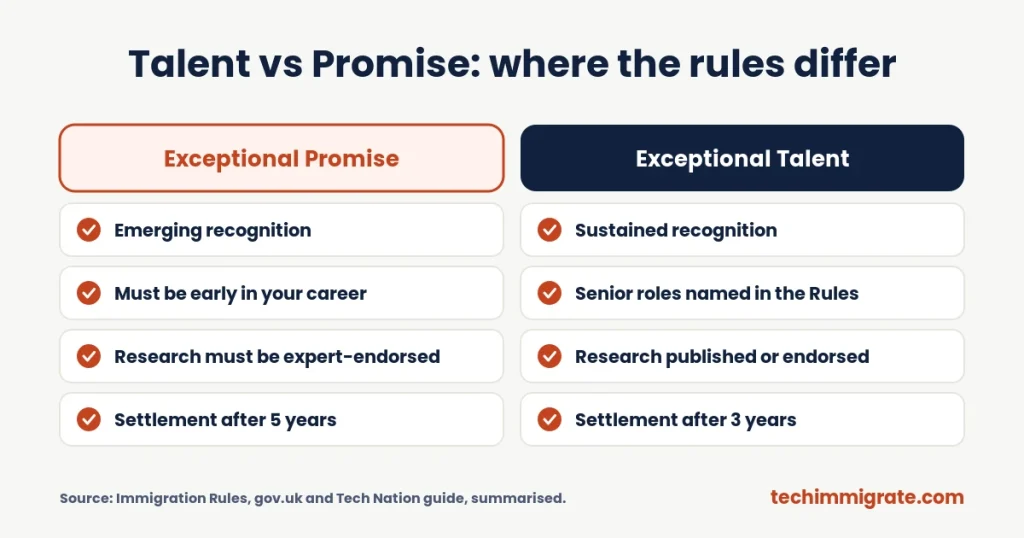
The two optional-criteria lists look almost identical at first glance. Yet the Immigration Rules word them differently, in paragraphs GTE 7.3 for Talent and GTE 7.4 for Promise.
| Rule | Exceptional Talent | Exceptional Promise |
|---|---|---|
| Mandatory criterion | Recognised as a leading talent | Recognised as having potential to be a leading talent |
| Innovation criterion | Founder or senior executive, or employee in a new field | Founder, or employee in a new field |
| Contribution criterion | Founder, senior executive, board member or employee | Founder or employee |
| Research criterion | Published or endorsed by an expert | Endorsed by an expert |
| Extra condition | None | Be at an early stage in your career |
| Settlement | After 3 continuous years | After 5 continuous years |
Exceptional Talent: Built for Leaders Whose Standing Has Lasted
Exceptional Talent is for people already recognised as leading talent in digital technology. Tech Nation’s “What to Consider” page describes Talent applicants as having 5 or more years of experience. It adds that they are already leading in their field.
The wording of the Rules backs that up. Only the Talent list names senior executives and board members as people who can show innovation or contribution. That signals that the route expects seniority, while the Promise list stops at founders and employees.
The research criterion is also broader for Talent. Talent accepts research that is “published or endorsed by an expert”, while Promise only lists research endorsed by an expert. Our reading is that a leader’s published record can speak for itself. A newer researcher, by contrast, needs an expert to vouch for the work.
Exceptional Promise: Built for Early Careers With Visible Momentum
Exceptional Promise is for emerging leaders. Gov.uk says these applicants are likely to have less than 5 years of experience in technology. However, they can have had a longer career in another type of work before moving into tech.
That caveat matters for career changers. A former teacher, doctor or lawyer with three years as a data scientist can still be early in their tech career. The rule counts your time in technology, not your total working life.
Promise also adds one condition that Talent does not have. The applicant must “be at an early stage in their career”, according to paragraph GTE 7.4 of the Rules. Tech Nation’s guide says you show this through the evidence you already submit. It also says unpaid internships do not count towards your years of experience.
Finally, the guide excludes one group from Promise outright. It says junior investors and analysts are “not suitable” for Promise. The reason is that investment roles need a track record built at a senior level.
After Endorsement: How Exceptional Talent vs Exceptional Promise Changes Settlement
Your endorsement route follows you for years. So it is worth knowing exactly what the Rules say about settlement. Settlement is also called indefinite leave to remain (ILR), which means permission to live in the UK with no time limit.
Appendix Global Talent sets the qualifying period in paragraphs GT 11.1 and GT 11.2. You need a continuous 3 years in the UK if Tech Nation endorsed you under the Exceptional Talent criteria. Instead, you need 5 continuous years if it endorsed you under the Exceptional Promise criteria.
That period can mix visa routes. Paragraph GT 11.3 says the continuous time can include permission on Global Talent, Skilled Worker, Innovator Founder, Scale-up and several other routes. So a Promise holder with earlier Skilled Worker time may be closer to 5 years than they think.
Some settlement conditions apply to both routes. The Rules say you must have earned money in the UK in your endorsed field during your last permission. Your endorsement must also still stand, meaning Tech Nation has not withdrawn it. You need English at level B1 or higher, which the Rules schedule to rise to B2. Finally, you must meet the Life in the UK requirement.
Extensions Work the Same on Both Routes
Staying longer does not depend on your route. Gov.uk says each Global Talent visa lasts up to 5 years, and you choose the length. After that, you can extend as many times as you like, for 1 to 5 years each time.
The extension test is simple but strict. Paragraph GT 5.1 says you must have earned money in the UK in the field you were endorsed in. So a Promise holder who drifts into an unrelated job outside digital technology may find it hard to extend their visa later. In short, the Exceptional Talent vs Exceptional Promise decision changes when you can settle, not whether you can stay.
The Family Detail Most Guides Skip
Your partner does not settle on your timeline. Paragraph GT 30.1 says a dependent partner needs 5 continuous years in the UK as your partner to settle. If you settle after 3 years, paragraph GT 24.1 gives your partner a further 3 years’ permission, so the family can stay together while they finish their own qualifying period.
The cost gap is real as well. Here is our own arithmetic, using the gov.uk surcharge of £1,035 per person per year. One person on the visa for 3 years pays £3,105 in surcharge, while 5 years costs £5,175. For a couple who both stay on the visa, the gap between those two timelines is £4,140, before any visa or settlement fees.
How to Build Your Case for Each Route: The Evidence That Leads
The two routes use the same four optional criteria. However, the evidence that persuades differs, because Talent must show lasting standing and Promise must show early momentum. Here is the Exceptional Talent vs Exceptional Promise evidence split, mirrored.
Exceptional Talent: Lead With Recognition Spread Across Several Years
For Talent, spread matters as much as strength. Tech Nation’s guide asks for evidence that shows “a consistent level of activity over time”. It also rejects evidence made “solely to support the timing” of an application, which rules out a burst of activity just before you apply. So a leader’s file should show recognition in several different years within the 5-year window.
Use the seniority the Rules name. A product-led company is one whose main revenue comes from its own digital product. If you were a senior executive or board member of one, show it with signed company accounts and sales figures for each country. The guide asks for audited accounts, or accounts covering more than 12 months, for any business you ran in the last 5 years.
Also, keep one question in front of every document: does this prove I lead, or only that I work? A contract and a job title prove employment. A keynote invitation proves more. So does an award from outside your employer, or press coverage about your work.
Exceptional Promise: Lead With Early Signals Other People Noticed
For Promise, the test is trajectory. You do not need a decade of honours. But you do need outside proof that your field has started to notice you. A national hackathon prize, a main-stage talk or an open source project others adopt can each show emerging recognition.
Keep the same quality bar as Talent. Tech Nation’s guide applies the same evidence rules to both routes. So self-published posts, internal awards and course certificates do not count for either one. Our guide to Tech Nation endorsement mistakes lists the other traps that catch early-career applicants.
Make your career stage easy to read. Put your dates in tech clearly in your CV. Then explain any earlier career in one line, so assessors can see the switch. If open source is part of your case, our guide on turning GitHub into Global Talent evidence shows how to present steady work.
How to Measure Which Route Your Evidence Supports
You cannot see Tech Nation’s scoring. Still, you can measure your own file before you pay the £561 fee. These five checks turn the Exceptional Talent vs Exceptional Promise choice into numbers you can track.
- Years in digital technology: your paid, full-time-equivalent years in tech roles, excluding unpaid internships. Under 5 points towards Promise, and 5 or more points towards Talent.
- Recognition span: the number of years between your first and latest independent recognition item. A span of 1 year reads as emerging, while 3 or more reads as sustained.
- Independent recognition count: the number of items where someone outside your employer chose to award, feature or invite you. You need at least 2 strong items for the mandatory criterion on either route.
- Seniority signals: the number of documents that show you leading people, products or budgets, such as a founder, executive or board role. Several of these support Talent, and none suggests Promise.
- Criteria coverage: the number of optional criteria with 2 or more documents that prove them on their own terms. Both routes need 2.
Read the checks together, not one by one. For example, 8 years in tech with a 1-year recognition span is a mixed signal. In that case, your letters and evidence must show why your standing is sustained. Otherwise, keep building it. Our guide to Global Talent Visa recommendation letters explains how referees can confirm the same story.
The Decision Rule: Let Your Evidence Pick the Route, Not the Settlement Clock
The most useful rule in this guide: choose Exceptional Talent only if you have 5 or more years in digital technology. You also need independent recognition spread across at least 3 of the last 5 years. If either part is missing, apply for Exceptional Promise while you still count as early career, or keep building first.
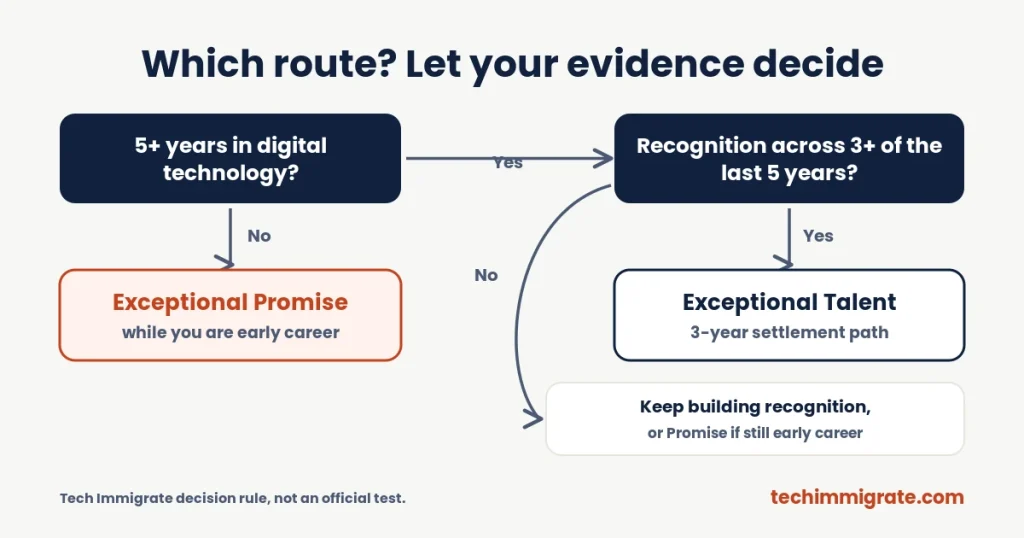
The faster settlement clock tempts many people towards Talent. But the clock only helps if you are endorsed, and each refusal means paying the £561 fee again. So the honest question is which route your file can win, not which route you would prefer.
Here is the rule at work in an illustrative, invented example. Imagine two applicants. The first is a product manager with 9 years in tech. They gave a conference keynote four years ago, won an industry award two years ago and got press coverage last year. That spread passes both parts of the rule, so Talent fits.
The second is a machine learning engineer with 3 years in tech after a career in finance. They won a national AI competition last year and published a peer-reviewed paper with a supervisor’s backing. That is strong, emerging recognition, so Promise fits. If they applied for Talent instead, their short tech career would work against them.
What Real Outcomes Show, and Their Limits
Real results show that both routes work for people without famous names. Yet public data on Exceptional Talent vs Exceptional Promise outcomes is thin. The Tech Immigrate homepage shares genuine client messages. One shows a person endorsed for Exceptional Talent, and another shows a visa granted by the Home Office.
Those messages have clear limits. They confirm the outcome, but not the evidence behind it, and names are hidden for privacy. So they show that the route can be won, not how a specific file was built.
Tech Nation publishes its own evidence of scale. Its Global Talent Visa page reports an alumni network of more than 2,600 members. However, its public success stories do not say which route each person used. So they cannot show how Exceptional Talent vs Exceptional Promise outcomes compare.
The lesson from both sources is the same. Successful applicants match their route to their real career stage. They do not stretch a promising early career into a claim of lasting leadership.
Frequently Asked Questions About Exceptional Talent vs Exceptional Promise
Not in structure. Both routes need one mandatory and two optional criteria with the same document rules. Promise asks for emerging rather than sustained recognition, but it adds the condition that you are early in your career.
Only if you are still early in your tech career. Gov.uk says Promise applicants usually have under 5 years in technology. They may have a longer career in another field, so career changers can fit.
Tech Nation’s guide says its panel decides whether to endorse you and for which route. Even so, pick the route your evidence clearly supports, because the panel only sees the file you send.
No. Gov.uk lists the same £561 endorsement fee and £205 visa fee for both, plus the healthcare surcharge for each year of the visa.
Not always. The Immigration Rules say a dependent partner needs 5 continuous years as your partner to settle. So they may settle later than an Exceptional Talent holder.
The Rules link the 3-year settlement period to an Exceptional Talent endorsement. They do not describe an upgrade process. If this matters to your plans, confirm your options with the Home Office or a regulated adviser.
Your Next Step
Do one exercise this week to settle the Exceptional Talent vs Exceptional Promise question. Write down your years in digital technology. Then list every independent recognition item with its year. If you have 5 or more years and recognition across at least 3 different years, draft for Talent. Otherwise, draft for Promise.
Record the results in a simple table with one row per document, noting its year, its criterion and whether it names you personally. Once the table is finished, the Exceptional Talent vs Exceptional Promise answer is usually clear, because your years and the spread of your recognition either line up or they do not.
For a structured way to build the file, try the Tech Immigrate endorsement guides. Each is written for one role, including software developers, digital marketers and tech investors. Each guide includes evidence checklists and a 12-week planner. You can also compare the benefits and costs of the Global Talent Visa before you decide.
How We Checked This Article
We checked every rule and figure against primary sources before publication. We used the gov.uk Global Talent pages and the gov.uk endorsement document list. Appendix Global Talent of the Immigration Rules and Tech Nation’s published guide were also checked. The table of wording differences quotes paragraphs GTE 7.3 and GTE 7.4 of the Rules.
Tech Immigrate is independent of Tech Nation and the Home Office. This article is general information, not legal advice, and no one can guarantee an endorsement. Always confirm the latest rules on gov.uk before you apply, and visit techimmigrate.com for more guides.
Every figure in this guide was checked against its original source before publication. Figures marked as illustrative are invented examples, not real results.
We write practical guides for tech professionals applying for the UK Global Talent visa. Tech Immigrate is independent of Tech Nation and the Home Office, and our articles are general information, not legal advice. Rules and fees change, so always check gov.uk before you apply.