UX UI Designer Global Talent Visa: Can Designers Qualify? (6 Evidence Types)
A UX UI designer Global Talent Visa application can work in digital technology. See the 6 evidence types Tech Nation looks for and check where you stand.

In this article
- Can a UX UI designer Global Talent Visa application succeed?
- Which route do UX and UI designers use now?
- How the criteria work for a UX UI designer Global Talent Visa
- What Tech Nation counts for design roles
- The 6 evidence types for a UX UI designer Global Talent Visa
- Portfolio vs evidence: what is the difference?
- How to map your evidence to the criteria
- Illustrative example (fictional)
- Agency, consultant and freelance designers
- Common mistakes in a UX UI designer Global Talent Visa application
- Exceptional Talent or Exceptional Promise for designers?
- How to build design evidence in 12 months
- How to write each design evidence document
- What if your best work is under NDA?
- Should designers use the arts route instead?
- What does it cost, and how long does it take?
- UX UI Designer Global Talent Visa FAQ
- Your Next Step
- How We Checked This Article
A UX UI designer Global Talent Visa application can succeed if you meet the digital technology criteria. Job titles do not decide the outcome. Evidence of recognition and real product impact does.
Many designers assume this route is only for engineers and founders. That is a myth. This guide shows which design evidence tends to count, where portfolios fall short, and how to plan.
Key takeaways
- Designers can apply under the digital technology route, and law firms report that UX and UI designers stay with Tech Nation.
- You need one mandatory criterion plus two of four optional criteria, backed by up to 10 evidence documents.
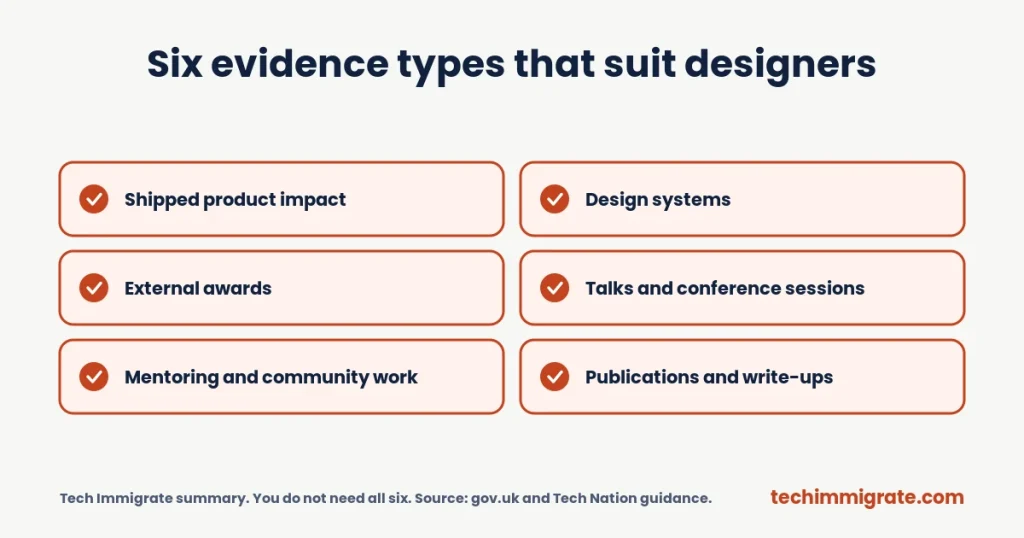
- Six evidence types suit designers: shipped impact, design systems, external awards, talks, mentoring, and publications.
- A portfolio shows your work. Evidence proves other people recognise it.
- Internal awards, self-published posts and employer-only material usually do not carry much weight.
Can a UX UI designer Global Talent Visa application succeed?
Yes, a UX UI designer Global Talent Visa application can succeed, because the digital technology route covers more than coding. The gov.uk page describes leaders in fields such as fintech, gaming, cyber security and AI. It says your background can be technical or business-focused.
That wording leaves room for product and design roles. However, a good title is not enough. Tech Nation's independent panel decides overall whether to endorse you, so meeting the criteria is necessary but not sufficient.
Applicants also ask whether a design career is "tech enough". In practice, the question is whether you work in a product-led digital technology company and whether others outside that company recognise your work.
Which route do UX and UI designers use now?
UX and UI designers still use the Tech Nation digital technology route, according to law firm commentary on a newer design route. At the time of writing, the gov.uk page for digital technology is the official starting point.
What changed for other designers
Law firms and Free Movement report that a Design Industry route opened on 1 July 2026. The Design Business Association assesses it for Arts Council England. It covers fields such as graphic, brand, product and industrial design.
Why UX and UI stay with Tech Nation
The same sources say digital design and UX/UI design are excluded from that route. They say those fields fall under Tech Nation instead. We could not find this wording on a gov.uk page, so treat it as reported and confirm on gov.uk before you choose a route.
If your work is mostly physical or commercial product design, read the design route rules separately. If you design software interfaces, the digital technology route is the likely home.
How the criteria work for a UX UI designer Global Talent Visa
You need one mandatory criterion and two of four optional criteria. The mandatory criterion (MC) is recognition as a leading talent, or an emerging one, in digital technology within the last five years.
The optional criteria (OC) are:
- Innovation (OC1): you helped create a new product or technology in a product-led company.
- Recognition outside your day job (OC2): for example talks, mentoring, judging or community work.
- Significant contribution (OC3): a technical, commercial or entrepreneurial contribution to a product-led digital technology business.
- Academic contributions (OC4): research, peer review, publications or conference papers.
Designers most often build the case around the MC, OC2 and OC3. OC1 and OC4 are harder, because many design projects improve existing products rather than invent new ones, and few designers publish research.
Evidence limits to plan around
You can send up to 10 evidence documents. Each one can run to 3 A4 sides. You need at least 2 documents per criterion, and one document cannot serve two criteria. Evidence must come from the last five years.
You also need three recommendation letters and a CV of up to 3 sides. Letters support your evidence but cannot replace it. Read our guide to recommendation letters before you ask anyone.
What Tech Nation counts for design roles
Tech Nation looks for impact that other people can verify, not for a nice portfolio. Its public guidance for the route points to things like reputable awards, speaking at prominent events and features in well-known publications.
For designers, that translates into a few patterns. First, the product must be product-led. Next, the proof should come from outside your own team where possible. Finally, the numbers should link back to your decisions, not just to the company's growth.
Tech Nation's guidance also warns against AI-written or templated documents. Internal awards do not count for recognition. LinkedIn or Medium posts on their own do not count either.
Applicants often tell us a thin role at a famous brand matters less than a clear role at a smaller product company. That is applicant experience, not an official rule. Still, it shows why a documented outcome beats a logo.
The 6 evidence types for a UX UI designer Global Talent Visa
Six evidence types fit most design careers: shipped impact, design systems, external awards, talks, mentoring and publications. You do not need all six. Two or three strong ones per criterion are enough.
1. Shipped product impact
Shipped impact is proof that your design changed a measurable outcome. Examples include conversion, retention, task completion, support tickets, or revenue linked to a redesign.
This type usually supports OC3. A strong document names the product, your role, the date and the result. Ideally, a senior leader or an external source confirms the numbers. A before-and-after screenshot alone proves very little.
2. Design systems
A design system shows scale. If you built or led one that other teams adopted, you can show how many products, designers and engineers use it.
Useful proof includes adoption figures, release notes, time saved, and public documentation. This usually supports OC3. If the system was new to the market or open source, it may also support OC1.
3. External awards
External awards are prizes from independent bodies, not from your employer. Examples include design competitions, industry awards and shortlists with published judging criteria.
This type usually supports the MC or OC2. Include the award page, the entry criteria, the number of entrants, and your named role. Without your name on it, an award for a team product is weak evidence.
4. Talks and conference sessions
Talks show peers think you have something to teach. Invited talks at independent conferences, meetups with real reach, and podcast guest slots can all help.
This type usually supports the MC or OC2. Provide the programme page, the audience size, the invitation, and a recording where one exists. Internal company talks do not count as outside recognition.
5. Mentoring and community contribution
Mentoring and teaching show you lift the field beyond your day job. Think design courses, mentoring schemes, hackathon judging, community leadership and open design resources.
This type usually supports OC2. Show the programme, your hours, the number of people helped, and any independent feedback. Vague claims like "I mentor juniors" will not carry weight on their own.
6. Publications and independent write-ups
Publications are articles or research about your work in independent outlets. They include trade press, journals, books, case studies written by others, and peer review roles.
Press features can support the MC. Real research or peer review supports OC4. Your own blog on its own does not count, so look for an outside editor or publisher.
Portfolio vs evidence: what is the difference?
A portfolio shows what you made, while evidence shows who noticed and what changed because of it. Tech Nation needs the second thing.
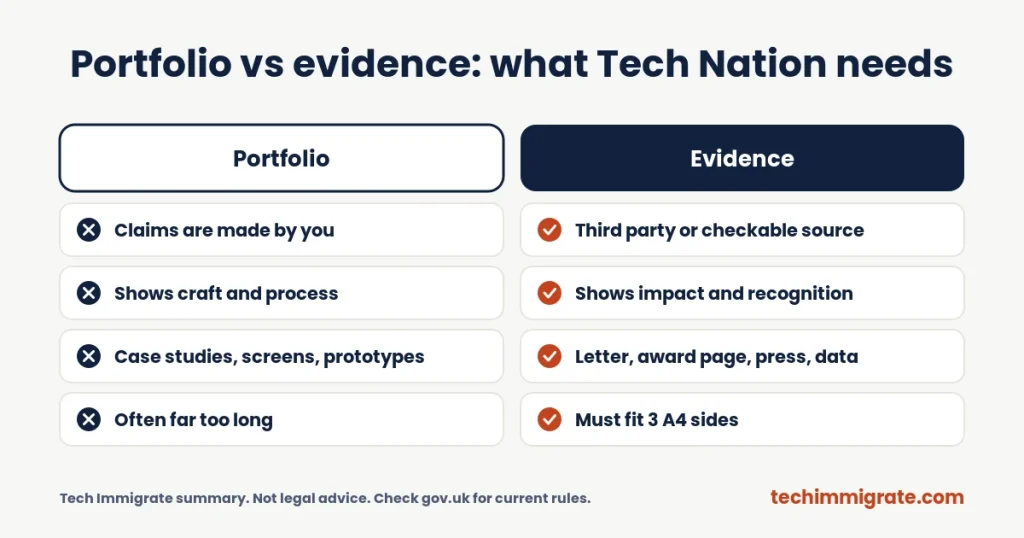
Here is a simple way to tell them apart:
| Question | Portfolio | Evidence |
|---|---|---|
| Who made the claim? | You | A third party or a checkable source |
| What does it show? | Craft and process | Impact and recognition |
| What is the format? | Case study, screens, prototype | Letter, award page, press, data, programme |
| Does it fit the page limit? | Often far too long | Must fit 3 A4 sides |
| Which criterion? | None on its own | One criterion at a time |
You can still use your portfolio, and our UX and product designer guide shows how to reference it. For example, link to it from your CV or cite a case study inside a document. However, do not paste screens into the evidence file and call it done.
How to map your evidence to the criteria
Mapping means deciding which document proves which criterion before you write anything. Doing it first stops reuse, gaps and padding.
| Criterion | Design evidence that often fits | Documents to aim for |
|---|---|---|
| MC recognition | External awards, invited talks, press features | 2 |
| OC2 outside day job | Mentoring, teaching, judging, community work | 2 |
| OC3 significant contribution | Shipped impact, design system adoption | 2 |
| OC1 innovation | A new product or interaction model you created | 2 |
| OC4 academic | Research, peer review, publications | 2 |
You only need the MC and two optional criteria. Pick the two where your proof is strongest. That is 6 documents at minimum, leaving up to 4 spare for depth.
Remember that one document cannot count twice. If a talk proves recognition, you cannot reuse it for OC2. Plan separate documents from the start.
Illustrative example (fictional)
Here is how a plan might look for a made-up product designer, "Sam", who has six years in a fintech app company.
Sam led the redesign of an onboarding flow. Sign-up completion rose from 54% to 71% over two quarters, and the finance lead can confirm the figures. Sam also built a component library now used by four product teams.
Outside work, Sam spoke at two independent design conferences and mentors on an external scheme. One industry award shortlist names Sam as lead designer.
Sam's plan could look like this:
- MC: the award shortlist page and a trade press feature.
- OC2: a conference programme with audience figures and a mentoring scheme confirmation.
- OC3: an onboarding impact document and a design system adoption summary.
- Letters: a product director, a former client engineer, and a conference organiser.
Notice what Sam did not do. Sam did not reuse the conference talk across two criteria. Sam also did not rely on internal praise. This is only an illustration, not a prediction of any decision.
Agency, consultant and freelance designers
Agency and freelance designers can apply, but they need extra care to show product-led impact. Applicants report that endorsers sometimes question consultancy-style roles.
One law firm describes a designer whose first application was refused on this basis and later succeeded. That is a firm's account of one case, not official guidance. Treat it as a reminder, not a rule.
In practice, you can strengthen this kind of profile in three ways:
- Name the product-led clients and your exact role on each.
- Show outcomes from the clients' own data, with their permission.
- Get letters from client-side leaders who saw your work over 12 months or more.
Common mistakes in a UX UI designer Global Talent Visa application
The most common mistakes are weak proof, not weak design. Read our Tech Nation endorsement mistakes guide for the wider list. For designers, these come up often:
- Sending a portfolio as evidence. Screens do not prove recognition.
- Relying on internal awards. Employer prizes do not show outside recognition.
- Using vanity metrics. Followers and likes need context and independence.
- Claiming team results as personal ones. Say exactly what you owned.
- Reusing one document for two criteria. The rules do not allow it.
- Ignoring the date window. Evidence must fall in the last five years.
- Using AI-written or templated text. Tech Nation says it does not accept it.
- Leaning on letters. Three strong letters cannot replace documents.
Applicants in refusal communities also report that vague, unlinked claims cause trouble. That is applicant-reported, so treat it as a pattern to avoid rather than a rule.
Exceptional Talent or Exceptional Promise for designers?
Exceptional Talent suits established leaders, and Exceptional Promise suits emerging ones. Many designers with a few years of experience look at Promise first.
Settlement is possible after 3 years on Talent and 5 years on Promise. The route you pick is a strategic choice, not a label for your job title. Our guide to Exceptional Talent vs Exceptional Promise explains the difference.
Applicants in this situation often compare their evidence to the criteria first. If you have mostly early awards and mentoring, Promise may fit. If you have years of scaled impact and international recognition, Talent may fit. Want the guide for your role? See the guides.
How to build design evidence in 12 months
You can build useful evidence in a year if you start with the criteria, not the calendar. Each step below creates something a third party can check.
- Month 1: list your last five years of shipped work and pull the metrics.
- Month 2: write down who can confirm each result, and ask for their data.
- Months 3 to 5: pitch talks to independent events and submit work for external awards.
- Months 4 to 8: join a mentoring scheme or teach a course with a real programme page.
- Between months 6 and 9: write for trade outlets or give interviews to independent press.
- By months 9 to 12: collect programme pages, confirmations and letters, then draft your documents.
Keep dated records as you go. A talk without a programme page is hard to prove a year later.
How to write each design evidence document
Each evidence document should answer who, what, when, how much and who says so. A tight structure keeps you inside three A4 sides and makes the panel's job easy.
Use the same skeleton for every document:
- A one-line claim: what this document proves, and for which criterion.
- Context: the product, the company, the date and your exact role.
- Proof: the numbers, the programme page, the award rules or the press link.
- Independence: who produced the proof, and why they are credible.
- Source links: pages a reader can open and check in a minute.
Write in plain, specific language. Skip adjectives such as "world-class" and show the result instead. Tech Nation says it does not accept AI-written or templated documents, so write each one yourself from your own records.
What if your best work is under NDA?
Confidential work can still help, but you must show impact without exposing secrets. Many designers worry about this, because the strongest projects are often the ones they cannot share.
First, ask your employer what you may say. Often, a general metric such as "completion rose by a fifth" is fine even when screens are not. Next, ask a senior colleague to confirm the result in a letter or statement. Finally, pair it with public proof, such as a talk or an award, that does not need the confidential details.
If nothing about a project can be shared, leave it out of the evidence set. It can still appear on your CV in a short line. In practice, a public award or a conference page often does more work than a long document no one can check.
Should designers use the arts route instead?
Designers who work on software products usually belong in digital technology, not the arts route. The arts and culture route is built for people in fields such as visual arts, film, music and fashion.
Some agencies pitch designers as sitting between the two routes. However, the law firm reports on the new design route say UX/UI is outside it, and the gov.uk page for digital technology lists no design-specific rule either way. So the sensible step is to read both sets of criteria and see which one your proof actually fits.
Ask yourself two questions. Do you work on a digital product? And can you show recognition from the digital technology community? If both answers are yes, the digital technology route is the natural fit. If your work is exhibitions, illustration or craft, the picture changes, and you should check the arts rules on gov.uk.
What does it cost, and how long does it take?
At the time of writing, the endorsement fee is £561 and the visa fee is £205. That makes £766 for the main applicant before the Immigration Health Surcharge. Check gov.uk for current figures.
The surcharge is £1,035 per year, or £776 for under-18s. Dependants pay their own visa fee and surcharge. Tech Nation usually decides in 5 to 8 weeks. The visa decision usually takes 3 weeks from outside the UK and 8 weeks from inside it.
You must apply for the visa within 3 months of the endorsement. There is no points system.
UX UI Designer Global Talent Visa FAQ
Yes, if you show recognition and contribution in digital technology. Tech Nation reviews UX and UI designers under the digital technology route. You need one mandatory criterion and two optional ones, supported by evidence from the last five years. Meeting the criteria does not guarantee endorsement.
No. The gov.uk page says your background can be technical or business-focused, and design impact counts when it is evidenced. Design systems, product metrics, awards and talks are common proof. You do not need open source code, though some designers add it as extra support.
Not by itself. The company should be product-led, and your evidence should be independent and checkable. Applicants often report that a clear, documented outcome at a smaller company beats a thin role at a famous one. That is applicant experience, not official guidance.
Reports from law firms say UX and UI design are excluded from the Design Industry route and sit with Tech Nation. Product and industrial designers may look at the design route. Check gov.uk and the endorsing body's rules before you choose.
You can ask for a free review within 28 days, but you cannot add new evidence to it. Otherwise you can submit a fresh application with a new fee. Many applicants first rebuild their evidence map and replace weak documents.
Your Next Step
Start by listing the six evidence types and marking which ones you already have. Then match each to a criterion, as in the tables above. Want the guide for your role? See the guides.
For a role-specific plan, see our UX and product designer guide. It is an endorsement guide with an evidence checklist and planner. You can also browse the full guides hub, or look at the product manager guide and the software developer guide if your role overlaps.
How We Checked This Article
We checked the route, criteria, document limits, fees and timings on the official gov.uk pages for the digital technology Global Talent visa and its documents page. We also read Tech Nation's public guidance on evidence.
For the design route, we read commentary from Free Movement and several law firms, including Free Movement's report. We label it as reported because we could not confirm the UX/UI exclusion on a gov.uk page. Applicant stories come from law firm case notes and communities, so we describe them as applicant-reported.
Tech Immigrate is independent of Tech Nation and the Home Office. This article is general information, not legal advice, and nobody can guarantee an endorsement. Always confirm current rules on gov.uk before you apply.
We write practical guides for tech professionals applying for the UK Global Talent visa. Tech Immigrate is independent of Tech Nation and the Home Office, and our articles are general information, not legal advice. Rules and fees change, so always check gov.uk before you apply.