
For tech researchers applying to Tech Nation
I was refused the Global Talent visa. Here is how to avoid my mistake.
Read this before you pay the £561 endorsement fee, because that fee is not refunded if you are refused.
If you work in this field, you probably assume your research speak for themselves. To a Tech Nation assessor, they only speak if you show them in the right format, with the right proof, against the right criteria.
I know this because it happened to me. Below is my story, the mistakes that cause most refusals, and how to avoid them. All of it is free to read. Keep going.
My story
I did it myself. I made a lot of mistakes. Then I got endorsed.
I applied for the Global Talent visa myself, and I was refused.
Looking back, I made a lot of mistakes, not just one. I chose the wrong criteria for my profile. I did not put my evidence together properly. And there were more small errors that added up, the kind you only spot once someone shows you what an assessor looks for.
A refusal is painful. The endorsement fee is not refunded, you lose months, and you start again from the beginning. It is also easy to take the wrong lesson from it, like deciding you are not good enough. That was not the lesson.
So I went back through the rules, found every place my application had gone wrong, and fixed each one. I applied again, and this time I was endorsed. I did the whole application myself.
That is why this guide exists. My goal is to help you avoid the mistakes I made, so you can get it right the first time.
The biggest mistake
The mistake that cost me: choosing the wrong criteria
To be endorsed on the Talent route, you must meet the Mandatory Criterion and two of the four Optional Criteria. In short, the four are innovation (OC1), recognition beyond your job (OC2), the impact of what you built or led (OC3), and research or academic work (OC4).
Here is the trap. You can have strong evidence and still be refused, because you lined it up against criteria it does not prove. The assessor does not rearrange your case for you. They check what you claimed.
As a rough guide, this is how strong evidence maps to the right criterion for tech researchers:
| If your strongest evidence is… | Lead with |
|---|---|
| Recognition from outside your own institution, such as an area chair role or a reviewer award at a leading venue | MC, recognition as a leader |
| Open datasets, benchmarks and community work outside your job | OC2, work beyond your job |
| Real-world results of your research, shown as a chain from your work to an outcome | OC3, impact |
| Peer-reviewed papers with citations, adopted by others | OC4, research |
That table is the short version. Your own mix of evidence decides the best pair, and the wrong pair is the quickest way to a refusal. Criteria are only the first of the common mistakes. Here they are for tech researchers.
Why researchers get refused
Seven reasons researchers get refused, and how the guide helps you avoid them.
01
Recognition that is only academic
02
Applying before anyone uses your work
03
Using student research for OC4
04
Claiming a team paper as yours alone
05
Calling expertise an advance
06
Outside work that is really your job
07
Templated recommendation letters
How to avoid them
The five-step approach that avoids them
The combination that works best for researchers is Optional Criteria 4 and 2, with the Mandatory Criterion: your academic contributions, your work beyond your job and your personal recognition. Here is how to build a case on it.
Show uptake, not just publication. Academic prizes, student audiences and brand-new papers in minor venues can fail all three criteria at once. Show citations, adoption and changed practice.
Choose your criteria on purpose. Pick the pair you can prove best, instead of trying to cover everything. This is the step that sank my first application.
Turn your work into short evidence documents. Each one is limited to 3 sides of A4 and ties to one criterion.
Back every claim with proof an assessor can check. Third-party proof beats your own screenshots, and your referees should write in their own words.
Run a final consistency check. Dates, titles and figures must match across your CV, letters, statement and LinkedIn before you submit.
That is the outline. Doing it well is where the detail matters, and the next section shows what that detail looks like.
A page from the guide
This is what an evidence document looks like
Here is one page from the guide, so you can see the level of detail before you decide. It is a fictional example of one Mandatory Criterion item.
Evidence 1: Area chair and Outstanding Reviewer at top-tier AI conferences, 2022–2026
Since 2022 I have reviewed 46 papers for three top-tier conferences in natural language processing and speech. In 2024 one of them named me an Outstanding Reviewer, an award given to 152 of about 1,900 reviewers (8%). In 2025 its organisers appointed me area chair for the speech and multilingual track, where I managed 38 submissions and 11 reviewers.
Letter from the 2025 programme chairs: “We invited Dr Bello as area chair because her Kasa-600 benchmark has become a standard test for speech systems in African languages.”
Why this sample works
- The letter names a specific piece of her research, so it reads as recognition of her, not of her employer.
- A paper you wrote is research, not recognition. Put it in OC4.
- Letters from your manager or a friend, and posts you published yourself, do not count as recognition.
The guide has worked samples like this for every kind of evidence, with the proof pages listed, so you know what to gather before you write.
If you are refused
What the refusal wording really means
The guide decodes the wording of real refusals into what it means and how to fix it. It also includes four anonymised case studies. Here is one of them, and a sample of the decoded wording.
The applied AI and robotics researcher refused on every criterion
A research assistant on a publicly funded project, and founder of a small robotics company, applied for Exceptional Promise under the Mandatory Criterion, OC2 and OC4. The recognition was “principally academic and institutional”, the talks and mentoring reached audiences “largely students rather than the sector”, and the research was “very recent, published in venues of limited standing” with no citations.
Lesson: Academic prizes, student audiences and new papers in minor venues fail all three criteria at once. This profile needs time and uptake, not a review.
Refusal wording, decoded
| What the refusal said | What it really meant |
|---|---|
| “The audiences are largely students rather than the sector” | Teaching students alone does not show you advance the field. Show outcomes: learners in tech jobs and practitioners reached. |
| “Expertise but does not constitute a significant, field-advancing contribution” | Expertise is not contribution. Show adoption, citations, benchmarks and changed practice. |
| “Activity within this space would fall into the applicant’s occupation” | Editorial and reviewing work counts as part of a researcher’s job unless you prove it is voluntary. Put academic service under the Mandatory Criterion, or prove it was voluntary. |
The guide gives you the full set of cases and the review method, so you know how to answer each kind of refusal if it happens to you.
Cases are anonymised and reported by applicants. They show how others have handled refusals, and no one can promise the same result. The guide is general information, not legal advice.
Want more?
The Endorsement Guide for Tech Researchers
The guide takes every step above and shows you how to do it, with Tech Nation’s own rules for each document. It is 97 pages in 7 parts, aligned with Tech Nation’s applicant guide, and you download it as a PDF straight after paying.
- 10-document mock evidence pack
- Evidence, evidence chain, letter, CV and statement templates
- 17 evidence checklists, a 12-week planner and final checks
What's inside
Everything you need to go from first draft to submitted.
PDF · 7 parts · 97 pages
The guide
- How the route works
- Are you eligible as a tech researcher?
- The application pack at a glance
- Choosing your criteria: why OC4 + OC2
- Mandatory Criterion: recognised as a leader
- Optional Criterion 4: academic contributions and the evidence chain
- Optional Criterion 2: contributions outside your job
- The criteria not chosen, and when to use them
- The 3-page evidence template
- Recommendation letters
- Third-party verification of your impact
- Your CV
- Your personal statement
- No evidence yet? A 12-month plan
- Common mistakes
- The six rejection patterns and 18 fixes
- What real refusals say
- How to request a review and win
- Pre-submission checklist
- Evidence checklists for 21 kinds of evidence
- Your 12-week application planner and trackers
Worked example
10-document mock evidence pack
Templates
Evidence, evidence chain, letter, CV and statement templates
Checklists
17 evidence checklists, a 12-week planner and final checks
If you are just starting
Planning your first application
Choose your criteria first, then follow the 12-week planner. Collect the right evidence while you still have time to get it, instead of finding gaps the week you submit.
If you were already refused
Planning to reapply or request a review
Use the refusal fixes and the review method to read what the decision really meant and decide your next move. I reapplied after a refusal, and it worked.
Success stories
From evidence pack to endorsement
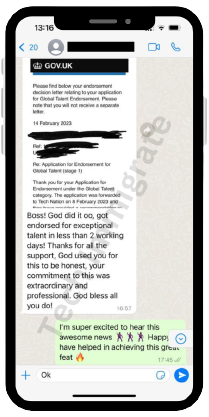
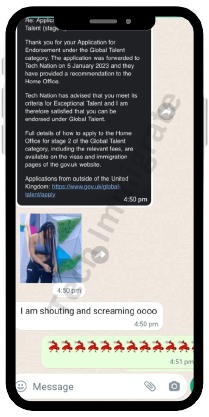
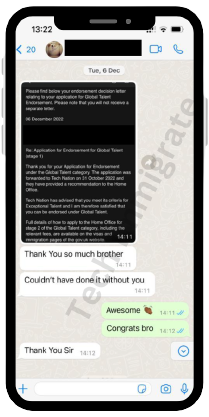
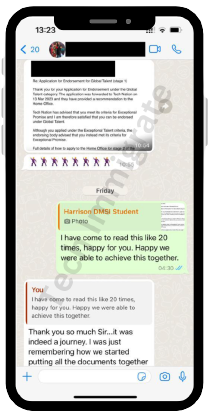
Real messages from people Tech Immigrate has helped. Names hidden for privacy.
Stop and think
You have two options
Option 1: work it out alone
Free, plus your time
- Read the official guidance and piece together what counts
- Guess which criteria and evidence an assessor will accept
- Submit, then wait for the decision
- If refused, pay the £561 fee again and wait again
Option 2: use the guide
$79$30 one-time
- Pick the right criteria before you write anything
- Copy the format from a full worked example
- Check everything before you pay the fee
- Instant PDF download
UK immigration solicitors typically quote £2,000 to £5,000 to help with a Global Talent application. One refusal costs the £561 fee. The guide costs less than a tenth of that.
Get your head start today
- Pick the right criteria before you write anything
- 10-document mock evidence pack
- 17 evidence checklists, a 12-week planner and final checks
- Evidence, evidence chain, letter, CV and statement templates
Limited-time offer ends 31 October.
Secure checkout by Stripe · Instant PDF download
The guide is general information, not legal advice, and no one can guarantee an endorsement.
Questions about this guide
Yes. This guide is written for Tech Researchers specifically, so it shows how to present your own kind of work, not engineering work, as evidence against the criteria. It does not assume you write code.
The route has two levels: Exceptional Talent for established leaders and Exceptional Promise for people earlier in their careers. The guide explains the difference and how to work out which one your record fits. It cannot promise either outcome. Whether you are endorsed is decided by the assessors.
The guide gives you evidence checklists and a planner, so you work through the application in order instead of facing everything at once. That is exactly where I lost time on my first attempt.
Because the guides are digital downloads you can access straight away, sales are final once you’ve downloaded them. If a file is faulty or won’t open, email [email protected] and we’ll fix it or refund you.
Yes. It was checked against the rules in October 2026. If we update it, buyers get the new version in their downloads at no extra cost.
Straight after payment. You can download the PDF right away, and you can come back to your downloads page later using the email you paid with.
Checkout is by Stripe and takes major debit and credit cards. If a payment fails, email [email protected] and we will help you sort it out.
This one is written for tech researchers. Researchers in AI, machine learning, language technology, data and systems. Other roles have their own guides.
No, and nobody can. The guide shows you how to build the strongest case you can. The decision is Tech Nation’s.
Email [email protected] and we will reply.