
For data scientists and AI/ML specialists applying to Tech Nation
I was refused the Global Talent visa. Here is how to avoid my mistake.
Read this before you pay the £561 endorsement fee, because that fee is not refunded if you are refused.
If you work in this field, you probably assume your models speak for themselves. To a Tech Nation assessor, they only speak if you show them in the right format, with the right proof, against the right criteria.
I know this because it happened to me. Below is my story, the mistakes that cause most refusals, and how to avoid them. All of it is free to read. Keep going.
My story
I did it myself. I made a lot of mistakes. Then I got endorsed.
I applied for the Global Talent visa myself, and I was refused.
Looking back, I made a lot of mistakes, not just one. I chose the wrong criteria for my profile. I did not put my evidence together properly. And there were more small errors that added up, the kind you only spot once someone shows you what an assessor looks for.
A refusal is painful. The endorsement fee is not refunded, you lose months, and you start again from the beginning. It is also easy to take the wrong lesson from it, like deciding you are not good enough. That was not the lesson.
So I went back through the rules, found every place my application had gone wrong, and fixed each one. I applied again, and this time I was endorsed. I did the whole application myself.
That is why this guide exists. My goal is to help you avoid the mistakes I made, so you can get it right the first time.
The biggest mistake
The mistake that cost me: choosing the wrong criteria
To be endorsed on the Talent route, you must meet the Mandatory Criterion and two of the four Optional Criteria. In short, the four are innovation (OC1), recognition beyond your job (OC2), the impact of what you built or led (OC3), and research or academic work (OC4).
Here is the trap. You can have strong evidence and still be refused, because you lined it up against criteria it does not prove. The assessor does not rearrange your case for you. They check what you claimed.
As a rough guide, this is how strong evidence maps to the right criterion for data scientists and AI/ML specialists:
| If your strongest evidence is… | Lead with |
|---|---|
| Outside recognition: invitations, awards, selective rankings | MC, recognition as a leader |
| Open-source libraries, open datasets and community work | OC2, work beyond your job |
| Models in production with measured impact, confirmed by your employer | OC3, impact |
| Peer-reviewed papers or supervisor-endorsed research | OC4, research |
That table is the short version. Your own mix of evidence decides the best pair, and the wrong pair is the quickest way to a refusal. Criteria are only the first of the common mistakes. Here they are for data scientists and AI/ML specialists.
Why data and AI specialists get refused
Seven reasons data and AI specialists get refused, and how the guide helps you avoid them.
01
Building your case on consultancy, agency or outsourcing work
Only product-led tech companies count. Work at analytics consultancies, AI agencies and outsourcers fails that test, however good it was.
The guide gives the product-led test employer by employer, and a 12-month plan to build evidence at a product company, in open source or in research.
02
Model metrics without business results
An accuracy or AUC figure does not show impact, and percentages without baselines have been refused as insufficient.
The guide shows how to build an evidence chain from your model to a controlled test, business results and funding, with proof for each link.
03
Claiming team results as your own
Assessors refuse outcomes that “cannot be attributed solely to the applicant’s individual work”.
The guide shows how to prove your share: your model design, your part of the architecture and an employer’s confirmation.
04
Using a thesis, courses or papers no one has cited
MSc thesis research does not qualify for OC4, certificates do not count for MC, and very recent papers with no citations have been refused.
The guide covers OC4 in full: peer review, citations, endorsement by a supervising academic, and when another route is stronger.
05
Relying on dashboards and your own screenshots
Assessors treat internal dashboards, slide decks and self-written descriptions as self-reported.
The guide lists 20 ways to get third-party proof, from experiment reports to client letters, to back every number.
06
Leaning on salary, notebooks and blog posts
Salary alone is insufficient, and self-published posts and notebooks rarely carry a criterion.
The guide shows which recognition counts under Tech Nation’s rules: top results in selective competitions, main-stage talks, judging, in-person mentoring and open-source adoption.
07
Templated or colleague-only letters
Letters with the same structure or phrasing raise authenticity concerns, and letters from an immediate colleague or manager are not sufficient.
The guide shows how to brief three referees, including one from outside your employers, so each writes in their own words.
How to avoid them
The five-step approach that avoids them
Data and AI specialists use four routes: MC + OC2 + OC3, MC + OC1 + OC3, MC + OC2 + OC4 and MC + OC3 + OC4. The guide has a table that matches your evidence to a route. Here is how to build your case.
Map each piece of evidence to one criterion. Put your strongest outside recognition under the Mandatory Criterion, models in production under OC3, and peer-reviewed papers under OC4. A paper proves research, not recognition.
Choose your criteria on purpose. Pick the pair you can prove best, instead of trying to cover everything. This is the step that sank my first application.
Turn your work into short evidence documents. Each one is limited to 3 sides of A4 and ties to one criterion.
Back every claim with proof an assessor can check. Third-party proof beats your own screenshots, and your referees should write in their own words.
Run a final consistency check. Dates, titles and figures must match across your CV, letters, statement and LinkedIn before you submit.
That is the outline. Doing it well is where the detail matters, and the next section shows what that detail looks like.
A page from the guide
This is what an evidence document looks like
Here is one page from the guide, so you can see the level of detail before you decide. It shows the rules for deciding where each piece of data and AI evidence belongs.
Mapping rules: which evidence goes under which criterion
Rule 1. Put your strongest external recognition under the Mandatory Criterion. If it fails, nothing else is assessed in your favour.
Rule 2. Put models in production under OC3, not the Mandatory Criterion. “My model cut defaults by 42%” is a contribution, not recognition.
Rule 3. Put open-source libraries, open datasets and community work under OC2, unless the main proof is that a company invited or rewarded you (Mandatory Criterion) or the dataset was peer reviewed (OC4).
Rule 4. Put peer-reviewed papers and supervisor-endorsed research under OC4, never under the Mandatory Criterion.
Why the mapping matters
- Never split one achievement across two criteria. A patent and the same model’s revenue results are one piece of work: file it under OC1 or OC3, not both.
- The guide has full evidence tables and worked samples for OC1 and OC4, and a table showing which documents make up each route.
The guide has worked samples like this for every kind of evidence, with the proof pages listed, so you know what to gather before you write.
If you are refused
What an appeal looks like, decoded
A refusal is not always the end. The guide includes anonymised refusal cases as reported by applicants, plus a review method. Here is one of them.
The AI researcher whose review pointed to reviewing and talks
A third-year PhD student with an internship at a global AI lab applied for Promise under the Mandatory Criterion, OC2 and OC4. OC4 was met. The Mandatory Criterion and OC2 were refused: the talks were seen as part of the PhD, and the letters as coming from fellow academics. Advisers pointed out that his selection as a reviewer for top AI journals and conferences was already in the pack and had not been mentioned.
Lesson: Reviews win on evidence the assessor did not mention. Reviewing for leading venues shows independent selection, and it was already in the pack.
Three lessons from a second case, decoded
| What went wrong | What it really meant |
|---|---|
| Advisers warned that “dashboard screenshots are not verifiable” without a letter and a point of contact | Put an employer letter and a named contact behind every internal number. |
| The Mandatory Criterion rested on a contract with a bonus increase and an internal revenue dashboard | Contracts and dashboards are weak recognition. Build the pack on published, outside proof. |
| OC4 rested on a programme ranking, a grant and academic awards, with no published research | Peer-reviewed papers prove research. Rankings and awards do not. |
The guide gives you the full set of cases and the review method, so you know how to answer each kind of refusal if it happens to you.
Cases are anonymised and reported by applicants. They show how others have handled refusals, and no one can promise the same result. The guide is general information, not legal advice.
Want more?
The Endorsement Guide for Data & AI Specialists
The guide takes every step above and shows you how to do it, with Tech Nation’s own rules for each document. It is 129 pages in 7 parts, aligned with Tech Nation’s applicant guide, and you download it as a PDF straight after paying.
- 10-document mock evidence pack
- Evidence, letter, CV and statement templates
- 25 evidence checklists, a 12-week planner and final checks
What's inside
Everything you need to go from first draft to submitted.
PDF · 7 parts · 129 pages
The guide
- How the route works
- Are you eligible as a data scientist or AI/ML specialist?
- The application pack at a glance, with what endorsed data and AI applicants report
- Choosing your criteria: which of the four routes fits your evidence
- Mandatory Criterion: recognised as a leader
- Optional Criterion 2: recognition beyond your job
- Optional Criterion 3: significant contributions and the evidence chain
- Optional Criteria 1 and 4: innovation and academic contributions, in full
- The 3-page evidence template
- Recommendation letters
- Third-party verification of your impact
- Your CV
- Your personal statement
- No evidence yet? A 12-month plan
- Common mistakes
- The six rejection patterns and 18 fixes
- What real refusals say: 4 applicant-reported cases and 12 more fixes
- How to request a review (appeal) and win, with a worked example
- Pre-submission checklist
- 25 evidence checklists
- Your 12-week application planner and trackers
Worked example
10-document mock evidence pack
A complete fictional application with every document in the 3-page format, built from Tech Nation’s rules and publicly reported endorsed cases, plus 4 swap-in documents and a pairing table for the other three routes.
Templates
Evidence, letter, CV and statement templates
A fill-in 3-page evidence template, what every recommendation letter must include, a 3-page CV layout and a personal statement plan, each with fictional samples.
Checklists
25 evidence checklists, a 12-week planner and final checks
A checklist for every kind of data and AI evidence, a week-by-week planner with evidence and referee trackers, 30 refusal fixes, 4 applicant-reported refusal cases with the wording decoded, a worked review (appeal) and a pre-submission checklist.
If you are just starting
Planning your first application
Choose your criteria first, then follow the 12-week planner. Collect the right evidence while you still have time to get it, instead of finding gaps the week you submit.
If you were already refused
Planning to reapply or request a review
Use the refusal fixes and the review method to read what the decision really meant and decide your next move. I reapplied after a refusal, and it worked.
Success stories
From evidence pack to endorsement
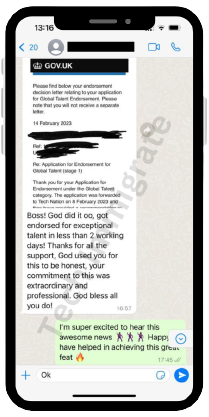
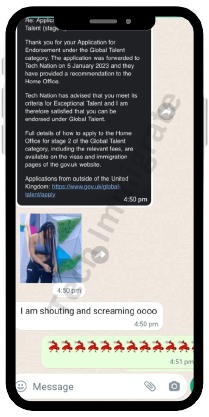
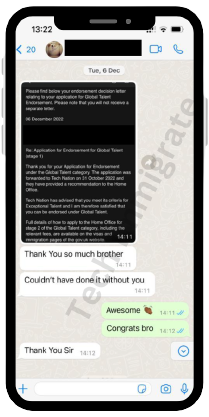
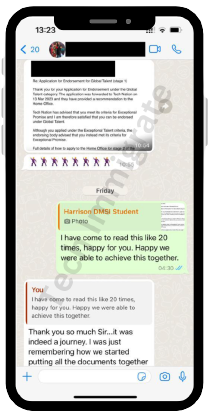
Real messages from people Tech Immigrate has helped. Names hidden for privacy.
Stop and think
You have two options
Option 1: work it out alone
Free, plus your time
- Read the official guidance and piece together what counts
- Guess which criteria and evidence an assessor will accept
- Submit, then wait for the decision
- If refused, pay the £561 fee again and wait again
Option 2: use the guide
$79$30 one-time
- Pick the right criteria before you write anything
- Copy the format from a full worked example
- Check everything before you pay the fee
- Instant PDF download
UK immigration solicitors typically quote £2,000 to £5,000 to help with a Global Talent application. One refusal costs the £561 fee. The guide costs less than a tenth of that.
Get your head start today
- Pick the right criteria before you write anything
- 10-document mock evidence pack
- 25 evidence checklists, a 12-week planner and final checks
- Evidence, letter, CV and statement templates
Limited-time offer ends 31 October.
Secure checkout by Stripe · Instant PDF download
The guide is general information, not legal advice, and no one can guarantee an endorsement.
Questions about this guide
Choose the route your strongest evidence already proves. Section 4 has a table that matches your evidence to one of four routes: MC + OC2 + OC3 for models in production plus open-source, mentoring or community work; MC + OC1 + OC3 for a granted patent or a model or data product independent sources call a first; MC + OC2 + OC4 for peer-reviewed research plus open-source or community work; and MC + OC3 + OC4 for research plus models in production. Section 8 shows which documents make up each route.
Yes, if your work is in digital technology. Section 8 covers Optional Criterion 4 in full: what peer review and endorsement by a supervising academic mean, why thesis research does not qualify, and how to pair research with Optional Criterion 2 or 3.
Possibly, but it’s harder. Section 2 gives the product-led test employer by employer, and Section 13 gives a 12-month plan to build evidence from product work, open source, research and contributions outside your job.
Yes. This guide is written for Data & AI Specialists specifically, so it shows how to present your own kind of work, not engineering work, as evidence against the criteria. It does not assume you write code.
The route has two levels: Exceptional Talent for established leaders and Exceptional Promise for people earlier in their careers. The guide explains the difference and how to work out which one your record fits. It cannot promise either outcome. Whether you are endorsed is decided by the assessors.
The guide gives you evidence checklists and a planner, so you work through the application in order instead of facing everything at once. That is exactly where I lost time on my first attempt.
No. The samples follow a fictional applicant, Achieng Otieno, a data scientist turned machine learning engineer, and show the standard to aim for. Tech Nation says templated letters and anything written with AI tools are not acceptable, so your referees must write in their own words about work they saw.
Section 14C explains how to request a review within 28 days, how to write each point with a full worked example, and when to fix your pack and reapply instead. Section 14B decodes the refusal wording data and AI applicants have reported.
Yes, briefly. Section 1 covers the visa fee, timings, the healthcare surcharge and dependants. The rest of the guide focuses on endorsement, where almost every refusal happens.
Yes. It follows Tech Nation’s Global Talent Visa Application Guide (last updated 27 February 2026), read in full in September 2026, including its rules on in-person mentoring, main-stage talks, salary evidence, academic research, letters and AI tools. The mock pack was checked against the same rules. Rules can change, so check GOV.UK and Tech Nation’s guide on the day you apply.
Section 16 has 25 checklists, one for each kind of data and AI evidence, showing what each document must have, what makes it stronger and the red flags that get it dismissed. Section 17 is a 12-week planner with key dates, tasks by stage and trackers for your evidence, referees and supporting letters.
Because the guides are digital downloads you can access straight away, sales are final once you’ve downloaded them. If a file is faulty or won’t open, email [email protected] and we’ll fix it or refund you.
Yes. It was checked against the rules in October 2026. If we update it, buyers get the new version in their downloads at no extra cost.
Straight after payment. You can download the PDF right away, and you can come back to your downloads page later using the email you paid with.
Checkout is by Stripe and takes major debit and credit cards. If a payment fails, email [email protected] and we will help you sort it out.
This one is written for data scientists and AI/ML specialists. Data scientists, ML engineers and AI researchers. Other roles have their own guides.
No, and nobody can. The guide shows you how to build the strongest case you can. The decision is Tech Nation’s.
Email [email protected] and we will reply.