
For software developers applying to Tech Nation
I was refused the Global Talent visa. Here is how to avoid my mistake.
Read this before you pay the £561 endorsement fee, because that fee is not refunded if you are refused.
If you write code for a living, you probably assume your work speaks for itself. To a Tech Nation assessor, it only speaks if you show it in the right format, with the right proof, against the right criteria.
I know this because it happened to me. Below is my story, the mistakes that cause most refusals, and how to avoid them. All of it is free to read. Keep going.
My story
I did it myself. I made a lot of mistakes. Then I got endorsed.
I applied for the Global Talent visa myself, and I was refused.
Looking back, I made a lot of mistakes, not just one. I chose the wrong criteria for my profile. I did not put my evidence together properly. And there were more small errors that added up, the kind you only spot once someone shows you what an assessor looks for.
A refusal is painful. The endorsement fee is not refunded, you lose months, and you start again from the beginning. It is also easy to take the wrong lesson from it, like deciding you are not good enough. That was not the lesson.
So I went back through the rules, found every place my application had gone wrong, and fixed each one. I applied again, and this time I was endorsed. I did the whole application myself.
That is why this guide exists. My goal is to help you avoid the mistakes I made, so you can get it right the first time.
The biggest mistake
The mistake that cost me: choosing the wrong criteria
To be endorsed on the Talent route, you must meet the Mandatory Criterion and two of the four Optional Criteria. In short, the four are innovation (OC1), recognition beyond your job (OC2), the impact of what you built (OC3), and research or academic work (OC4).
Here is the trap. You can have strong evidence and still be refused, because you lined it up against criteria it does not prove. The assessor does not rearrange your case for you. They check what you claimed.
As a rough guide, this is how strong evidence maps to the right criterion for a developer:
| If your strongest evidence is… | Lead with |
|---|---|
| Revenue, users or funding you can link to your code | OC3, impact |
| A granted patent, or a product independent sources call a first | OC1, innovation |
| Open-source adoption, main-stage talks, structured mentoring outside your job | OC2, recognition |
| Peer-reviewed papers or an expert-endorsed dataset | OC4, research |
That table is the short version. Your own mix of evidence decides the best pair, and the wrong pair is the quickest way to a refusal. Criteria are only the first of seven common mistakes. Here are all of them.
Why software developers get refused
Seven reasons software developers get refused, and how the guide helps you avoid them.
01
Building your case on IT-services, agency or outsourcing work
Only product-led tech companies count. Assessors have refused developers whose employers were agencies, outsourcers or IT-services firms.
The guide gives the product-led test employer by employer, and a 12-month plan to build evidence at a product company or through open source.
02
A GitHub profile with little adoption
Assessors count repositories, commits and releases, and have refused profiles with a few small repos and no releases.
The guide shows how to present one or two projects by installs, dependents and outside acknowledgement, in a 3-page document.
03
Claiming team results as your own
Assessors reject outcomes described as a team effort, and ask what you personally built.
The guide shows how to build an evidence chain from your code to launch, users, revenue and funding, with proof for each link.
04
Templated or colleague-only letters
Letters with the same structure or phrasing raise authenticity concerns, and letters that repeat your CV add nothing.
The guide shows how to brief three referees, including one from outside your employers, so each writes in their own words.
05
Relying on your own screenshots
Assessors treat internal dashboards, Jira tickets and self-written descriptions as self-reported.
The guide lists 20 kinds of third-party proof, from release notes to partner confirmations, to back every number.
06
Leaning on salary and self-published posts
Salary alone is insufficient, and self-published blog posts rarely carry a criterion.
The guide shows which recognition counts for developers under Tech Nation’s rules: main-stage talks, judging, unpaid invited writing, in-person mentoring and open-source adoption.
07
A CV that doesn't match LinkedIn
Assessors cross-check dates and titles, and unexplained gaps are cited in refusals.
The guide gives a 3-page CV layout and a final check that every date, title and figure matches across your CV, letters, statement and LinkedIn.
How to avoid them
The five-step approach that avoids them
The combination that works best for most developers is the Mandatory Criterion plus Optional Criteria 2 and 3: your recognition as a leader, your work beyond your job, and the impact of the code you shipped. Here is how to build a case on it.
Check your employer against the product-led test. Tech Nation looks for experience at product-led companies, so agency, outsourcing and IT-services work needs careful handling.
Choose your criteria on purpose. Pick the pair you can prove best, instead of trying to cover everything. This is the step that sank my first application.
Turn your work into short evidence documents. Each one is limited to 3 sides of A4 and ties to one criterion.
Back every claim with proof an assessor can check. Third-party proof beats your own screenshots, and your referees should write in their own words.
Run a final consistency check. Dates, titles and figures must match across your CV, letters, statement and LinkedIn before you submit.
That is the outline. Doing it well is where the detail matters, and the next section shows what that detail looks like.
A page from the guide
This is what an evidence document looks like
Here is one page from the guide, so you can see the level of detail before you decide. It is a fictional example of one evidence document for a main-stage conference talk.
Main-stage conference speaker: talk selected from 190 proposals
In my personal capacity I applied to speak at the Lagos API Summit 2023, and my talk “Designing webhooks that never lose an event” was selected for the main stage from 190 proposals (34 accepted, an 18% acceptance rate).
The summit had 1,200 in-person attendees, counted at the door and not as registrations, and 5,400 livestream viewers. My employer was not a sponsor and did not pay for the slot. I showed the delivery-ledger design I built at Pingrail, with load-test results showing zero lost events across 50 million test deliveries.
Tips for talk evidence
- Only main-stage talks count. Running a workshop or a session is not enough.
- Count people at the door, not registrations. The event needs at least 100 attendees.
- Say whether your employer sponsored the slot. A paid-for slot does not count.
- Back the claim with the organiser’s own letter, not your own description.
The guide has a worked sample like this for every kind of developer evidence, with the proof pages listed, so you know what to gather before you write.
If you are refused
What an appeal looks like, decoded
A refusal is not always the end. The guide includes four anonymised refusal cases, as reported by applicants, plus a worked review (the appeal route). Here is one of them, so you can see what a successful review looks like.
The mid-level engineer who won on review by citing pages
A mid-level engineer at a UK digital bank, with no awards or talks, applied on the Promise route. The evidence included core banking features, a chatbot he built alone, and a 75% commit share.
He took the refusal apart sentence by sentence. For each point he showed the exact document and page in his pack that already answered it.
Lesson: reviews succeed when the answer is already in the pack and you show the assessor exactly where.
Three refusal lines, decoded
| What the refusal said | What it really meant |
|---|---|
| A 5% engagement increase was insufficient | A percentage without its base proves nothing. Restate it as an absolute figure on the real user base. |
| Only 8 and 19 commits across two repositories, no releases | A thin GitHub profile does more harm than none. Show adoption, not activity. |
| Talks were treated as part of the job | The applicant had to prove they spoke in a personal capacity. Invitation and confirmation emails already in the pack fixed it on review. |
The guide gives you the full set of cases and the worked review, so you know how to answer each kind of refusal if it happens to you.
Cases are anonymised and reported by applicants. They show how others have handled refusals, and no one can promise the same result. The guide is general information, not legal advice.
Want more?
The Endorsement Guide for Software Developers
The guide takes every step above and shows you how to do it, with Tech Nation’s own rules for each document. It is 114 pages in 7 parts, aligned with Tech Nation’s applicant guide, and you download it as a PDF straight after paying.
- A complete 10-document mock evidence pack in the 3-page format, plus 4 swap-in documents
- Templates for evidence, recommendation letters, your CV and your personal statement
- 20 evidence checklists and a 12-week planner with evidence and referee trackers
- 30 refusal fixes, 4 anonymised refusal cases with the wording decoded, and a worked review (appeal)
- A pre-submission checklist to run before you pay the fee
What's inside
Everything you need to go from first draft to submitted.
PDF · 7 parts · 114 pages
The guide
- How the route works
- Are you eligible as a software developer?
- The application pack at a glance, with Tech Nation’s rules for every document
- Choosing your criteria: why MC + OC2 + OC3
- Mandatory Criterion: recognised as a leader
- Optional Criterion 2: recognition beyond your job
- Optional Criterion 3: significant contributions and the evidence chain
- Optional Criteria 1 and 4: the alternatives
- The 3-page evidence template
- Recommendation letters
- Third-party verification of your impact
- Your CV
- Your personal statement
- No evidence yet? A 12-month plan
- Common mistakes
- The six rejection patterns and 18 fixes
- What real refusals say: 4 refusal cases and 12 more fixes
- How to request a review (appeal) and win, with a worked example
- Pre-submission checklist
- Evidence checklists for 20 kinds of evidence
- Your 12-week application planner and trackers
Worked example
10-document mock evidence pack
A complete fictional application with every document in the 3-page format, modelled on a real endorsed software engineer’s pack and checked against Tech Nation’s rules, plus 4 swap-in documents for Optional Criteria 1 and 4.
Templates
Evidence, letter, CV and statement templates
A fill-in 3-page evidence template, what every recommendation letter must include, a 3-page CV layout and a personal statement plan, each with fictional samples.
Checklists
20 evidence checklists, a 12-week planner and final checks
A checklist for every kind of developer evidence, a week-by-week planner with evidence and referee trackers, 30 refusal fixes, 4 anonymised refusal cases with the wording decoded, a worked review (appeal) and a pre-submission checklist.
If you are just starting
Planning your first application
Choose your criteria first, then follow the 12-week planner. Collect the right evidence while you still have time to get it, instead of finding gaps the week you submit.
If you were already refused
Planning to reapply or request a review
Use the refusal cases and fixes to read what the decision really meant, and the worked review to decide your next move. I reapplied after a refusal, and it worked.
Success stories
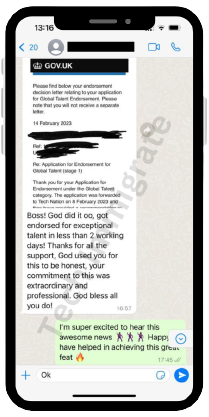
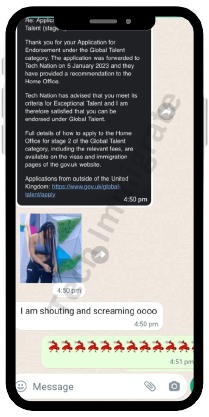
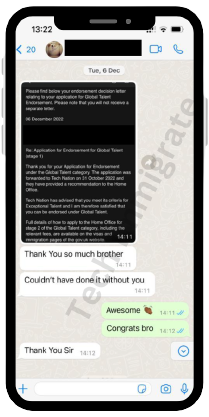
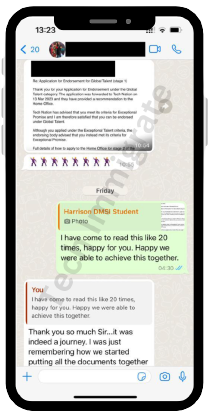
From evidence pack to endorsement
Real messages from people Tech Immigrate has helped. Names hidden for privacy.
Stop and think
You have two options
Option 1: work it out alone
Free, plus your time
- Read the official guidance and piece together what counts
- Guess which criteria and evidence an assessor will accept
- Submit, then wait for the decision
- If refused, pay the £561 fee again and wait again
Option 2: use the guide
$79$30 one-time
- Pick the right criteria before you write anything
- Copy the format from a full worked example
- Check everything before you pay the fee
- Instant PDF download
UK immigration solicitors typically quote £2,000 to £5,000 to help with a Global Talent application. One refusal costs the £561 fee. The guide costs less than a tenth of that.
Get your head start today
- Pick the right criteria before you write anything
- 10-document mock evidence pack to copy the format from
- 20 evidence checklists and a 12-week planner
- Pre-submission checklist to run before you pay the fee
Limited-time offer ends 31 October.
Secure checkout by Stripe · Instant PDF download
The guide is general information, not legal advice, and no one can guarantee an endorsement.
Questions about this guide
Yes, if your evidence is mainly technical. Section 8 explains when to use Optional Criterion 1 and the business records founders have to provide. If your strongest evidence is the company itself, such as customers, revenue and funding, the Startup Founders guide is a better fit.
Possibly, but it’s harder. Section 2 gives the product-led test employer by employer, and Section 13 gives a 12-month plan to build evidence from product work, open source and contributions outside your job.
No. The samples follow a fictional applicant, Kemi Adebayo, a backend engineer, and show the standard to aim for. Tech Nation says templated letters and anything written with AI tools are not acceptable, so your referees must write in their own words about work they saw.
Section 14C explains how to request a review within 28 days, how to write each point with a full worked example, and when to fix your pack and reapply instead. Section 14B decodes the refusal wording developers have received.
The route has two levels: Exceptional Talent for established leaders and Exceptional Promise for people earlier in their careers. The guide explains the difference and how to work out which one your record fits. It cannot promise either outcome. Whether you are endorsed is decided by the assessors.
The guide gives you evidence checklists and a planner, so you work through the application in order instead of facing everything at once. That is exactly where I lost time on my first attempt.
Yes, briefly. Section 1 covers the visa fee, timings, the healthcare surcharge and dependants. The rest of the guide focuses on endorsement, where almost every refusal happens.
Yes. It follows Tech Nation’s Global Talent Visa Application Guide (last updated 27 February 2026), read in full in September 2026, including its rules on in-person mentoring, main-stage talks, salary evidence, letters and AI tools. The mock pack was checked against the same rules. Rules can change, so check GOV.UK and Tech Nation’s guide on the day you apply.
Section 16 has a checklist for each of 20 kinds of evidence, showing what each document must have, what makes it stronger and the red flags that get it dismissed. Section 17 is a 12-week planner with key dates, tasks by stage and trackers for your evidence, referees and supporting letters.
Because the guides are digital downloads you can access straight away, sales are final once you’ve downloaded them. If a file is faulty or won’t open, email [email protected] and we’ll fix it or refund you.
Yes. It was checked against the rules in October 2026. If we update it, buyers get the new version in their downloads at no extra cost.
Straight after payment. You can download the PDF right away, and you can come back to your downloads page later using the email you paid with.
Checkout is by Stripe and takes major debit and credit cards. If a payment fails, email [email protected] and we will help you sort it out.
This one is written for software developers: engineers, DevOps, data and ML engineers, tech leads and CTOs. Other roles have their own guides.
No, and nobody can. The guide shows you how to build the strongest case you can. The decision is Tech Nation’s.
Email [email protected] and we will reply.